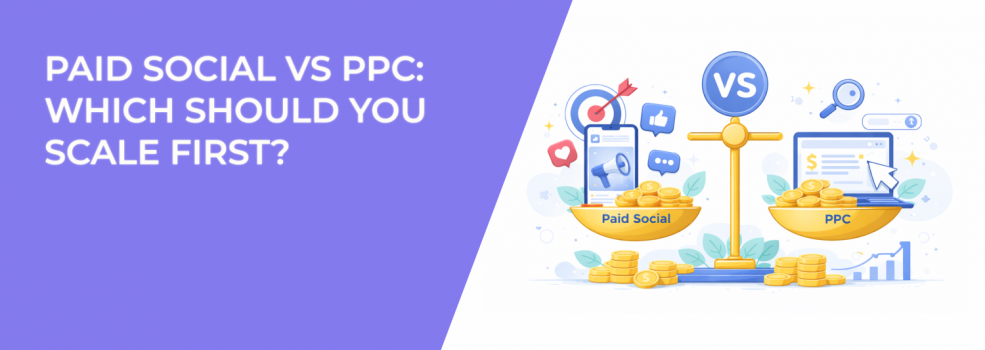
When scaling digital ad budgets, one of the most overlooked strategic decisions is which channel to scale first. While most advertisers run both paid social and PPC in parallel, deciding where to invest aggressively can determine your cost efficiency, data quality, and growth ceiling for the next 6–12 months.
This article is not a basic comparison of Facebook Ads and Google Ads. It’s a signal-based, performance-stage-specific breakdown to help you scale the right channel based on your current assets, offer maturity, and optimization levers.
How the platforms learn — and why that matters for scale
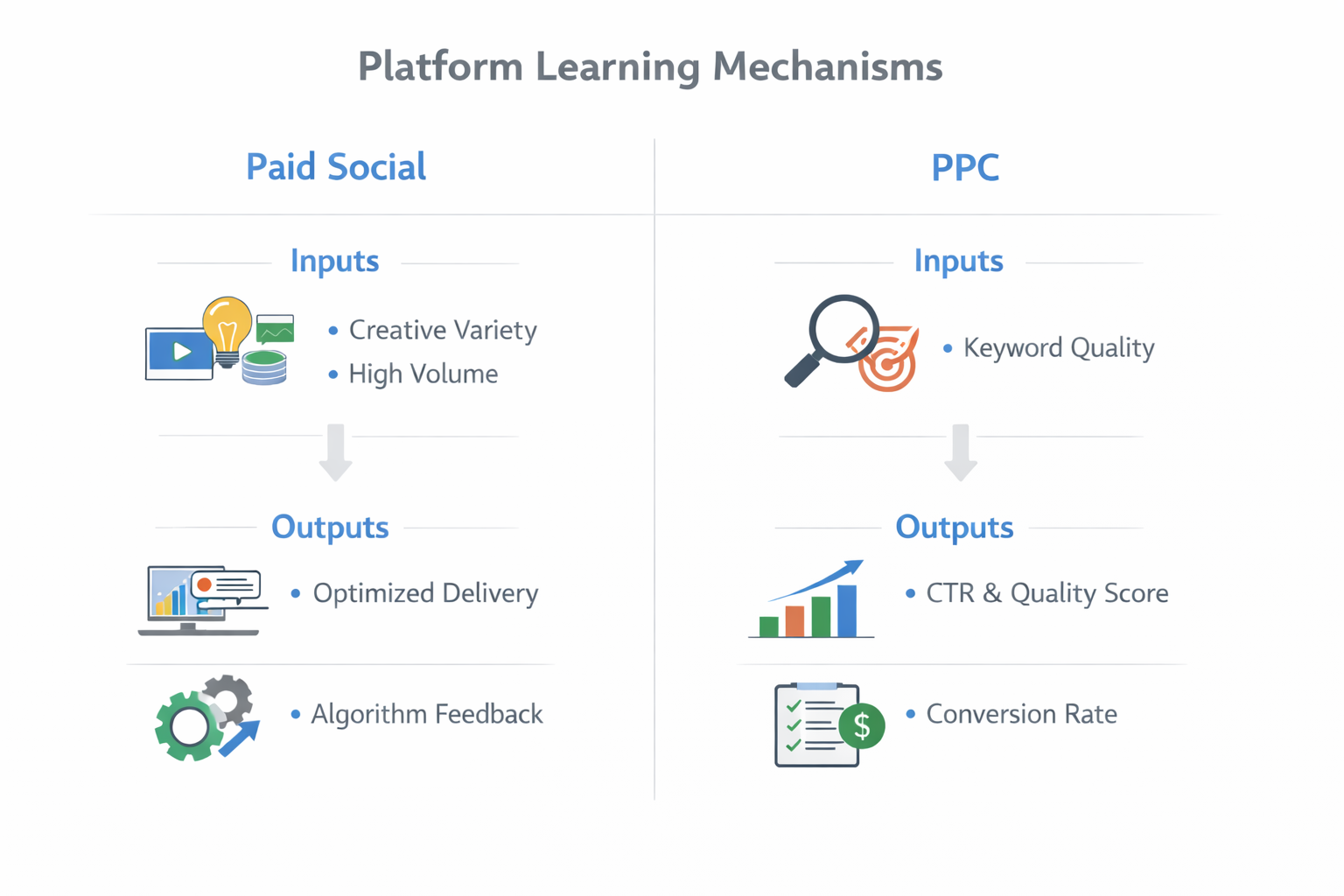
Both PPC and paid social use machine learning to optimize campaigns, but the inputs and learning processes are fundamentally different. Misunderstanding these mechanisms often leads to premature scaling or flatlined campaigns.
Paid social: feedback loops powered by volume and creative signals
Meta Ads and similar platforms (TikTok, Snap, etc.) rely heavily on event volume to improve performance. The algorithm adjusts based on behavioral signals from impressions, clicks, engagement, and conversions. Crucially, it uses creative and audience combinations as learning triggers.
Paid social works best when campaigns include:
-
Broad targeting paired with modular creative (e.g., combinations of headlines, CTAs, and visuals);
-
High daily spend to feed the algorithm enough conversions per ad set;
-
Rapid iteration across formats like Reels, carousels, and statics.
Without creative diversity and conversion volume, Meta’s algorithm struggles to exit the learning phase. This often results in fluctuating CPAs or underdelivery, even for proven offers.
In short, paid social doesn't just reward good strategy — it rewards enough strategy inputs.
If this is a bottleneck in your campaigns, read How to finish the Facebook learning phase quickly for actionable tactics.
PPC: intent-led efficiency with limited scale ceiling
Search platforms like Google and Bing optimize around intent — expressed through keywords, match types, and ad relevance. Even with modest budgets, PPC can drive efficient conversions if you’re bidding on terms with high buying signals.
PPC performs best when:
-
The offer matches mid- or bottom-of-funnel queries like “buy project management software”;
-
Campaigns are structured with SKAGs or tight keyword themes;
-
Conversion tracking includes assisted or micro-conversions like add-to-carts or demo views.
Unlike paid social, PPC campaigns don’t need volume to optimize. But they do require careful structure, negative keyword curation, and landing page relevance. The bottleneck is often keyword inventory — once you saturate intent-rich terms, scaling means moving into lower-performing or broader queries.
When PPC is the better first scale move
For many performance marketers, especially in SaaS and B2B, PPC is the more logical early-stage growth lever. The reasons go beyond targeting — they’re about control, predictability, and signal clarity.
PPC is a stronger starting point if:
-
Your product matches clear, purchase-ready search behavior;
-
You need fast feedback on landing pages, offers, or funnel friction;
-
You lack the creative firepower for visual-heavy paid social campaigns.
These scenarios create conditions where PPC is not only lower risk but also more immediately actionable.
Let’s break this down with some examples:
-
High-intent funnel testing — If you’re validating messaging or pricing, targeting terms like “CRM for freelancers” lets you isolate specific value props.
-
Tight targeting — Need to reach IT managers at mid-size companies? That’s far more practical via keyword targeting than paid social interest stacks.
-
Limited creative assets — Without polished video or UGC content, paid social campaigns will struggle to capture attention or sustain frequency.
In each of these cases, PPC provides more signal per dollar — not because it’s better overall, but because the context matches its strengths.
Think of PPC as a pressure test. It rewards message-offer-fit, not just budget size.
For deeper comparison, see Facebook Ads vs Google Ads: Which Delivers Better Leads?
When paid social is the better scaling choice
While PPC brings faster feedback, paid social delivers demand creation and long-term scale — but only when you feed it the right ingredients.
Paid social is a better scale path when:
-
Your offer is new, disruptive, or hard to categorize with search terms;
-
You’ve built modular creative that can train the algorithm efficiently;
-
You’re ready to invest in early-stage learning to unlock long-term CPA drops.
Many advertisers misuse paid social by launching narrow campaigns with fixed creative. Instead, think of the platform as a self-learning system that improves only when it sees variation and results.
Example use cases:
-
Category creators — If your product isn’t part of existing search behavior (e.g., “smart sleep mask”), Meta lets you educate cold audiences and shape demand.
-
Content-first funnels — You can’t sell a $5K coaching program on a single ad click, but you can nurture interest with retargeting sequences from Meta video views.
-
Repeat purchase behavior — CPG and DTC brands often see stronger LTV via social-driven discovery than intent-driven PPC.
Paid social scales not when ROAS looks great at $50/day, but when you’ve trained the system to identify your best customers before they search.
For more on when and how Facebook scaling works without killing performance, read The science of scaling Facebook ads without killing performance.
Cost dynamics: CPC vs CPM, and why they trick marketers
The difference in pricing models can lead to misleading performance comparisons and bad scaling decisions.
| Factor | PPC (CPC-based) | Paid social (CPM-based) |
|---|---|---|
| Pricing model | Pay per click | Pay per 1,000 impressions (CPM) |
| What you pay for | User intent | Exposure and reach |
| Initial performance | Efficient at low scale | Often unstable — CPA can spike until enough data is collected |
| Scaling friction | Limited by keyword volume; CPA increases as good keywords saturate | Algorithm improves with volume; CPA may drop with more budget |
| Best-case CPA trajectory | Flattens or rises over time | Dips after learning and stabilizes or improves |
| Optimization lever | Keyword quality and landing page relevance | Creative variety and signal strength |
Paid social (Meta, TikTok, etc.)
-
Cost model: CPM (cost per 1,000 impressions);
-
Performance impact: You pay for exposure, so creative quality directly affects ROI;
-
Scaling friction: Performance often worsens before it improves — as new spend enters new audiences.
This means that even a high-performing campaign may see a CPA spike when scaling from $100/day to $500/day. If your creative can’t sustain attention across broader segments, you’ll burn cash before results stabilize.
PPC (Google, Bing, etc.)
-
Cost model: CPC (cost per click);
-
Performance impact: You pay for intent. Relevance is rewarded via Quality Score and lower CPCs;
-
Scaling friction: Growth depends on keyword volume. High-performing campaigns often hit a ceiling.
That ceiling might look like: “We’ve maxed out our best keywords, and now we’re paying $15/click for lower-quality terms.” This is where paid social becomes essential for expanding demand.
Scaling PPC without new demand inflows is like overfishing a small pond — more budget brings diminishing returns.
If you're unsure how to shift between platforms based on cost behaviors, read When to choose Facebook Ads over Google Ads (and vice versa).
Decision framework: how to choose based on your current setup
There’s no universal winner — only contextual fit. Use this framework to assess your channel-readiness.
| Criteria | Scale PPC first | Scale Paid Social first |
|---|---|---|
| Search intent is strong | ✅ | ✅ |
| Creative assets are modular | ✅ | |
| Budget allows learning | ✅ | ✅ |
| Funnel requires education | ✅ |
Choose PPC first if:
-
You’re optimizing for fast CAC validation;
-
You’re launching in a competitive niche with known search behavior;
-
You lack the infrastructure (video, design, testing strategy) to support paid social’s feedback loop.
In these conditions, PPC will give you the fastest route to profitable CAC, funnel insights, and conversion data. You can then feed these insights back into your paid social strategy later.
Choose paid social first if:
-
You have modular, high-quality creative ready for dynamic testing;
-
You’re targeting broader demographics or aspirational products that lack clear search intent;
-
Your business model improves with scale (e.g., subscriptions, bundling, referral loops).
Paid social excels when you’re ready to let the algorithm find your customers — and you have the creative engine to support that process.
For tactical advice on what to prioritize in early-stage Meta testing, see What to test first: creative, copy or audience in Facebook campaigns.
Final takeaway: scale the algorithm you can train best
Most advertisers frame this as a budget efficiency question. In reality, it’s a data infrastructure question. Algorithms need clean inputs.
-
If your PPC campaigns are tightly structured and keyword-rich, and you can squeeze insights from small budgets, scale there first.
-
If your social campaigns are modular, diverse, and fed by strong creative, scale Meta first and let the system optimize over time.
The best scaling choice isn’t the cheaper one — it’s the one that matches your current ability to deliver high-quality signals at increasing spend.
Don’t ask which channel works better. Ask which one you can teach better right now.
That’s the difference between hoping a platform performs — and knowing it will.