
Your Facebook ads were scaling. The cost per result looked good. Then suddenly — nothing.
No improvements. No changes. No idea why.
Welcome to the performance plateau — a frustrating stage in every advertiser’s journey. The worst part? It often shows up when you think you've cracked the code. But don’t panic. Understanding why your ads stall is the first step toward smashing through that invisible ceiling.
Here’s how to fix it.
What Is a Performance Plateau in Advertising?
A performance plateau happens when your campaigns stop improving despite ongoing budget, testing, or optimization efforts. It’s not a total failure — your ads might still be profitable — but growth has flatlined.
That slow drift from momentum to stagnation? That’s your signal.
Plateaus happen for all kinds of reasons. Some are technical. Others are psychological — like over-relying on what used to work.
But before you start overhauling your entire strategy, let’s break down the usual suspects.
1. Audience Fatigue: You’re Reaching the Same People Over and Over
One of the most common causes of performance stalls? You're hammering the same users.
Facebook’s algorithm is excellent at optimizing for results — but that also means it leans hard into the warmest pockets of your audience. After a while, those people stop responding. Your frequency goes up. Your performance goes down.
Signs you’re dealing with audience fatigue:
-
Rising CPMs with declining CTRs.
-
High frequency (over 3) on key ad sets.
-
Identical creative served to the same audience for weeks.
These indicators tell you it’s time to rotate your message or find fresh eyeballs.
What to do about it:
-
Refresh your creatives weekly — especially in high-frequency accounts.
-
Expand your lookalikes or interest stacks to open up new segments.
-
Break your warm audiences into smaller buckets and rotate campaigns.
Want to dive deeper into early signals of fatigue? Here's how to spot it before it wrecks your ROAS.
2. Creative Blind Spots: You’re Only Testing Variations, Not Concepts
You’ve changed the color. Swapped the headline. Moved the CTA button.
Still no lift?
That’s because you’re not testing a new idea — you’re polishing the same one.
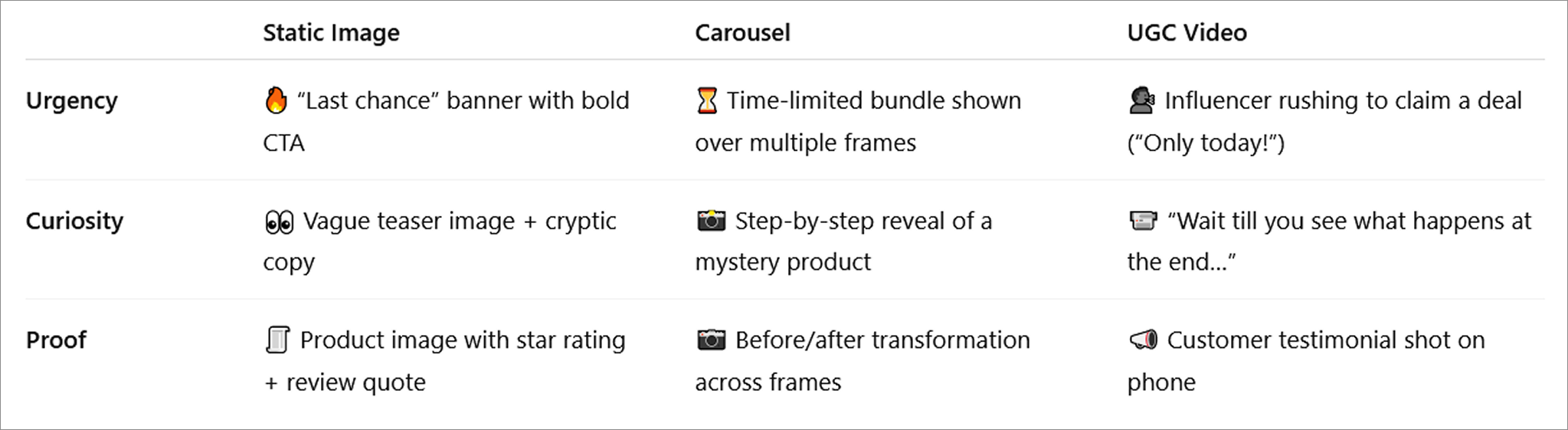
Most advertisers fall into the trap of creative iteration instead of concept exploration. But audiences don’t respond to tweaks — they respond to stories, triggers, and insights that hit differently.
Here’s how to break the mold:
-
Test entirely different hooks (fear, curiosity, humor, urgency, etc.).
-
Build creatives for different buyer stages — not everyone is ready to convert.
-
Use customer reviews or real-world use cases to inject authenticity.
Variety in message type often matters more than variety in visual style.
Not sure where to start with creative testing? These AI-powered tools can help speed up concept development without sacrificing quality.
3. Over-Optimized for Short-Term Wins
Sometimes your ads stall because you've trained them to do exactly that.
Here’s what happens: you start optimizing for lowest cost per conversion. Then you shorten attribution windows. You narrow the targeting. You eliminate outliers. It works — for a while.
But then the learning phase shrinks. The algorithm loses flexibility. Your funnel becomes brittle.
To build longevity into your account:
-
Use longer attribution windows to give delayed buyers room to convert.
-
Avoid cutting ad sets too early (especially in low-data niches).
-
Let some campaigns optimize for different stages — not just bottom-of-funnel.
Longevity comes from systems that allow delayed conversion — not just fast wins.
If your learning phase seems to last forever, you’re not alone. Learn how to get through it faster without breaking your setup.
4. Budget Stuck in ‘Safe’ Zones
Here’s an uncomfortable truth: your safest campaigns are probably blocking your growth.
Many advertisers keep pouring budget into reliable ad sets — even when they’re barely breaking even. Why? Because they’re scared to shake things up.
But sometimes, scaling means shifting spend toward the uncomfortable stuff.

Most spend should go to proven performers, while smaller shares support scalable experiments and high-risk testing.
Try this approach:
-
Cap spend on stable performers and reallocate to experimental ad sets.
-
Use campaign budget optimization (CBO) to let winners emerge organically.
-
Introduce structured testing campaigns with isolated variables.
Scaling safely doesn't mean standing still — it means testing smartly.
If you want to master scaling without killing performance, check out this breakdown of what actually works.
5. Too Much Data — Not Enough Insight
Marketers love metrics. But more data doesn’t always mean more clarity.
ROAS is up. CTR is down. AOV is flat. Which one matters?
If you're making decisions based on surface-level data, you might be missing the real story. Plateau-breaking advertisers look for patterns, not just numbers.
Dig deeper:
-
Segment performance by audience, device, time of day.
-
Compare day 1 vs. day 7 return, not just last-click ROAS.
-
Use qualitative data (like comment sentiment or post saves) to read buyer intent.
Contextual analysis turns raw data into real strategy.
6. You’re Scaling Tactics, Not Strategy
Most performance stalls aren't technical. They're strategic.
You found one thing that worked and built everything around it. But platforms evolve. Buyer behavior shifts. The market gets louder.
If your strategy is a tower of tactics — you’re one change away from collapse.
To evolve beyond the plateau:
-
Revisit your positioning. Are you still solving the same problem for the same people?
-
Analyze your funnel. Are you educating, nurturing, and converting — or just pitching?
-
Align creative, copy, and targeting around real user journeys.
If the foundation is weak, even high-performing ads can collapse under scaling pressure.
Final Thoughts: Plateaus Are Feedback
If your ads stall, it’s not a sign of failure — it’s a signal to reassess.
Every great advertiser hits a wall. The ones who grow? They stop guessing and start diagnosing.
So if your performance has hit a ceiling, ask: What changed? Who am I targeting? What haven’t I tried yet?
Your next breakthrough might not be a new tactic — just a better question.
