
Prospecting in niche industries presents a structural challenge: the total addressable market (TAM) is small, company data is inconsistent, and decision-makers are often difficult to identify. Unlike broad verticals such as SaaS or manufacturing, niche sectors frequently lack standardized classifications, reliable employee counts, or transparent revenue reporting.
According to industry research, sales representatives spend up to 40% of their time searching for contact and company information instead of engaging prospects. In narrowly defined industries, that percentage can increase due to fragmented data sources and limited digital footprints.
Yet niche industries often offer:
-
Higher average deal values
-
Lower competitive saturation
-
Stronger long-term customer retention
-
Greater specialization and loyalty
The constraint is not opportunity — it is intelligence.
This article outlines a systematic approach to prospecting when structured data is limited.
The Structural Challenges of Niche Prospecting
Before designing a strategy, it is critical to understand why niche industries create data gaps.
1. Limited Digital Footprint
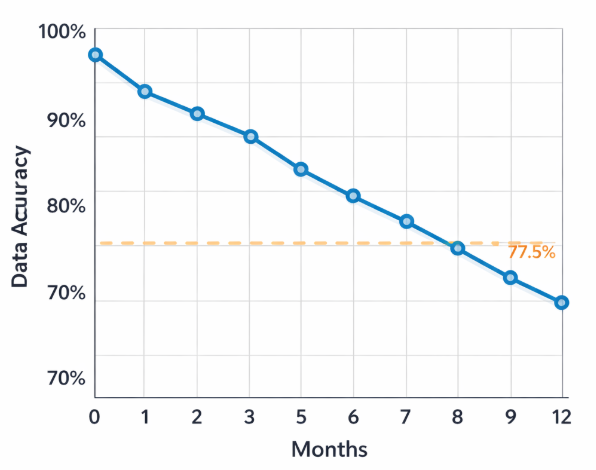
Annual decay of B2B contact data: contact information loses ~22.5% accuracy in 12 months
Many specialized companies operate offline-heavy models. Research shows that approximately 27% of small B2B companies lack comprehensive website information, and many decision-makers are absent from mainstream professional networks.
2. Non-Standard Industry Classification
Niche sectors often span multiple NAICS or SIC codes. As a result, traditional filters fail to isolate the correct segment.
3. Small Sample Sizes
In some verticals, the total number of viable accounts may range from 500 to 5,000 globally. A single inaccurate dataset can distort your TAM analysis.
4. Role Ambiguity
Decision-makers in specialized industries frequently hold hybrid roles. Titles may not align with corporate standards (e.g., "Technical Director" may function as Head of Operations).
Addressing these constraints requires moving beyond conventional list-building tactics.
Framework: Prospecting with Limited Data
Step 1: Define Micro-Segments with Precision
Instead of targeting an industry broadly, define micro-segments using:
-
Equipment type used
-
Regulatory environment
-
Geographic clustering
-
Membership in industry associations
-
Technology adoption signals
For example, rather than "industrial manufacturers," define:
"Mid-sized precision CNC machining firms serving aerospace Tier 2 suppliers in North America."
This precision improves filtering logic and reduces irrelevant records.
Step 2: Use Signal-Based Prospect Identification
When static firmographic data is insufficient, behavioral and operational signals become primary indicators.
High-value signals include:
-
Job postings referencing specific technologies
-
Participation in niche trade events
-
Regulatory filings
-
Import/export activity
-
Patent registrations
Studies indicate that signal-driven prospecting can increase conversion rates by 30–50% compared to static list-based outreach.
Step 3: Build Account Intelligence Layers
In limited-data environments, enrichment should be layered:
-
Base company validation (legal existence, size estimation)
-
Operational footprint validation
-
Decision-maker mapping
-
Trigger event identification
Layered enrichment reduces bounce rates and improves deliverability. High-performing outbound teams maintain email bounce rates below 3%; in poorly enriched niche datasets, bounce rates can exceed 10%.
Step 4: Leverage Geographic Density
Many niche industries cluster geographically. For example:
-
Specialized manufacturing hubs
-
Regional healthcare ecosystems
-
Maritime logistics corridors
Targeting clusters increases efficiency because referral networks and industry relationships are concentrated.
Step 5: Combine Top-Down and Bottom-Up Prospecting
Top-Down Approach:
Start with known industry leaders, identify suppliers, partners, and competitors.
Bottom-Up Approach:
Aggregate smaller players through event exhibitor lists, association directories, and regulatory databases.
Combining both approaches improves coverage and reduces blind spots.
Quantitative Benchmarks for Niche Prospecting
When evaluating your performance in limited-data markets, track these benchmarks:
-
Data accuracy rate: Target 95%+ validated company records
-
Email deliverability: Maintain <3% bounce rate
-
Response rate (cold outreach): 5–12% depending on specialization
-
Meeting conversion rate: 10–25% of positive replies
-
Account penetration: 3–5 stakeholders per account in small TAM markets
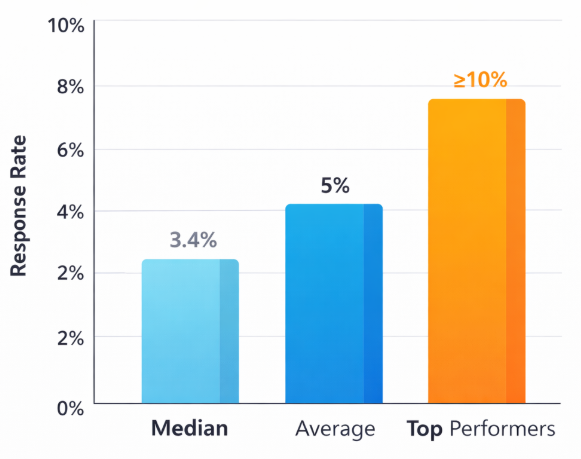
Benchmarks for B2B cold outreach: average ~5% response, top campaigns ≥10%
Because TAM is limited, depth matters more than breadth. Multi-threading increases close rates by up to 2.3x in complex B2B sales cycles.
Tactical Execution Model
Phase 1: Market Mapping
Create a master spreadsheet including:
-
Company name
-
Location
-
Estimated revenue range
-
Technology indicators
-
Known decision-makers
-
Data confidence score
Assign confidence scores (High, Medium, Low) to prioritize outreach.
Phase 2: Contact Discovery and Verification
Use layered validation methods to ensure:
-
Active domains
-
Verified email formats
-
Role confirmation
In niche sectors, manual validation may be required for 15–30% of accounts.
Phase 3: Precision Outreach
Messaging in niche markets must demonstrate domain awareness. Generic value propositions underperform because industry insiders quickly recognize superficial outreach.
Effective outreach references:
-
Specific compliance pressures
-
Operational bottlenecks
-
Supply chain dependencies
-
Industry terminology
Phase 4: Account Expansion
Given limited total accounts, expansion within each organization is critical. After securing one conversation, systematically map:
-
Adjacent departments
-
Executive sponsors
-
Budget holders
-
Technical evaluators
This reduces risk associated with small TAM markets.
Common Mistakes in Niche Prospecting
-
Over-reliance on generic databases
-
Ignoring local industry associations
-
Failing to validate data before outreach
-
Treating niche markets like high-volume outbound campaigns
-
Underestimating the importance of domain-specific messaging
Precision consistently outperforms volume in constrained datasets.
Strategic Advantage of Niche Focus
While limited data increases complexity, niche industries often demonstrate:
-
Lower vendor churn
-
Higher switching costs
-
Strong referral networks
-
Longer customer lifetime value (CLV)
In some specialized B2B sectors, CLV can exceed 5–7 times annual contract value due to extended retention cycles.
For organizations willing to invest in data refinement and signal-based targeting, niche markets offer disproportionately high returns.
Final Thoughts
Prospecting in niche industries is not a volume game. It is an intelligence game.
When traditional datasets fail, competitive advantage comes from:
-
Micro-segmentation
-
Signal-based discovery
-
Layered enrichment
-
Geographic clustering
-
Multi-threaded engagement
Revenue teams that build structured processes for limited-data environments consistently outperform those relying on scale alone.
In constrained markets, precision is the growth lever.
Recommended Articles for Further Reading
-
How to Build Highly Targeted B2B Prospect Lists
-
Signal-Based Sales Prospecting Strategies
-
Improving Data Accuracy in B2B Lead Generation