
You finally have a winning Facebook ad. Cost per result is stable, volume looks healthy, and sales are consistent. Then you increase the budget and performance drops.
This happens more often than most advertisers admit. Scaling changes how Meta delivers your ads. If you do it carelessly, you disrupt the very conditions that made the campaign profitable.
Protecting winners during scaling is about control. You want more volume without destroying efficiency.
Why Winning Campaigns Break When You Scale
A winning ad usually sits in a stable delivery pocket. The algorithm has identified who is most likely to convert. It serves impressions to similar users at a predictable cost.
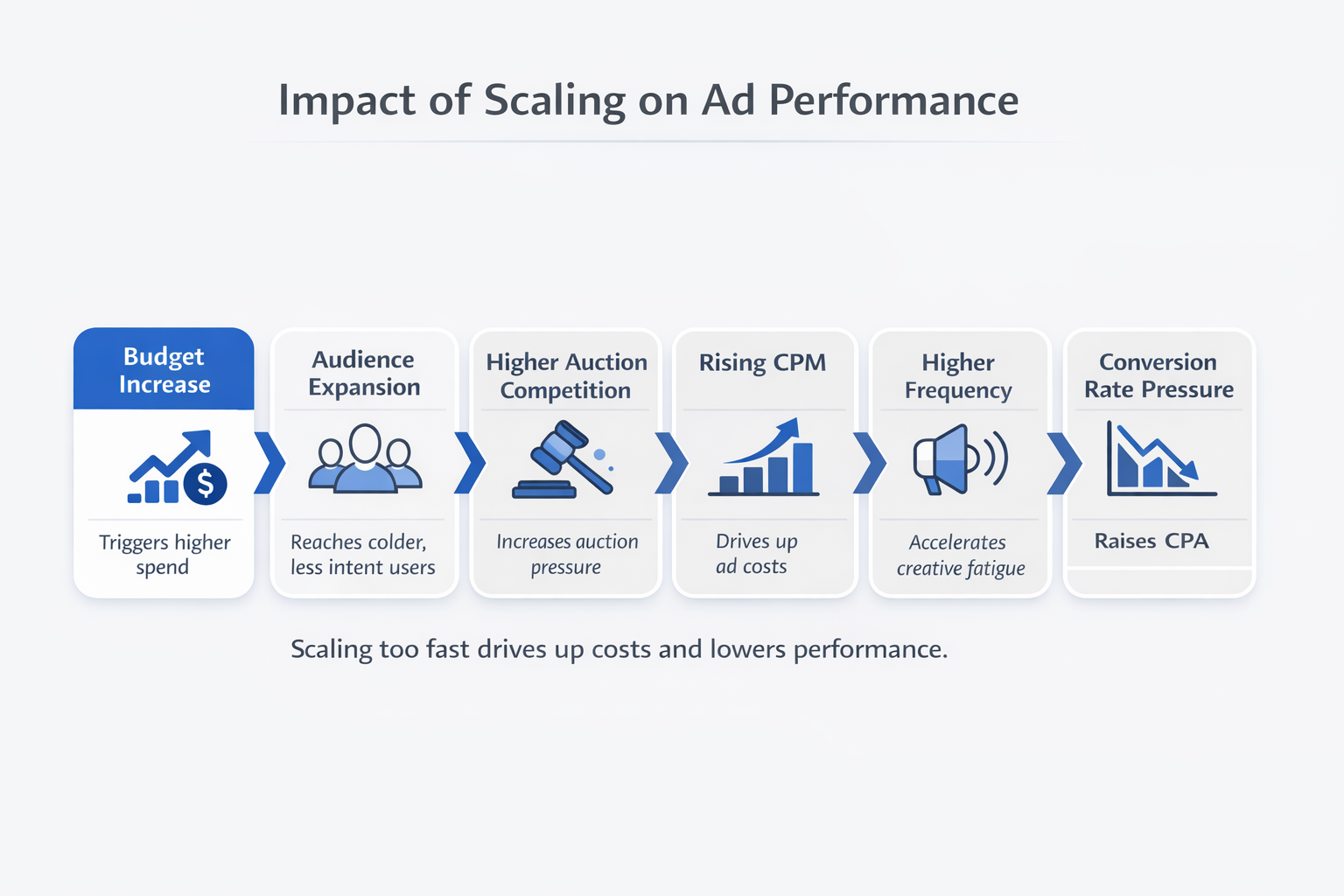
When you increase budget too fast, several things happen at once:
-
The system looks for more users; it expands into colder audience segments where intent is lower.
-
You enter more competitive auctions; your effective CPM often rises.
-
Frequency increases faster; your best audience sees the ad more often.
-
Learning signals change; large edits can reset optimization patterns.
If you want a deeper breakdown of why scaling disrupts performance, review why winning ads often fail at scale.
The result is subtle at first. CTR declines slightly. Conversion rate softens. Cost per result climbs within a few days.
Scaling is not just adding budget. It is changing the auction environment.
Scale Budgets Without Shocking the Algorithm
Use Gradual Budget Increases
Large jumps create instability. A 50 percent increase forces the system to search for new inventory quickly.
Instead, increase budgets by 10 to 20 percent every two or three days. Watch key metrics closely during that window. If cost per result stays within your target range, continue scaling.
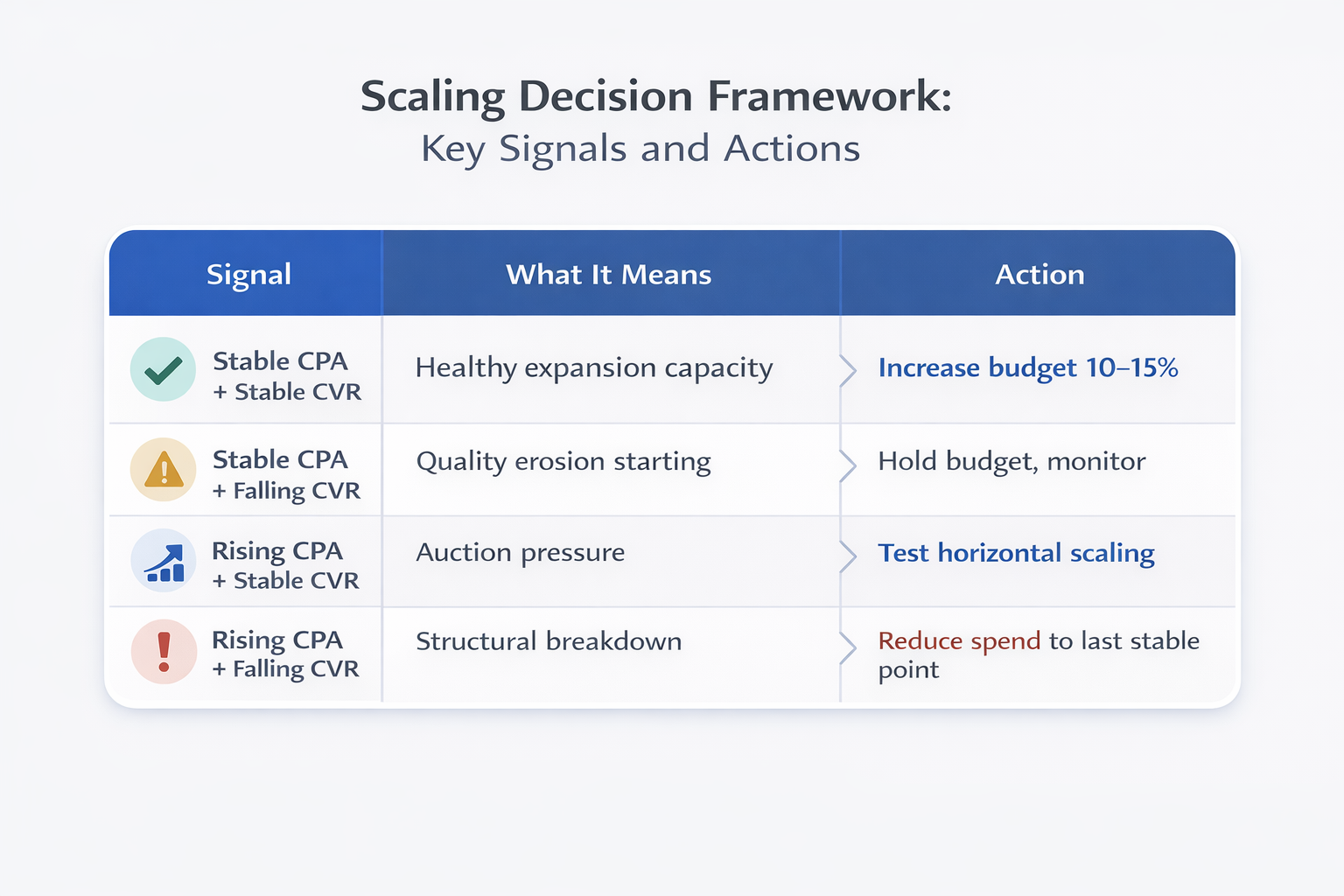
If performance drops beyond your acceptable margin, pause increases. Let the campaign stabilize before touching it again. For a structured approach, see the right way to increase ad spend without hurting ROAS.
This approach feels slower. It protects your margin.
Scale Horizontally Instead of Only Vertically
Vertical scaling means increasing budget inside one ad set. Horizontal scaling means duplicating what works.
When duplicating, keep structure clean:
-
Use the same targeting; do not stack new interests immediately.
-
Keep the same optimization event; avoid switching from leads to purchases mid-scale.
-
Keep the same creatives; test new variations in a separate campaign.
If you are unsure when to shift from testing to scaling, read when to switch from testing to scaling in Meta ads.
This isolates risk. If the duplicate underperforms, your original campaign remains untouched.
Protect Audience Quality During Expansion
Scaling often reduces lead quality before it affects volume. You see more conversions but weaker downstream metrics.
Monitor deeper indicators:
-
Lead-to-meeting rate; if it drops, your traffic is less qualified.
-
Cost per opportunity; not just cost per lead.
-
Close rate by campaign; scaling should not dilute sales efficiency.
If lead volume increases but revenue per lead declines, you are buying cheaper attention, not better customers. The concept of audience decay is explained well in why audience quality drops over time and how to fix it .
Sometimes the right move is to cap spend. Protecting margin beats chasing volume.
Keep Retargeting Stable
Prospecting and retargeting play different roles. Prospecting drives new traffic. Retargeting converts existing intent.
When you scale prospecting aggressively, it can pull budget away from retargeting campaigns. This reduces bottom-funnel efficiency.
Protect retargeting budgets intentionally:
-
Set minimum spend levels for retargeting campaigns.
-
Avoid moving them into the same CBO structure as prospecting.
-
Monitor blended CPA across the whole account.
If retargeting is part of your core revenue engine, revisit the ultimate guide to Facebook retargeting to strengthen that layer before scaling further.
Your overall profitability depends on the full funnel, not just top-of-funnel growth.
Separate Testing From Scaling
Many advertisers make one common mistake. They scale and test new creatives at the same time.
This creates noise. When performance shifts, you do not know what caused it.
Keep testing in a dedicated campaign with controlled budgets. Let your scaling campaign run only proven assets. Once a new creative proves stable, introduce it carefully.
Clarity in structure leads to clarity in decisions.
Watch the Right Metrics While Scaling
Platform metrics alone can mislead you. More impressions and clicks do not equal better business outcomes.
Focus on metrics that reflect real value:
-
Revenue per thousand impressions; this shows monetization efficiency under higher spend.
-
Cost per qualified lead; filter out low-intent submissions.
-
Average order value by campaign; scaling should not attract lower-spending customers.
-
Blended return on ad spend; evaluate account-level performance.
If revenue grows proportionally with spend, scaling works. If revenue grows slower than spend, something is breaking.
Know When to Stop
Every audience has a natural ceiling. After a certain point, incremental budget adds lower-quality impressions.
Warning signs include:
-
Consistent CTR decline over several days.
-
Rising cost per purchase without higher average order value.
-
Drop in sales conversion rate while traffic remains stable.
When you see these patterns, reduce budget to the last stable level. Stabilize performance before trying again.
Scaling is not a one-way direction. It requires adjustment.
Treat Scaling as Risk Management
Winning ads do not fail because scaling is impossible. They fail because changes happen too fast and without structure.
Increase budgets gradually. Protect retargeting. Separate testing from scaling. Monitor revenue-based metrics, not vanity numbers.
Scaling should feel controlled. When you protect the conditions that created the win, you give your campaigns room to grow without losing profitability.