Most accounts don’t have a lead generation problem. They have a lead decay problem.
Leads come in, fill forms, maybe even book calls — and then disappear. Weeks later, those same users are still in your CRM, but they’re no longer in your targeting logic. The ad system has moved on.
Re-engagement isn’t about sending reminders. It’s about reintroducing qualified intent signals back into the delivery system so campaigns can act on them again.
If your funnel already struggles with drop-off after the first interaction, the issue often starts earlier than you think — as explained in Why your Facebook ads aren’t generating leads and how to fix it.
Why Leads Go Cold Faster Than You Expect
You can watch this happen directly in Ads Manager.
A campaign generates leads at a stable CPL. Then SQL rate starts dropping, even though nothing in targeting or creative changed. Frequency stays low, CPM is stable, but pipeline quality declines.
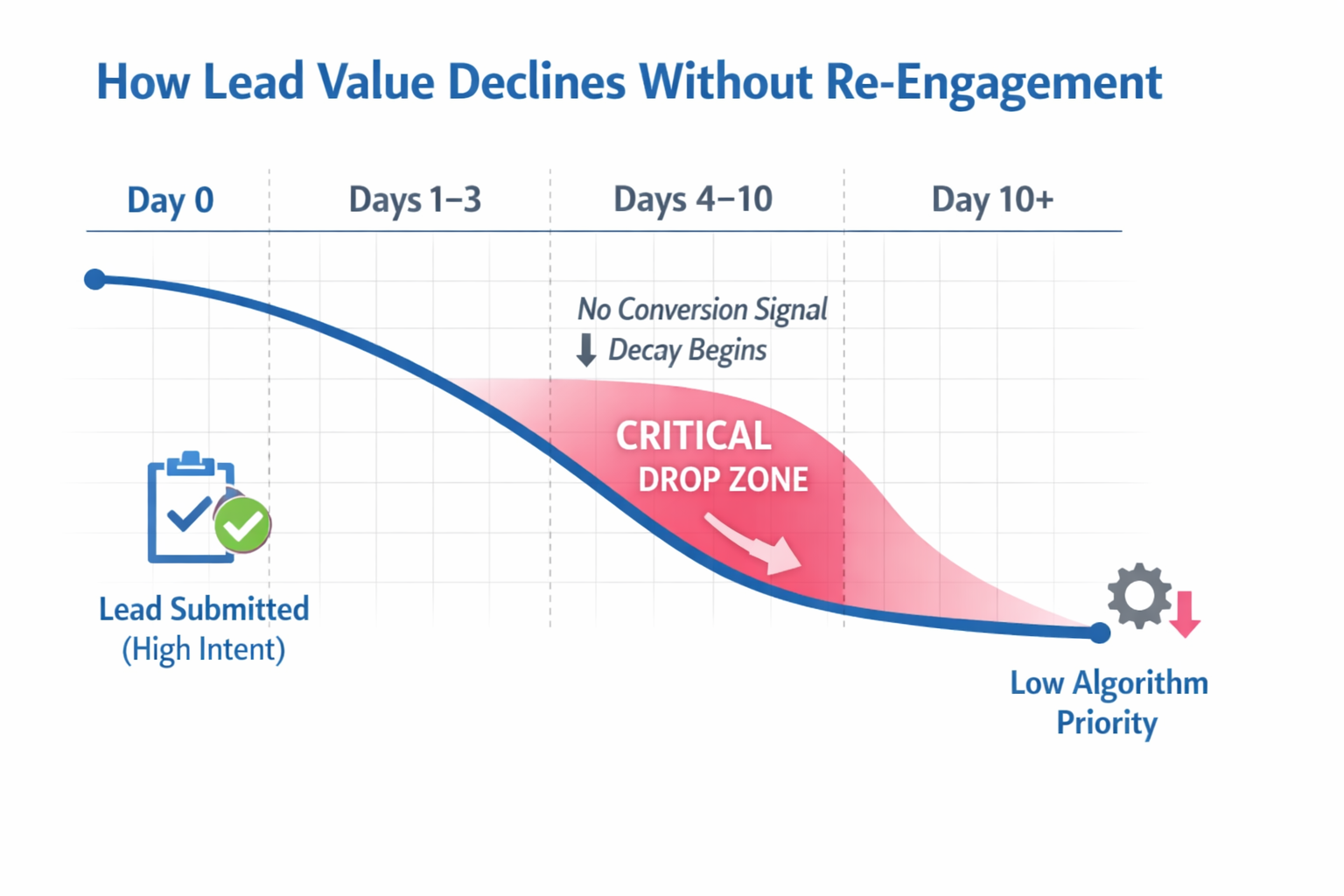
What’s happening is not creative fatigue — it’s signal decay.
When a user submits a lead:
-
The algorithm briefly treats them as a high-intent profile.
-
If no follow-up conversion (e.g., meeting booked, deal progression) occurs, that signal weakens quickly.
-
Within days, the system stops prioritizing similar users because it lacks reinforcement.
This creates a structural gap:
-
Your CRM still contains potentially valuable prospects.
-
The ad platform no longer sees them as relevant signals.
Re-engagement campaigns exist to bridge that gap.
The Core Mistake: Treating All Lost Leads the Same
Most re-engagement setups fail because they group all inactive leads into a single audience.
That ignores how different these users actually are.
A lead who opened three emails but didn’t book a call behaves very differently from someone who never responded after form submission. Yet both often get the same ads.
This creates two problems:
-
The message becomes too generic, so response rates stay low.
-
The algorithm receives mixed signals, which weakens optimization.
This is closely related to a broader issue discussed in 5 audience segmentation mistakes that waste ad budget, where poor segmentation directly reduces performance.
Segmenting Lost Leads by Actual Friction Point
Instead of time-based buckets (“30-day leads,” “60-day leads”), segment based on what stopped them.
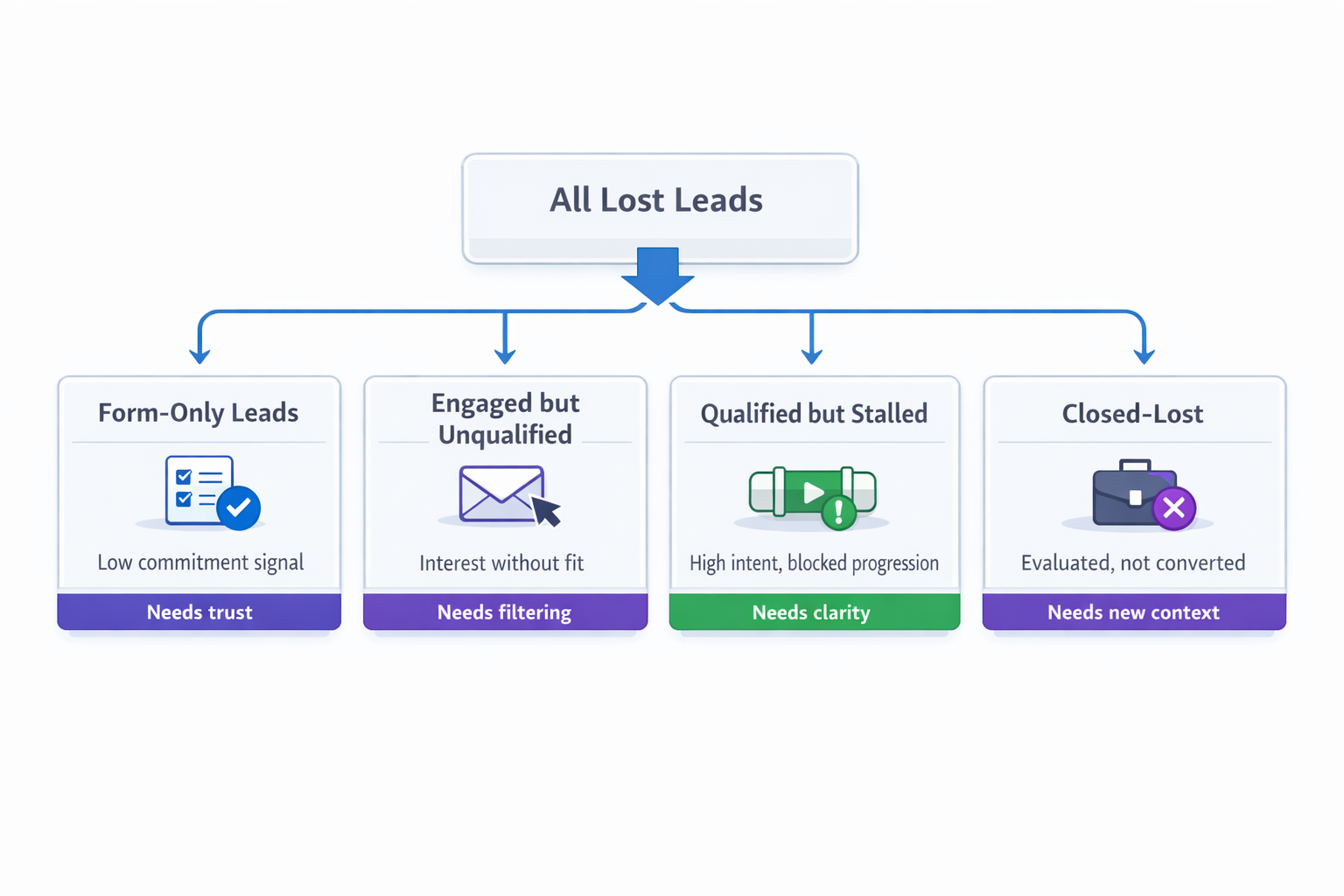
For example:
-
Form-only leads (no further action).
These users converted on the lowest-friction step but never engaged again. They often require clarification or trust-building, not urgency. -
Engaged but unqualified leads.
They opened emails, maybe clicked links, but didn’t meet criteria. Re-engagement here should filter harder, not push harder. -
Qualified but stalled leads (SQLs with no progression).
These are high-value users. The issue is usually timing, internal priorities, or unclear next steps. -
Closed-lost opportunities.
These users were deep in the funnel. Re-engagement should introduce new context, not repeat the same offer.
Each segment requires different campaign logic. More importantly, each produces a different type of signal when it re-engages.
What Re-Engagement Actually Does to the Algorithm
When a lost lead clicks, returns, or converts again, the system doesn’t just record a conversion — it updates its understanding of who is still valuable.
Here’s what changes under the hood:
-
The algorithm reassigns value to older behavioral clusters.
-
It increases auction competitiveness for similar users.
-
It reintroduces previously ignored segments into delivery.
You can often see this in practice:
-
CPA stabilizes after a re-engagement push.
-
Audience performance improves when previously “inactive” segments start converting again.
-
Delivery becomes more consistent across campaigns.
This behavior ties into how Meta prioritizes signals, which is broken down in How Facebook’s algorithm decides who sees your ads.
Campaign Structures That Actually Work
A single “retargeting campaign” is rarely enough. You need separation between recovery, qualification, and reactivation.
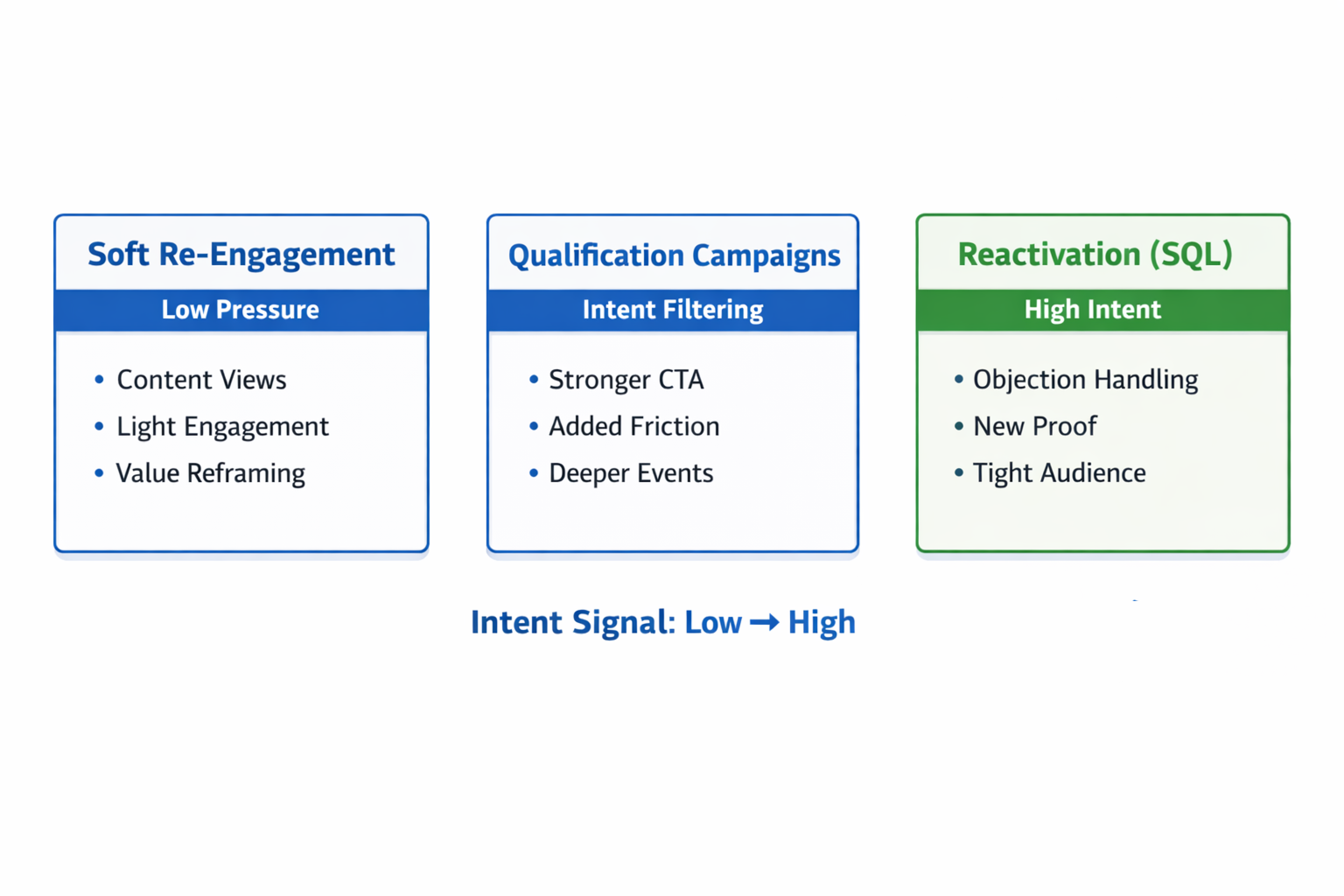
1. Soft Re-Engagement (Low Pressure)
Used for early-stage or unresponsive leads.
-
Focus on low-friction actions, such as content views or lightweight interactions.
-
Rotate creatives that reframe the original value proposition rather than repeating it.
-
Exclude recent converters to avoid redundancy.
This stage helps identify which leads still show latent interest.
2. Qualification Campaigns (Intent Filtering)
Used after initial re-engagement.
-
Introduce stronger CTAs, such as booking a call or requesting pricing.
-
Add friction intentionally, for example by requiring more detailed input.
-
Optimize for deeper funnel events, not just clicks.
This prevents low-quality leads from re-entering your core pipeline.
3. High-Intent Reactivation (SQL Recovery)
Target leads who previously reached qualification but stalled.
-
Use messaging tied to specific objections (timing, budget, integration concerns).
-
Introduce new proof points, such as case-specific outcomes or updated offers.
-
Limit audience size to maintain signal clarity.
This is where re-engagement has the highest revenue impact — especially if you structure follow-up flows similarly to lead nurturing with Facebook ads: from opt-in to customer.
Diagnosing When Re-Engagement Is Needed
You don’t need to guess. The signals show up clearly if you know where to look.
Common indicators:
-
Stable CPL, declining SQL rate.
Lead generation is working, but downstream intent is weakening. -
Lookalike or broad audience performance dropping over time.
The system is losing clarity on what “good users” look like. -
Short conversion windows.
If most conversions happen within 1 – 3 days, you’re likely losing late converters. -
CRM stagnation.
Large volumes of leads with no movement between stages.
If you see two or more of these, re-engagement should be part of your structure, not an afterthought.
Common Mistakes That Kill Re-Engagement Performance
These show up frequently in accounts that “tried retargeting” and saw no results.
-
Overlapping audiences.
Running multiple campaigns against the same pool creates auction competition and noisy signals. -
Recycling the same creatives.
If a user ignored the first message, repeating it rarely changes behavior. -
Optimizing for clicks instead of outcomes.
This floods campaigns with low-intent re-engagement that doesn’t convert downstream. -
Ignoring CRM feedback loops.
If re-engaged leads don’t progress, the system needs updated signals to adjust targeting.
Each of these issues reduces the system’s ability to learn from re-engagement events.
The Structural Shift Most Teams Miss
Re-engagement is often treated as a recovery tactic. In practice, it should function as a continuous signal layer.
Instead of asking:
“How do we bring back old leads?”
A better question is:
“How do we keep high-intent signals alive long enough for the algorithm to act on them?”
This shift changes how you build campaigns:
-
You design re-engagement alongside acquisition, not after it.
-
You connect CRM stages directly to audience logic.
-
You treat every reactivation as a new data point for targeting expansion.
Practical Takeaway
If your pipeline weakens over time despite steady lead volume, the issue is not just targeting — it’s signal continuity.
Start by segmenting lost leads based on where they dropped off. Then build separate campaigns that:
-
reintroduce low-intent users gradually,
-
filter for real intent before pushing them forward,
-
and reinforce high-value behaviors back into the system.
When done correctly, re-engagement doesn’t just recover leads. It makes your entire acquisition system more accurate.