Warm leads don’t stall because of lack of interest. They stall because the system stops receiving strong enough signals to prioritize them.
In most ad accounts, you can see this happen directly: frequency increases, CTR drops slightly, and conversion lag stretches from 1–2 days to 5–7 days. Nothing “breaks,” but momentum disappears.
This article explains how to restore that momentum — by tightening feedback loops, compressing decision windows, and feeding the algorithm stronger signals at the right time.
Why Warm Leads Slow Down in the First Place
A lead doesn’t become “cold” suddenly. The decay is gradual and measurable.
In Meta or Google Ads, you’ll typically notice:
-
Conversion delay increases, meaning users take longer between first interaction and action.
A user who used to convert within 24–48 hours now takes several days. This stretches your feedback loop and weakens the algorithm’s ability to identify high-intent patterns quickly. -
Retargeting audiences start overlapping heavily, causing redundant impressions without incremental conversions.
The same users are hit across multiple ad sets, which inflates frequency without adding new decision triggers. You’re spending more to repeat the same message instead of progressing the user. -
Spend shifts toward broader prospecting because the system finds stronger signals elsewhere.
When warm audiences stop converting quickly, the algorithm reallocates budget toward colder audiences where signal density appears higher.
This behavior closely mirrors what’s explained in Why Your Facebook Ads Stop Performing After Two Weeks and How to Fix It, where performance decay is tied directly to signal loss and audience saturation.
The Core Principle: Compression of Decision Cycles
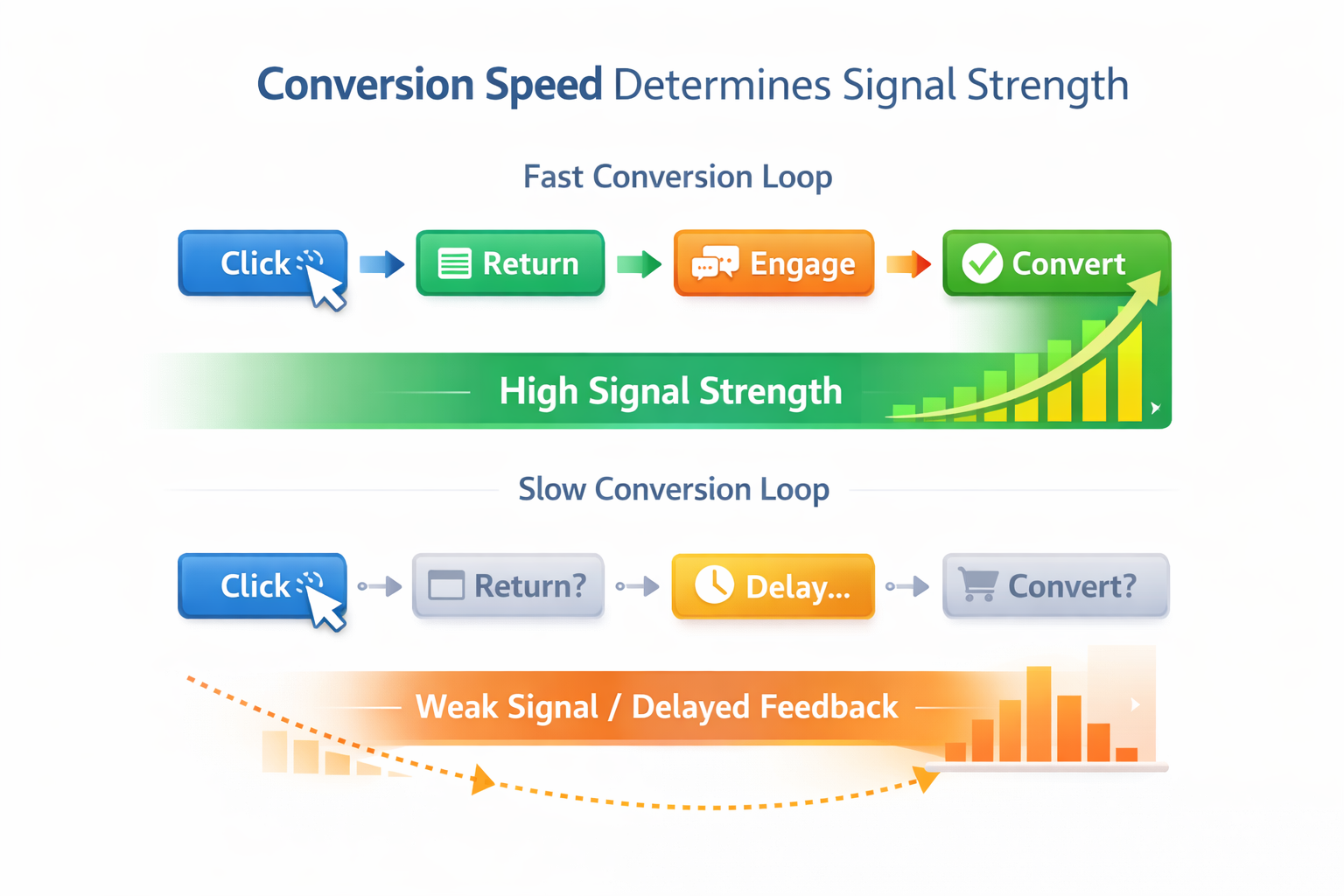
Acceleration is not about adding more touchpoints. It’s about reducing the time between meaningful interactions.
When a user moves quickly from click to return visit to conversion, the system identifies a tight behavioral pattern. That pattern increases confidence in similar users and pushes more delivery into that segment.
When the same actions are spread across a week or more, the connection weakens. The algorithm still sees the conversion, but it becomes less useful as a predictive signal.
Acceleration strategies are built around tightening that loop.
Strategy 1: Sequence Retargeting Based on Time-Since-Visit
Most accounts use static retargeting. Everyone sees the same ads regardless of when they entered the funnel.
That removes timing from the equation, even though timing is one of the strongest intent signals.
Instead, segment your audiences by recency:
-
0–2 days (High urgency window):
These users still remember why they clicked. Their context is fresh, and hesitation is usually minimal.
The goal here is not persuasion — it’s completion.
Show direct CTAs, simplify the next step, and remove friction. For example, shorten the path to booking or highlight a single clear action instead of multiple options. -
3–7 days (Reinforcement window):
At this stage, the initial intent is fading. The user may still be interested, but uncertainty increases.
This is where proof matters.
Introduce case studies, testimonials, or comparisons that help justify the decision they already considered but didn’t complete. -
8–14 days (Recovery window):
These users are no longer prioritized by the system. Their behavior resembles colder traffic.
Repeating the same message here rarely works.
Instead, reposition the offer — show a different use case, highlight a new benefit, or reframe the problem entirely.
This progression follows the same logic outlined in The Best Retargeting Sequence for Long Sales Cycles, where message evolution drives re-engagement.
Strategy 2: Introduce Micro-Conversions to Feed the Algorithm
If your only signal is the final conversion, the algorithm has very little to work with.
Micro-conversions fill that gap by providing earlier indicators of intent.
Examples:
-
Viewing pricing pages:
This signals commercial intent. Users who reach pricing are already evaluating value, not just browsing. -
Clicking “compare plans”:
This indicates active decision-making. The user is weighing options rather than passively consuming information. -
Watching 50%+ of a product video:
This shows sustained engagement. The algorithm can identify patterns among users who commit attention, not just clicks. -
Starting a form without submitting:
This is one of the strongest signals of near-conversion intent. The user is willing to act but is blocked by friction or hesitation.
These events allow the system to recognize intent clusters earlier. Instead of waiting for delayed conversions, it begins optimizing based on progression signals.
This approach aligns with Using Micro-Conversions to Optimize Facebook Campaign Performance, where intermediate actions stabilize campaigns faster.
Strategy 3: Tighten Retargeting Frequency Without Causing Saturation
Warm leads need repeated exposure — but only within a controlled range.
Too little exposure, and the user forgets. Too much, and engagement drops.
A structured approach looks like:
-
Increase frequency in the first 72 hours after interaction.
This is when intent is highest. Higher exposure during this window reinforces the initial action and encourages faster decision-making. -
Rotate creatives every 2–3 days to prevent fatigue.
Even if the message stays the same, the format should change. This keeps engagement stable while maintaining pressure. -
Monitor frequency alongside CTR, not in isolation.
Frequency alone doesn’t indicate a problem.
If CTR remains stable, the audience is still responsive.
If CTR declines as frequency rises, you’ve reached saturation.
These dynamics are explained in Ad Fatigue on Facebook: How to Spot It Early and Fix It Fast, where engagement decline signals overexposure.
Strategy 4: Use Conversion Window Alignment to Reinforce Signals
Conversion windows determine how the platform values user actions.
If your funnel naturally takes several days but your campaign is optimized for a 1-day window, the system undercounts successful outcomes.
To fix this:
-
Match your optimization window to actual conversion behavior.
If most conversions happen within 3–5 days, a longer window allows the system to capture those signals properly. -
Compare performance across different attribution windows.
This reveals where your true signal density exists and prevents misinterpretation of campaign performance. -
Identify where conversions cluster in time.
If most conversions happen within a specific window, aligning optimization to that range increases delivery efficiency.
When aligned correctly, the algorithm stops undervaluing warm leads and begins bidding more aggressively on similar users.
Strategy 5: Trigger Re-Engagement Based on Behavioral Drop-Off
Continuous retargeting assumes all users behave the same way. They don’t.
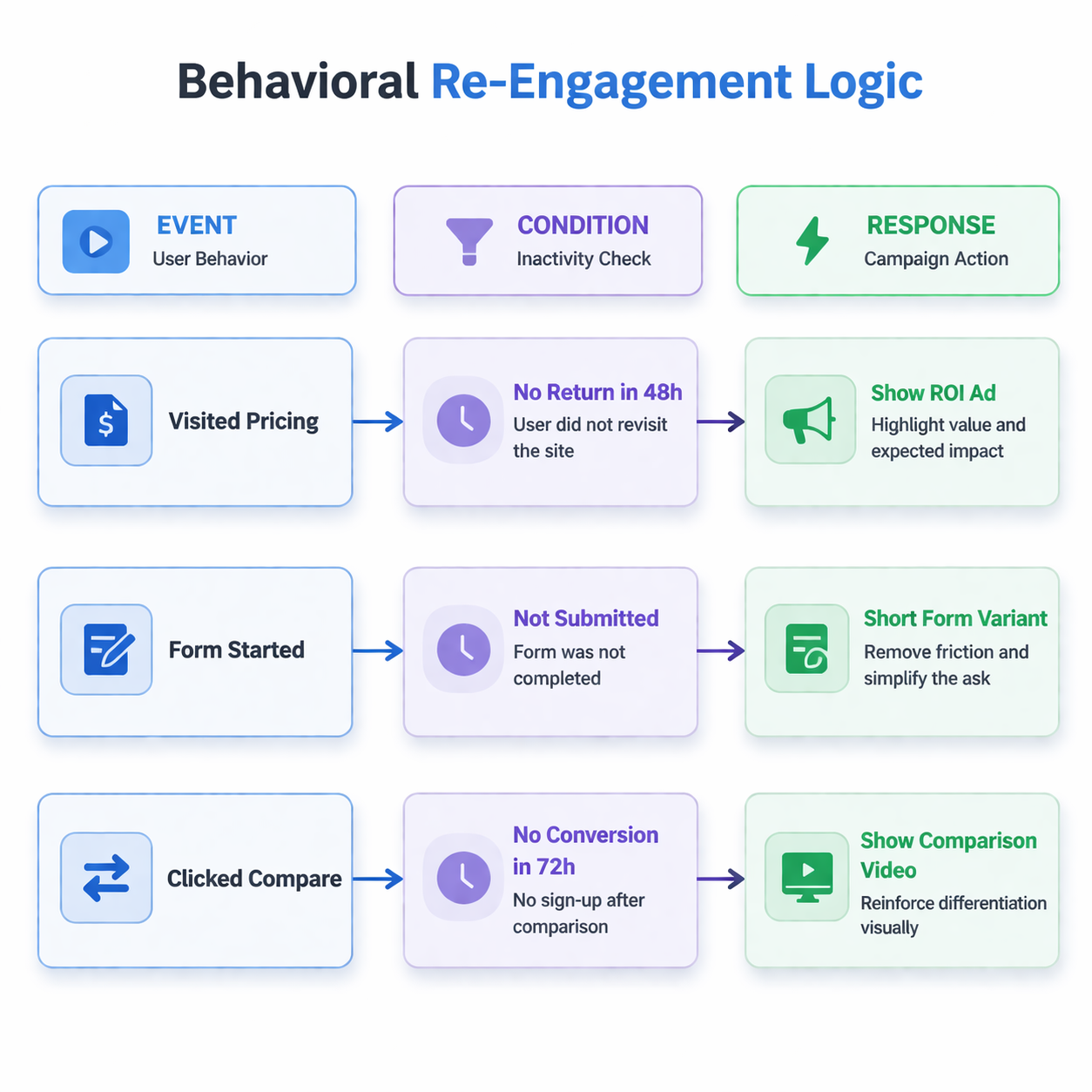
Trigger-based campaigns respond to specific behaviors instead of time alone.
Examples:
-
Visited pricing page but didn’t return within 48 hours:
This indicates hesitation at the decision stage. The response should reduce uncertainty — for example, showing ROI breakdowns or clarifying pricing structure. -
Opened a lead form but abandoned midway:
This signals friction. The user is willing to act but is blocked.
Reducing required fields or offering a simpler alternative often recovers these leads. -
Clicked multiple ads but never reached conversion pages:
This suggests curiosity without commitment.
A stronger CTA or clearer value proposition can push them further down the funnel.
This method adds a manual layer on top of algorithmic behavior. Instead of waiting for the system to react, you reinforce signals immediately.
Strategy 6: Align Creative With Funnel Position, Not Audience Type
Warm audiences are often treated as a single group, but they contain multiple decision stages.
Creative should reflect where the user is in the decision process:
-
Early warm (first interaction):
The user is still understanding the offer.
Focus on clarity — what the product does, who it’s for, and why it matters. -
Mid-funnel (evaluation phase):
The user is comparing options.
Address objections directly, show differentiation, and provide concrete reasons to choose your solution. -
Late stage (ready to convert):
The decision is almost made.
Remove friction — simplify onboarding, highlight guarantees, and reinforce urgency.
Misalignment often appears as high CTR with low conversions. The message attracts attention but doesn’t match the user’s decision stage.
Strategy 7: Reduce Friction Inside the Funnel Itself
Sometimes the bottleneck is not in targeting or creatives — it’s in the user experience.
Common friction points:
-
Multi-step forms without progress indicators:
Users don’t know how much effort is required, which increases abandonment. -
Slow landing pages:
Even a 2–3 second delay can reduce engagement significantly, especially for mobile users. -
Unclear next steps after engagement:
If users don’t immediately understand what to do next, momentum is lost.
These issues are visible in analytics through drop-offs, incomplete forms, and low engagement depth.
Reducing friction shortens the time between actions, which directly strengthens algorithmic signals.
Putting It Together: Acceleration Is a System, Not a Tactic
No single tactic accelerates a funnel on its own.
What works is the combination:
-
Time-based sequencing ensures users receive the right message at the right moment.
-
Micro-conversions maintain a steady flow of signals for the algorithm.
-
Frequency control keeps engagement high without causing fatigue.
-
Conversion window alignment ensures signals are interpreted correctly.
-
Trigger-based campaigns recover users at key drop-off points.
-
Stage-specific creatives match user intent.
-
Funnel optimization removes barriers to conversion.
When these elements align, the system regains confidence in your audience.
Final Takeaway
Warm leads don’t need more attention. They need better-timed reinforcement.
If your funnel slows down, don’t expand targeting immediately. Look at how quickly users move between meaningful actions.
Acceleration comes from tightening that sequence.
And once the system sees fast, consistent conversions again, it scales naturally.