Before an agency or freelancer can run effective Meta campaigns for a client, they often need access to the client’s Facebook Page.
That access request is easy to underestimate. It can feel like a small onboarding task, but it directly affects campaign launch speed, Page identity, audience activation, engagement management, and reporting clarity.
Requesting Page access the right way helps agencies move faster and helps clients stay in control.
What Is Happening When You Request Facebook Page Access?
When you request access to a Facebook Page, you are asking permission to work with another person’s or business’s Page. You are not taking ownership of it.
That distinction is important.
A client may still own the Page. The agency or freelancer receives the permission needed to support campaign work. Depending on the access level, that may include advertising, content management, insights, engagement management, or other Page-related tasks.
For performance marketers, the request should match the campaign role.
If you only need to run ads, ask for the access required to run ads. If you need to manage comments, coordinate creative, or connect Page-related assets, clarify that before the client approves anything.
A vague access request creates friction. A precise request builds trust and speeds up onboarding.
Why This Affects Campaign Performance
Campaigns cannot perform well if the team cannot execute properly.
If Page access is delayed, audience tests are delayed. Creative launches are delayed. Campaign learning starts later. The first week of a new client engagement may disappear into permission chasing instead of performance testing.
If the request is too narrow, the agency may get access but still be unable to do essential work. That creates more back-and-forth and slows optimization.
If the request is too broad, the client may hesitate to approve it. That also slows execution and can create trust concerns.
The best access request gives the client a clear reason to approve it. It should explain what the agency needs, why it needs it, and how the access supports the campaign plan.
This matters even more when the campaign strategy depends on structured audience testing. If you plan to test high-intent audiences built from Facebook groups, Instagram engagers, LinkedIn-derived professional data, or competitor ecosystems, the Page access request should not be an afterthought.
Business Impact
A poor access request can affect campaign economics before the campaign even launches.
Delayed access reduces testing time. Fewer tests mean slower learning and slower budget optimization.
Wrong access creates wasted setup work. The team may build campaigns in the wrong structure or discover late that it cannot use the intended Page.
Unclear access increases client friction. If the client does not understand why the request matters, they may delay approval or grant the wrong permission level.
Incomplete access can hurt conversion quality. If the Page identity, ad account, Instagram account, and audience structure do not line up, prospects may experience a disjointed journey.
Budget allocation becomes harder when the setup is unclear. If early campaign results are poor, the team may not know whether the issue is the audience, creative, offer, landing page, or account structure.
For agencies, this can damage client confidence. For advertisers, it can waste valuable testing budget.
Typical Scenarios Where This Applies
A paid social agency is onboarding a new client
The agency needs Page access before launching Facebook and Instagram campaigns. A clear request helps the client approve access faster and with fewer concerns.
A freelancer is hired to manage lead generation campaigns
The freelancer may need Page access plus ad account access. If they only request Page access, they may still be unable to launch campaigns.
A B2B growth team wants to test high-intent audiences
The team plans to build segments from LinkedIn professional data, Facebook communities, or social-profile sources. They need access to activate those audiences under the right brand Page and campaign structure.
An ecommerce agency is preparing catalog and retargeting campaigns
The Page may need to align with Instagram, catalog, dataset, and ad account assets. Requesting Page access alone may not be enough.
A local advertiser works with an external marketing consultant
The consultant needs access to the correct location Page. If the request goes to the wrong Page, campaigns may launch with the wrong local identity.
Risks and Considerations
The first risk is requesting access to the wrong Page. Clients often have duplicate, inactive, old, or similarly named Pages. Confirm the exact Page before sending the request.
The second risk is asking for the wrong permission level. Too little access blocks execution. Too much access may make the client uncomfortable or expose assets unnecessarily.
The third risk is assuming Page access includes everything else. It does not. Campaign execution may also require ad account access, Instagram access, dataset access, catalog access, lead form access, or partner permissions.
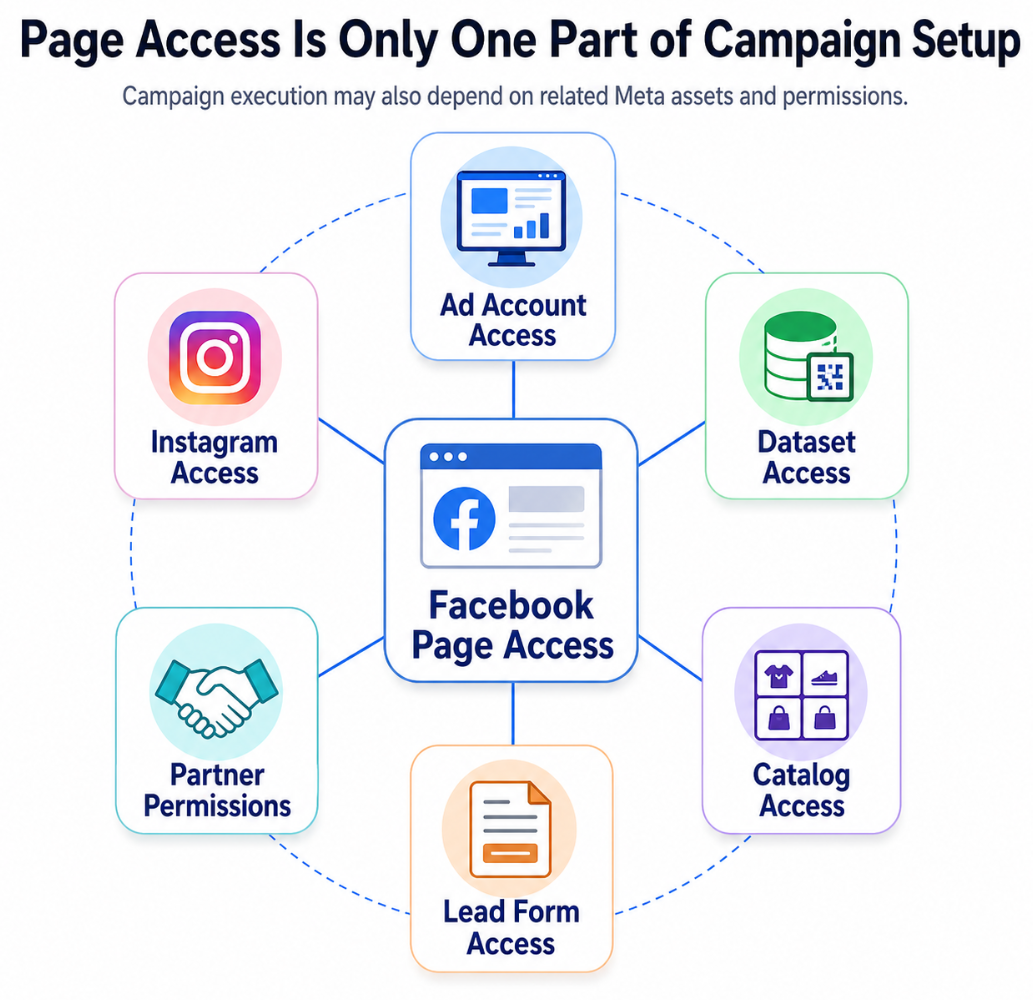
Page access is only one part of the campaign-access stack. Depending on the campaign setup, teams may also need access to ad accounts, Instagram assets, datasets, catalogs, lead forms, or partner permissions
The fourth risk is weak campaign fundamentals. Access will not fix poor audience fit, unclear offers, weak creative, bad landing pages, or unreliable conversion tracking.
The fifth risk is over-reliance on one channel or one audience source. Even high-intent audiences should be tested against other prospecting, retargeting, and creative strategies.
The sixth risk is compliance. Agencies and advertisers should respect platform policies, client data rules, and privacy expectations when using custom audiences or external audience sources.
Prerequisites and Dependencies
Before requesting Page access, prepare the client and the campaign plan.
You should have:
- Your own business portfolio or agency structure ready.
- The correct client Page name or URL.
- A clear explanation of why Page access is needed.
- A defined permission level request.
- A list of any other assets needed for the campaign.
- The client-side approver with full control identified.
- An active ad account or plan for ad account access.
- Reliable conversion tracking.
- A defined campaign objective.
- A strong offer and landing page.
- Success metrics such as CPA, CAC, ROAS, conversion rate, lead quality, or sales volume.
- A first-round audience testing plan.
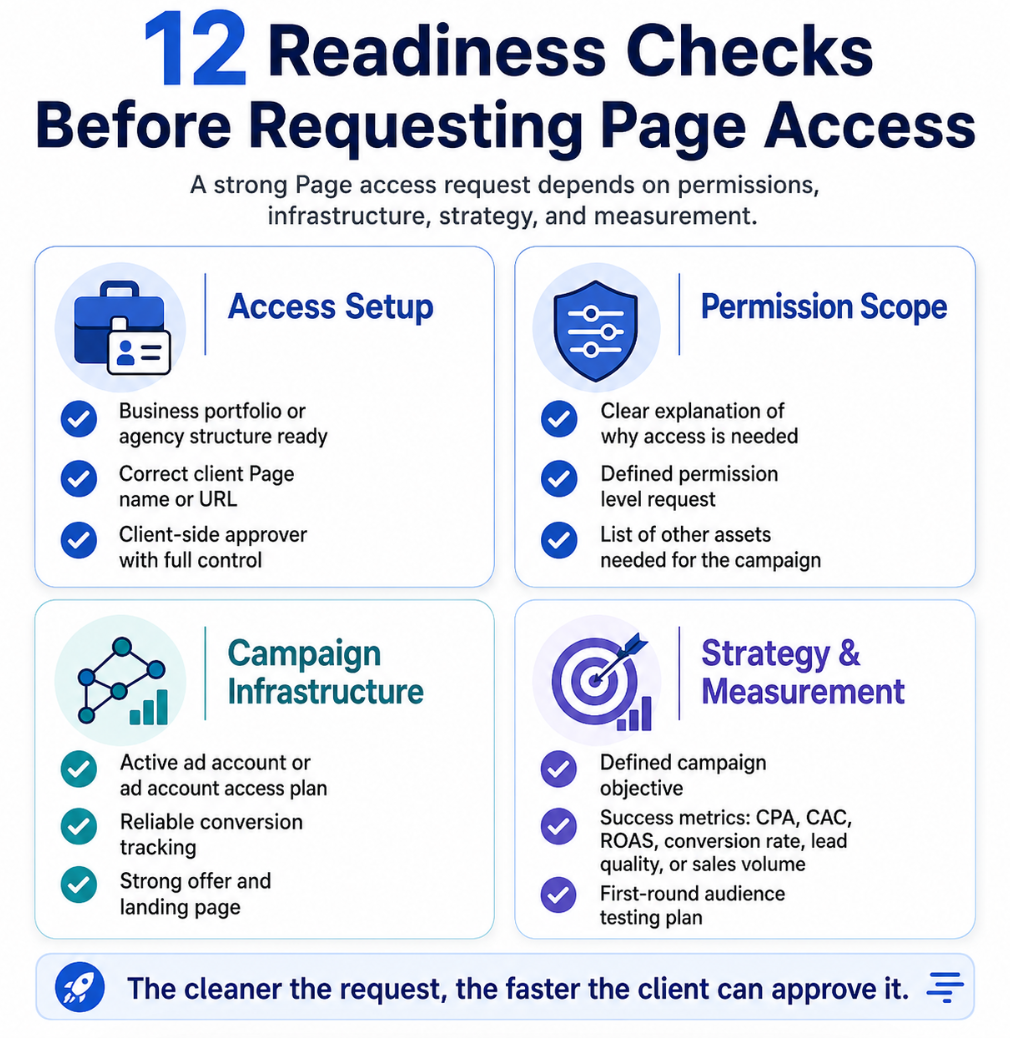
A strong Page access request starts before the request is sent. Agencies should confirm access details, campaign infrastructure, strategy, tracking, and success metrics before asking the client to approve permissions
The cleaner the request, the faster the client can approve it.
How LeadEnforce Helps
LeadEnforce helps agencies and advertisers make better use of Page access once it is approved.
Before requesting access, a team can use LeadEnforce to plan higher-quality audience tests. For example, it can identify relevant Facebook groups, Instagram profiles, follower and engager segments, LinkedIn-derived professional audiences, and custom social-profile data that match the client’s ICP.
After Page access is granted, the team can activate these audience segments in the right campaign structure and compare them against broader Meta targeting.
This helps reduce guesswork.
A B2B agency can build audiences around job roles, professional communities, and niche social behavior. An ecommerce team can test competitor-profile audiences and Instagram engagement-based segments. A local business can test community audiences instead of relying only on broad location targeting.
LeadEnforce does not request Meta access, approve permissions, or fix ownership conflicts. It helps improve audience precision after the access foundation is ready.
Practical Recommendations
Send access requests with context. Tell the client what you need, why you need it, and which campaign work depends on it.
Ask for the minimum sufficient access. This builds trust and reduces approval friction.
Confirm the exact Page before requesting access. Avoid old, duplicate, or inactive Pages.
Create a client onboarding checklist. Include Page access, ad account access, Instagram access, dataset access, catalog access, tracking status, landing page readiness, and success metrics.
Do not wait until launch day. Access requests should be handled before creative production and media planning are finalized.
Pair access with audience strategy. Once access is approved, move quickly into structured testing with relevant audiences, clear creative hypotheses, and defined performance benchmarks.
Review access after the engagement ends. Agencies should support clean offboarding, and clients should remove unnecessary permissions.
Final Takeaway
Requesting Facebook Page access is not just an onboarding step. It is the first operational gate before serious campaign testing can happen.
A clear, scoped access request helps agencies move faster, helps clients stay in control, and gives performance teams a cleaner foundation for testing high-intent audiences without wasting budget on avoidable setup friction.
Related LeadEnforce Articles
- How to Give an Agency Partner Access to Meta Assets Without Losing Campaign Control — Useful for understanding the client-side view of granting agency access.
- Find Your Meta Business Portfolio ID Faster When Agencies, Partners, or Tools Need Access — Helpful when access requests depend on portfolio details or agency-client coordination.
- No Full Control of Your Meta Business Portfolio? Fix Access Before Campaigns Stall — Relevant when access requests cannot be approved because the right person lacks full control.
- Why You Can’t Add or Connect Business Assets in Meta — Explains common blockers when Pages or other assets cannot be connected or accessed.
- Accepting a Meta Business Portfolio Invitation: What Advertisers Must Check First — Useful for teams coordinating access invitations and avoiding campaign disruption.