Domain verification is easy to dismiss as a technical checkbox.
For advertisers, that is a mistake.
If your Meta campaigns send traffic to a website, landing page, product page, lead form, or sales page, Meta needs to know which business controls that domain. Without clear domain ownership, link editing, partner access, campaign setup, and asset control can become harder than they need to be.
That matters because paid social teams do not just need ads that look good. They need campaigns that can launch quickly, test cleanly, and send traffic to the right destination without operational friction.
What Meta Domain Verification Actually Controls
Meta domain verification establishes that your business portfolio controls a website domain.
The practical value for advertisers is control.
When a domain is verified, the business can better manage who has permission to edit links and related content connected to that domain. This is especially relevant for ad link editing permissions, where multiple Pages, agencies, freelancers, or business portfolios may be involved.
That does not mean domain verification magically improves performance. It does not fix a weak offer, bad creative, poor tracking, or an irrelevant audience.
But it does help create a cleaner operating structure around the domain your ads rely on.
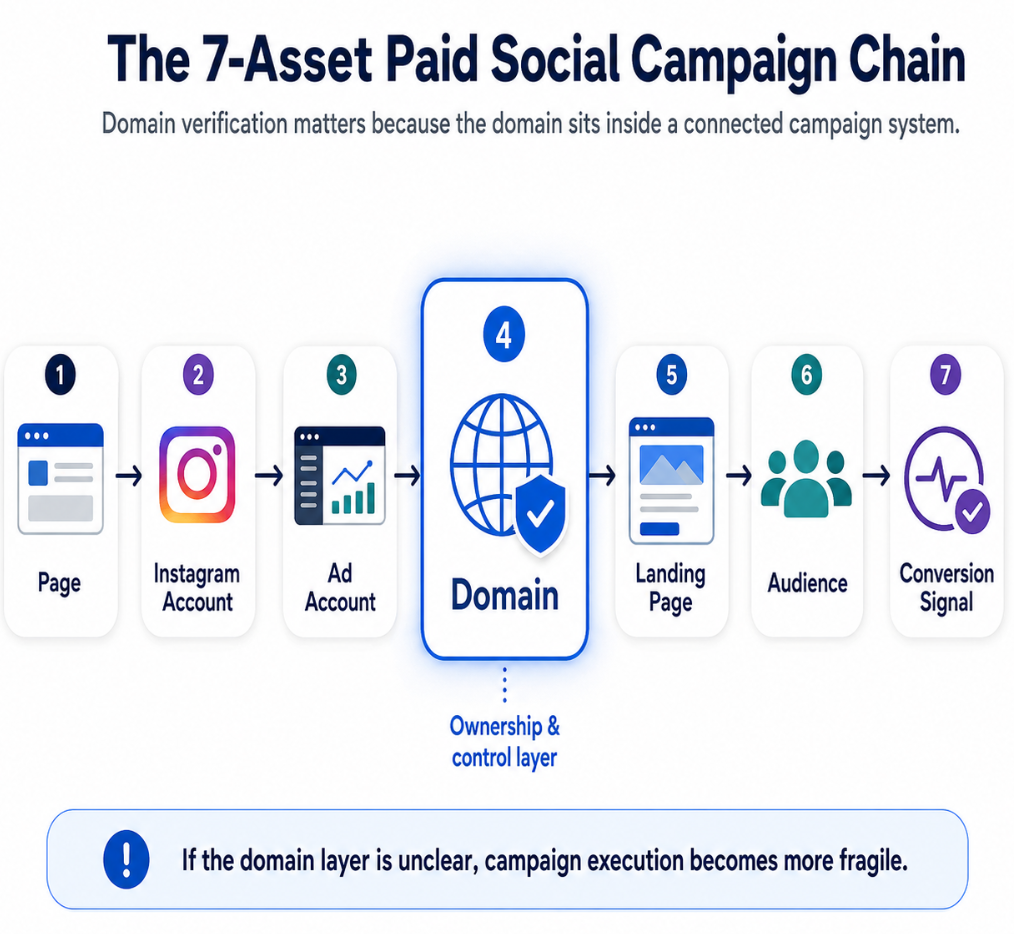
Paid social campaigns depend on a connected asset chain. Domain verification helps clarify control over the destination layer that ads, landing pages, audiences, and conversion signals rely on.
For performance marketers, that operating structure matters because every campaign depends on a chain of assets: Page, Instagram account, ad account, domain, landing page, audience, and conversion signal. If the domain layer is unclear, campaign execution becomes more fragile.
Why This Affects Paid Social Performance
Meta Ads performance is not only determined inside Ads Manager.
It is also affected by whether your business assets are organized correctly.
A verified domain helps clarify which business controls the destination used in your ads. That reduces confusion when teams need to edit link previews, manage landing page messaging, coordinate with agencies, or confirm that campaigns are pointing to the right owned property.
When domain control is unclear, small problems can slow down paid social work.
A headline in a link preview may need to be adjusted before launch. A campaign may be delayed because an agency does not have the right domain permissions. A rebrand may leave the old domain connected to the wrong portfolio. A startup may build several landing pages before confirming which domain actually belongs in Meta Business Suite.
None of these issues show up as a simple “bad CPC” problem. But they can affect the speed, quality, and consistency of campaign testing.
Business Impact
Domain verification influences performance indirectly.
The main business impact comes from fewer launch delays, cleaner campaign governance, and better control over the links used in ads.
If domain permissions are messy, advertisers may experience:
- Slower campaign launches because the right person cannot manage link editing.
- Wasted impressions if ads use outdated link previews or inconsistent landing page messaging.
- Reduced testing speed when creative and landing page variations cannot be coordinated cleanly.
- Agency onboarding friction because nobody knows which portfolio controls the client domain.
- Confusion during rebrands, website migrations, or new landing page launches.
- More budget waste when campaigns are launched before asset ownership is reviewed.
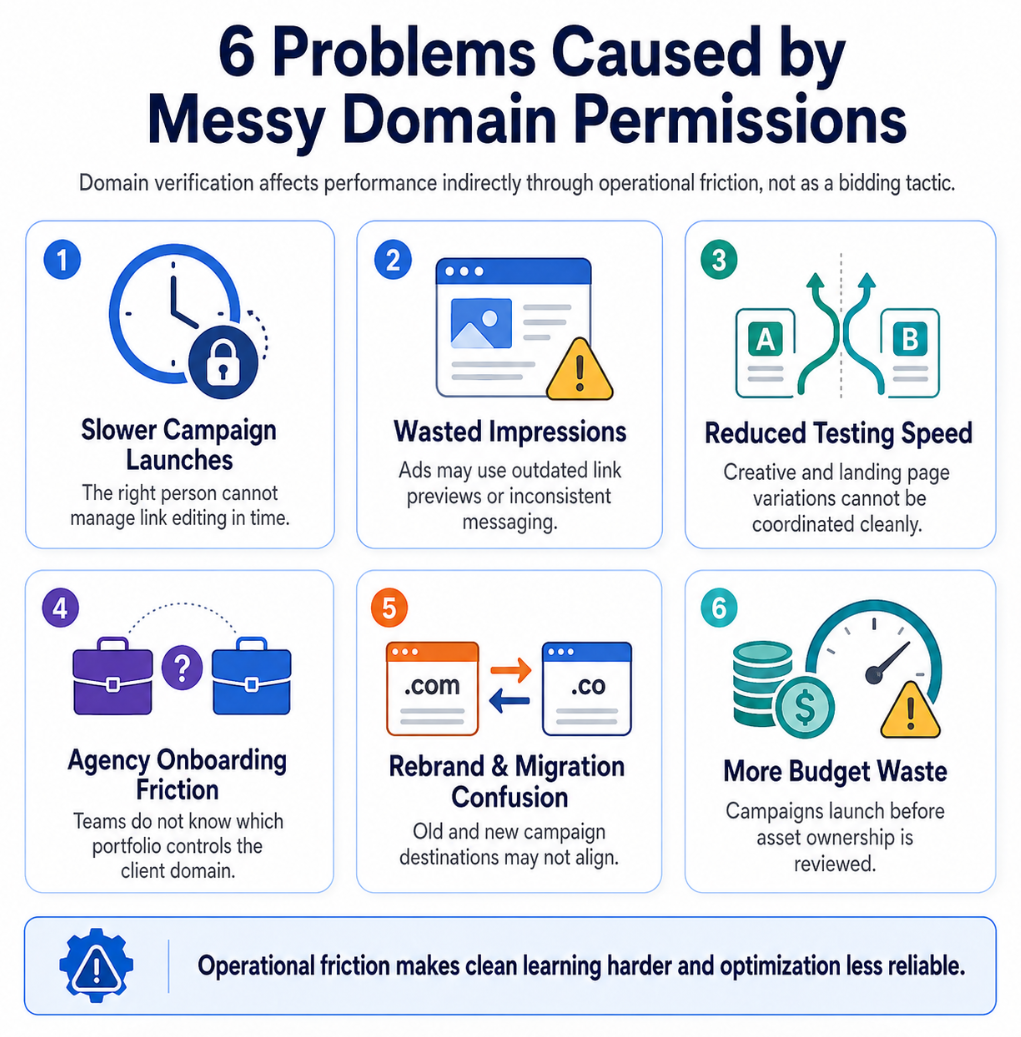
Messy domain permissions create operational friction: slower launches, weaker coordination, onboarding delays, migration confusion, and avoidable budget waste before campaigns can produce clean learning
This can affect CPC, CPA, CAC, ROAS, and lead quality, but not because domain verification is a bidding tactic.
The effect is operational.
If teams spend time fighting access issues, duplicating campaign structures, or launching with inconsistent destination messaging, the budget is less likely to support clean learning. Campaign results become harder to interpret, and optimization decisions become less reliable.
Typical Scenarios Where This Applies
An Agency Takes Over a Client Account
A marketing agency inherits an ad account, Page, pixel, and landing page strategy from a previous vendor.
Campaigns are ready to launch, but the client’s domain is not verified in the correct business portfolio. The agency can build audiences and ads, but link editing and ownership questions slow the launch.
This is common during agency transitions. The fix is not to create more workarounds. The fix is to confirm ownership and domain control before campaign testing begins.
A Startup Builds New Landing Pages
A startup launches fast.
The team tests one domain, then a subdomain, then a new brand domain after repositioning. Meta campaigns keep running, but the business portfolio does not reflect the current domain structure.
This can create confusion around verification, landing page consistency, and partner access.
Before scaling spend, the startup should confirm which domain is the primary paid acquisition destination and make sure it is controlled by the correct business portfolio.
An Ecommerce Brand Migrates Its Store
Ecommerce teams often move from one storefront setup to another.
The website migration may be technically successful, but Meta assets may still point to old assumptions. Product pages, catalogs, tracking, ad destinations, and business details all need to be reviewed together.
Domain verification should be part of that migration checklist.
If it is skipped, campaign teams may discover the issue only when they need to edit links, adjust campaign destinations, or troubleshoot inconsistent signals.
A B2B Team Runs Landing Page Tests
B2B lead-generation teams often test different landing pages for different ICPs.
One campaign may target SaaS founders. Another may target HR leaders. Another may target enterprise procurement teams using LinkedIn-derived or custom social-profile audience inputs.
If the domain structure is unclear, it becomes harder to keep those tests clean. The audience strategy may be strong, but operational confusion around the domain can still slow testing.
Affiliate and Freelance Marketers Use Multiple Offers
Affiliate marketers and freelance media buyers often work across multiple offers, domains, and client assets.
This increases the risk of launching campaigns through the wrong business structure or relying on domains that are not properly controlled.
Domain verification helps create clearer boundaries between owned domains, client domains, and campaign destinations.
Risks and Considerations
Domain verification should be handled carefully.
First, verify the domain in the business portfolio that actually owns or controls the domain. For client work, this usually means the client’s business portfolio, not the agency’s portfolio.
Second, do not confuse domain verification with business verification. They are related to trust and ownership, but they are not the same process.
Third, do not treat domain verification as a tracking fix. It does not replace proper conversion tracking, clean event setup, reliable landing pages, or strong campaign objectives.
Fourth, avoid overreacting to platform metrics. If CPA rises after a launch, the issue may be audience fit, creative quality, landing page friction, offer strength, or conversion signal quality. Domain verification is one part of the operating system, not the whole performance strategy.
Advertisers should also check compliance and brand safety before granting link editing permissions. Giving broad control to every partner or freelancer may make execution easier in the short term, but it can create risk if people edit links, previews, or destinations without proper review.
Prerequisites and Dependencies
Before domain verification becomes useful for paid social, advertisers need a few basics in place.
The business should have a clear Meta Business Portfolio structure. The correct Page, Instagram account, ad account, data source, and domain should be connected logically.
The team should know who owns the domain and who can make website or DNS-related changes. Even if the media buyer is not handling technical setup, someone must be able to coordinate with the website owner, developer, IT provider, or domain administrator.
Campaign strategy also matters.
Domain verification will not help much if the campaign objective is unclear or the offer is weak. Advertisers should have a defined ICP, clear success metrics, and a practical budget for testing.
Audience size matters too. If the audience is too small, too broad, or poorly matched to the offer, the campaign will still struggle. Domain control supports execution, but audience quality still drives performance.
How LeadEnforce Helps
LeadEnforce does not verify domains, fix Meta permissions, or solve technical setup problems.
Its value comes after the campaign infrastructure is organized.
Once the correct domain, Page, ad account, and business portfolio are ready, LeadEnforce helps advertisers improve the quality of the audiences they bring into campaigns.
Instead of relying only on broad interests or generic targeting, advertisers can use LeadEnforce to build more relevant audiences from Facebook groups, Instagram profiles, followers, engagers, LinkedIn professional data, and custom social-profile data.
That matters because domain verification helps clarify where traffic goes and who controls the destination. LeadEnforce helps clarify who the traffic should come from.
For example, an agency can build audiences from competitor communities before launching campaigns to a verified client domain. A B2B team can use professional and community-based signals to build ICP-aligned segments. An ecommerce brand can test audiences built around niche Instagram profiles or Facebook groups that match its product category.
The practical workflow is simple: use Meta domain verification to reduce operational ambiguity, then use LeadEnforce to improve audience relevance.
Practical Recommendations
Start by auditing the domains used in your Meta campaigns.
List every domain, subdomain, landing page platform, ecommerce store, and campaign microsite currently receiving paid traffic. Then confirm which business portfolio controls each one.
Next, map domains to campaign ownership. Identify who can edit links, who manages landing pages, who owns the ad account, and who is responsible for campaign QA before launch.
Do not wait until a campaign is live to check this.
Domain verification should be reviewed before rebrands, store migrations, new agency onboarding, franchise expansion, affiliate offer launches, or major budget increases.
Also separate operational problems from performance problems.
If campaign results are weak, domain verification may not be the cause. Check audience fit, creative quality, landing page relevance, conversion tracking, offer strength, and budget allocation before drawing conclusions.
Finally, pair clean domain control with better audience testing. Once the domain layer is stable, use sharper audiences to test real demand instead of spending budget on broad targeting assumptions.
Final Takeaway
Domain verification is not a magic performance lever.
It is a control layer.
For paid social advertisers, that control layer helps keep link editing, domain ownership, campaign destinations, and agency workflows cleaner. When the operational structure is clean, teams can test faster, reduce avoidable friction, and make better decisions about audience quality and budget allocation.
Related LeadEnforce Articles
- How to Verify Your Business in Meta Business Suite (Step-by-Step Guide) — Useful for understanding how verification workflows affect business trust, domains, and campaign scaling.
- Meta Business Verification: Why It Matters for Ad Performance — Explains how verification status can affect account trust, campaign stability, and scaling readiness.
- Update Meta Business Details Without Putting Verified Status at Risk — Relevant when domain changes, rebrands, or website updates may affect Meta business consistency.
- Meta Data Sources Explained: Improve Ad Performance with Better Signals — Helps advertisers connect domain and asset hygiene to cleaner conversion signals and campaign optimization.
- Set Up Your Meta Business Portfolio Before Scaling Paid Social Campaigns — Covers the broader business portfolio structure needed before scaling Facebook and Instagram campaigns.