

Retargeting performance usually starts to drop when frequency climbs past 4–5 and conversions stop moving. At that point, the issue isn’t creative fatigue — it’s audience quality.
Most setups group users based on visits, not behavior. So someone who bounced after 5 seconds sits in the same pool as someone who read three pages and checked pricing.
The algorithm doesn’t fix that for you. It amplifies whatever signal you feed it. This is also why many campaigns underperform even when everything “looks right” — a pattern explained in why your ad targeting strategy isn’t working.
Where Standard Retargeting Breaks
You can see the problem directly in Ads Manager.
Spend continues to deliver, but the underlying signals degrade. CTR drops below ~1%, frequency keeps rising, and CPA increases without meaningful volume gains. That combination usually points to weak audience structure.
The issue comes from how most retargeting audiences are built:
-
All visitors (30 days): includes accidental clicks, low-intent sessions, and irrelevant traffic. Meta still tries to find similar users, but the base signal is mixed and inconsistent.
-
Single-page triggers (e.g., pricing page): a pricing visit alone doesn’t indicate intent. Some users leave immediately, others compare solutions — the system treats both as equal inputs.
-
Recency-only segmentation: a user from yesterday isn’t necessarily stronger than one from five days ago who explored multiple pages and returned twice.
When these signals are blended, delivery spreads across users with very different probabilities to convert.
Engagement Signals That Actually Indicate Intent
Two users can fire the same PageView event while behaving completely differently.
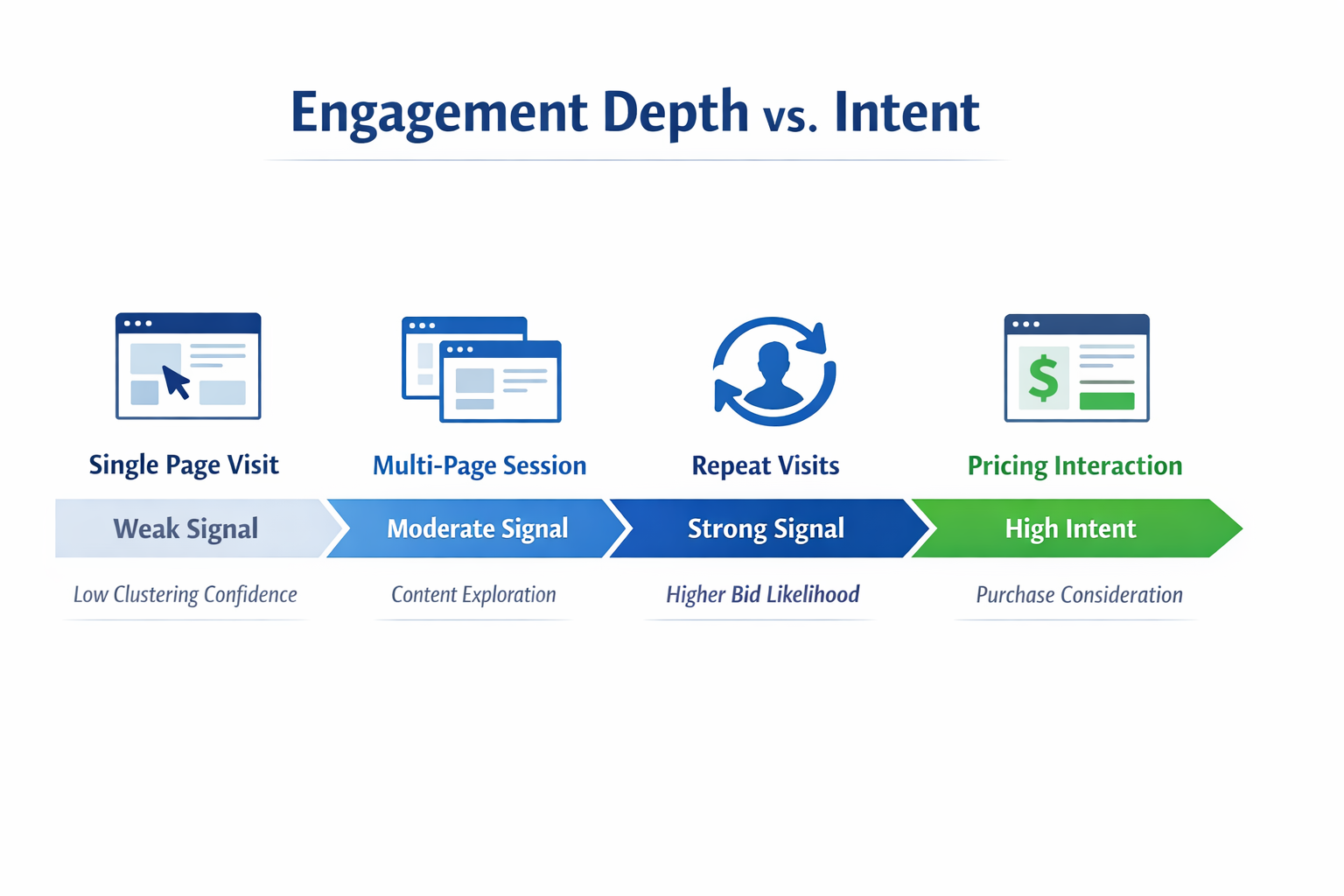
The difference shows up in depth, not presence.
What matters is how users move through your content. Certain patterns consistently correlate with higher conversion probability because they create stronger behavioral clusters inside the algorithm.
-
Sequential page behavior: when a user moves from blog content to product pages and then to pricing within one session, Meta groups that sequence into a tighter intent pattern. These users often receive more aggressive bidding in future auctions.
-
Scroll depth on long-form pages: reaching 75–100% scroll typically means the user stayed engaged long enough to trigger additional signals. These sessions often show higher downstream conversion rates.
-
Short-interval return visits: two sessions within 48 hours usually outperform a single recent visit. This pattern often appears before retargeting conversion spikes.
-
Content progression: moving from educational content to commercial pages signals evaluation. Repeating top-of-funnel content does not create the same effect.
-
On-site interactions: video plays, tool usage, or calculator inputs generate additional signals that help the algorithm prioritize similar users in delivery.
This logic aligns with how advanced segmentation works in behavior-based audience segmentation strategies.
How Engagement Changes Retargeting Structure
Once you segment by behavior, retargeting stops being a single audience and becomes a layered system.
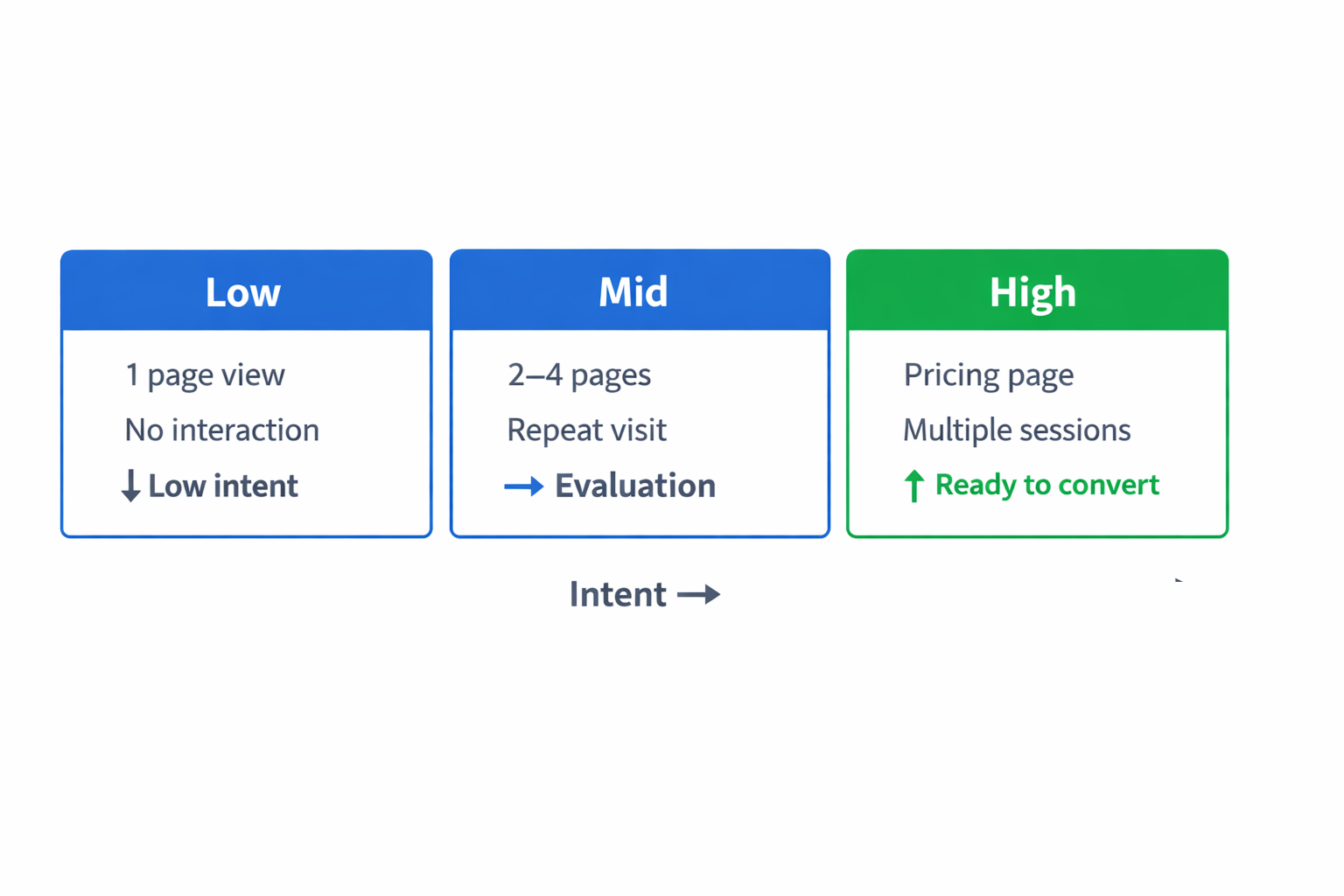
Low Engagement — Traffic Filtering
This group includes users who triggered a visit but showed minimal depth.
Typical pattern:
-
1 page view.
-
No scroll or interaction.
-
No return session.
In campaigns, these users absorb impressions but rarely convert. You’ll often see frequency rise quickly while CTR declines.
The goal here is not to push conversions aggressively. Instead, keep budgets constrained, use broader messaging, and exclude users early if engagement remains weak.
Mid Engagement — Active Evaluation
This is where most efficient retargeting performance happens.
Users in this group typically view multiple pages, interact with both educational and product content, and return within a short timeframe. In Ads Manager, this segment stabilizes quickly — CTR improves, CPM remains controlled, and conversions become more predictable.
At this stage, users are comparing options. They don’t need general explanations — they need clarity.
You should:
-
Introduce structured value propositions.
-
Show specific use cases or comparisons.
-
Present measurable outcomes such as cost reduction or lead quality improvements.
High Engagement — Conversion Window
High-intent users behave differently in delivery, and you can usually see it in the numbers.
They visit pricing pages, return within short intervals, and engage deeply with product content. Frequency can increase without immediate performance decay, and conversion lag shortens.
At this stage, retargeting shifts from education to decision support.
Focus on:
-
Removing friction through demos or onboarding clarity.
-
Addressing objections directly.
-
Increasing bid competitiveness when audience size is limited.
If messaging stays generic here, conversions slow down.
Turning Signals Into Audiences
Most teams understand engagement conceptually but fail when translating it into audience rules.
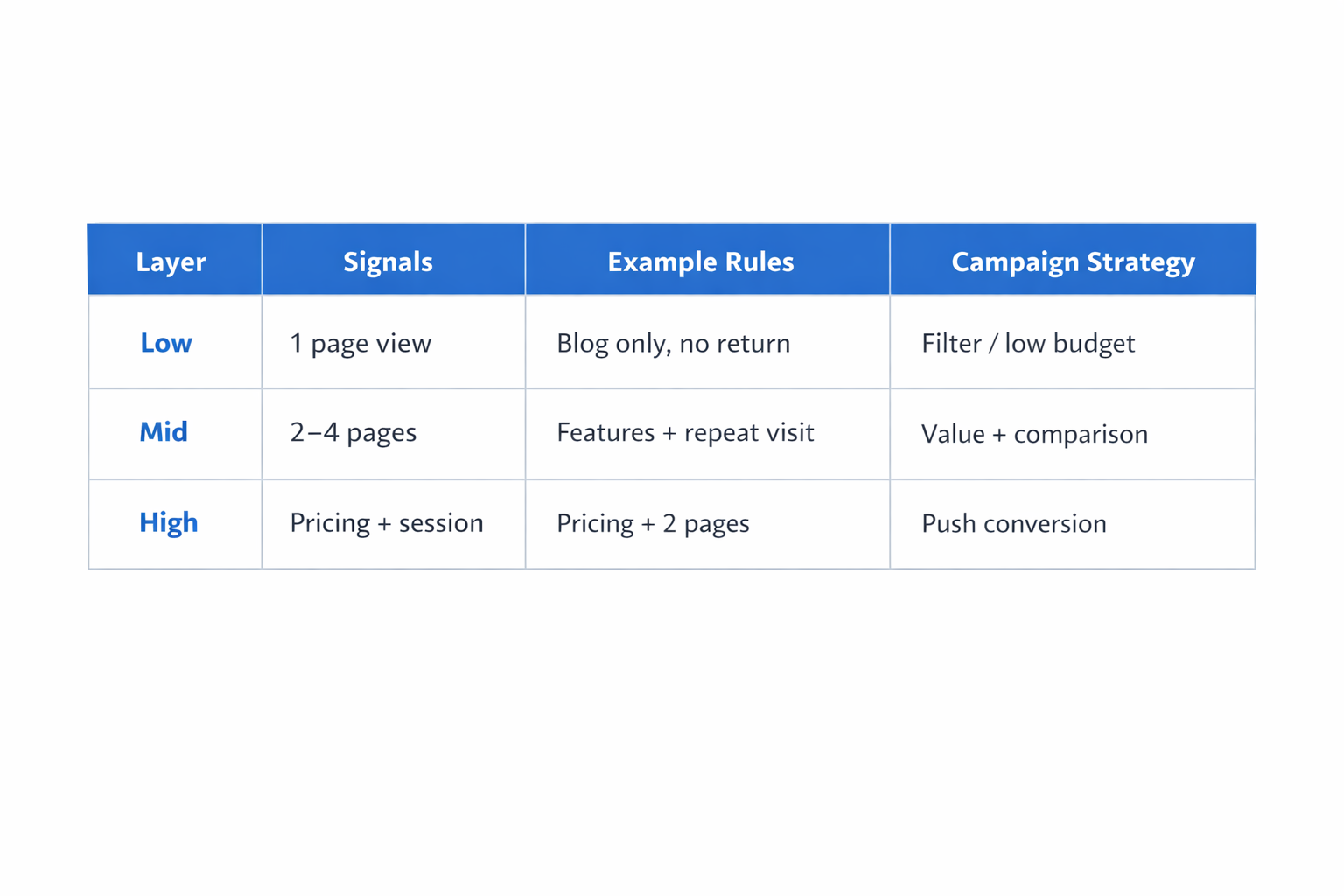
A simple structure is enough to improve signal clarity:
-
Low Intent Audience: URL contains
/blog/; session count = 1; exclude product and pricing pages. -
Mid Intent Audience: visited two or more pages; includes
/features/or/use-cases/; or repeat visit within seven days. -
High Intent Audience: visited
/pricing/or/demo/; and at least one additional page; or two or more sessions within three days.
Even this basic segmentation changes how the algorithm interprets user behavior.
If you extend this with event tracking, you can assign weight to actions. A pricing visit carries more value than a blog view, and deep scroll carries more weight than a short session.
Where Most Setups Go Wrong
The issue isn’t missing data — it’s how signals are grouped.
Many setups collapse different intent levels into a single audience. When that happens, the algorithm loses the ability to distinguish between evaluation and decision-stage users.
Other common issues include:
-
Audience overlap: high-intent users remain inside mid-intent pools, creating internal competition and unstable delivery.
-
Over-reliance on time windows: short lookback periods still include weak users if behavioral filtering is missing.
-
Uniform messaging: showing the same ad to all engagement levels ignores where the user is in the decision process.
These problems are similar to what’s outlined in audience segmentation mistakes that waste ad budget.
What Changes After Fixing Signal Quality
Once engagement layers are separated correctly, performance shifts in a predictable direction.
Spend begins to concentrate on users who show stronger intent. Conversion density increases, especially in mid and high engagement segments. The learning phase stabilizes because the system receives clearer feedback.
Scaling also becomes more controlled. You can increase spend on high-intent audiences without inflating frequency across low-value traffic.
This shift is one of the core drivers behind successful retargeting, as explained in retargeting strategies that double your ROAS.
Strategic Takeaway
Retargeting performance reflects how clearly intent is defined.
If all visitors look the same, delivery spreads across low-probability users. Once behavior is structured, the algorithm concentrates spend where conversion likelihood is higher.
Content engagement signals make that structure explicit.
When you separate users based on how they interact with your content — not just where they landed — retargeting becomes more predictable and easier to scale.
