Retargeting is one of the highest-performing tactics in performance marketing, but results depend heavily on timing. How long a user remains in a retargeting audience—known as the retargeting window—determines how relevant ads feel and how efficiently budgets are spent.
Short retargeting cycles prioritize immediacy and intent, while long cycles aim to nurture users with extended consideration periods. Understanding when to use each approach is essential for scaling campaigns without overspending or saturating audiences.
What Is a Retargeting Window?
A retargeting window defines the number of days after a user interaction (such as a website visit, form view, or content engagement) during which that user continues to see ads.
For example:
-
A 7-day window targets users who interacted within the last week
-
A 30-day window includes users from the past month
-
A 90-day window extends reach to longer consideration cycles
The optimal window length varies based on buying intent, product complexity, and deal velocity.
Short Retargeting Windows (1–14 Days)
When Short Windows Work Best
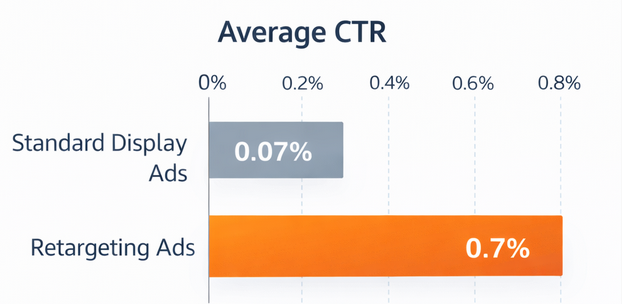
Retargeting ads outperform standard display ads in engagement, with roughly ten times higher click-through rates
Short retargeting windows focus on high-intent users who are still actively considering a decision. These users tend to remember the brand and require fewer impressions to convert.
Common use cases include:
-
Free trials and demos
-
E-commerce purchases
-
Limited-time offers
-
Low-to-mid price products
Performance Characteristics
-
Higher click-through rates due to message relevance
-
Faster conversion cycles
-
Lower cost per acquisition
-
Smaller audience size
Industry benchmarks show that retargeting users within the first 7 days can produce conversion rates 2–3× higher than audiences older than 30 days. Additionally, ads served within the first week after a site visit often generate 30–50% lower acquisition costs compared to longer windows.
Risks of Overuse
The main downside of short windows is scale. Audiences can become too small, leading to high frequency and ad fatigue if budgets are not carefully controlled.
Long Retargeting Windows (30–180 Days)
When Long Windows Make Sense
Long retargeting windows are designed for products and services with extended consideration periods. These users may not be ready to convert immediately but still represent future demand.
Common scenarios include:
-
High-ticket services
-
B2B solutions
-
Subscription products with longer evaluation cycles
-
Complex offerings requiring education
Performance Characteristics
-
Larger audience pools
-
Lower frequency pressure
-
Longer time to conversion
-
Higher cost per acquisition
Data from multi-touch attribution studies indicates that conversions from 60–90 day retargeting windows cost 20–40% more than short-window conversions, but they often contribute significantly to total pipeline volume—especially in B2B campaigns.
Key Challenge
The biggest challenge with long windows is relevance. As time passes, user intent weakens, requiring more educational or brand-focused messaging rather than direct response offers.
Short vs Long Windows: Key Trade-Offs
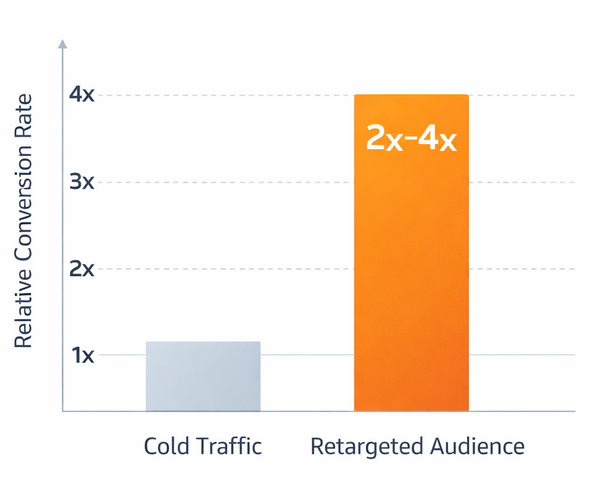
Retargeted audiences convert 2× to 4× more often than cold traffic, highlighting the power of reinvesting ad spend toward users who’ve already shown interest
| Factor | Short Windows | Long Windows |
|---|---|---|
| User intent | Very high | Moderate to low |
| Conversion speed | Fast | Slow |
| Cost per acquisition | Lower | Higher |
| Audience size | Small | Large |
| Best for | Direct response | Demand nurturing |
Rather than choosing one approach exclusively, high-performing accounts typically layer multiple windows to capture intent at different stages.
Recommended Hybrid Strategy
A balanced retargeting structure often includes:
-
1–7 days: High-intent offer-focused ads
-
8–30 days: Social proof and benefit-driven messaging
-
31–90 days: Educational content and brand reinforcement
This sequencing allows advertisers to maximize efficiency early while still extracting value from longer consideration cycles without overspending on low-intent users.
Advertisers using segmented retargeting windows report up to 25% higher return on ad spend compared to single-window setups, primarily due to better message alignment and frequency control.
Common Mistakes to Avoid
-
Using one retargeting window for all campaigns
-
Running the same creative across short and long windows
-
Applying aggressive offers to low-intent, long-window audiences
-
Ignoring frequency and audience saturation
Retargeting efficiency declines rapidly when timing and messaging are misaligned.
Measuring Retargeting Window Performance
To evaluate window effectiveness, track metrics separately for each audience duration:
-
Cost per acquisition
-
Conversion rate
-
Frequency
-
Time to conversion
Comparing these metrics across windows reveals where budgets should be concentrated and where messaging adjustments are required.
Related Articles
-
How to Structure Ad Accounts for Scale
-
What Every Marketer Should Know About Lookalike Audiences
-
Smarter Targeting, Bigger Impact: How Data-Driven Audiences Improve ROI
Conclusion
Retargeting windows are not a one-size-fits-all decision. Short cycles deliver efficiency and speed, while long cycles provide scale and future demand. The strongest performance comes from combining both—using timing, intent, and messaging to guide users naturally toward conversion.