Meta Business Suite gives you full control over when and how your content goes live. You can save posts as drafts, schedule them for specific times, and reschedule them if plans change.
Most teams treat these as workflow features. In practice, they directly shape how Meta evaluates your content — and how your ads perform later.
Why content timing is part of your targeting system
Every post you publish generates engagement signals. Those signals influence how Meta distributes content and how similar users are treated in paid campaigns.
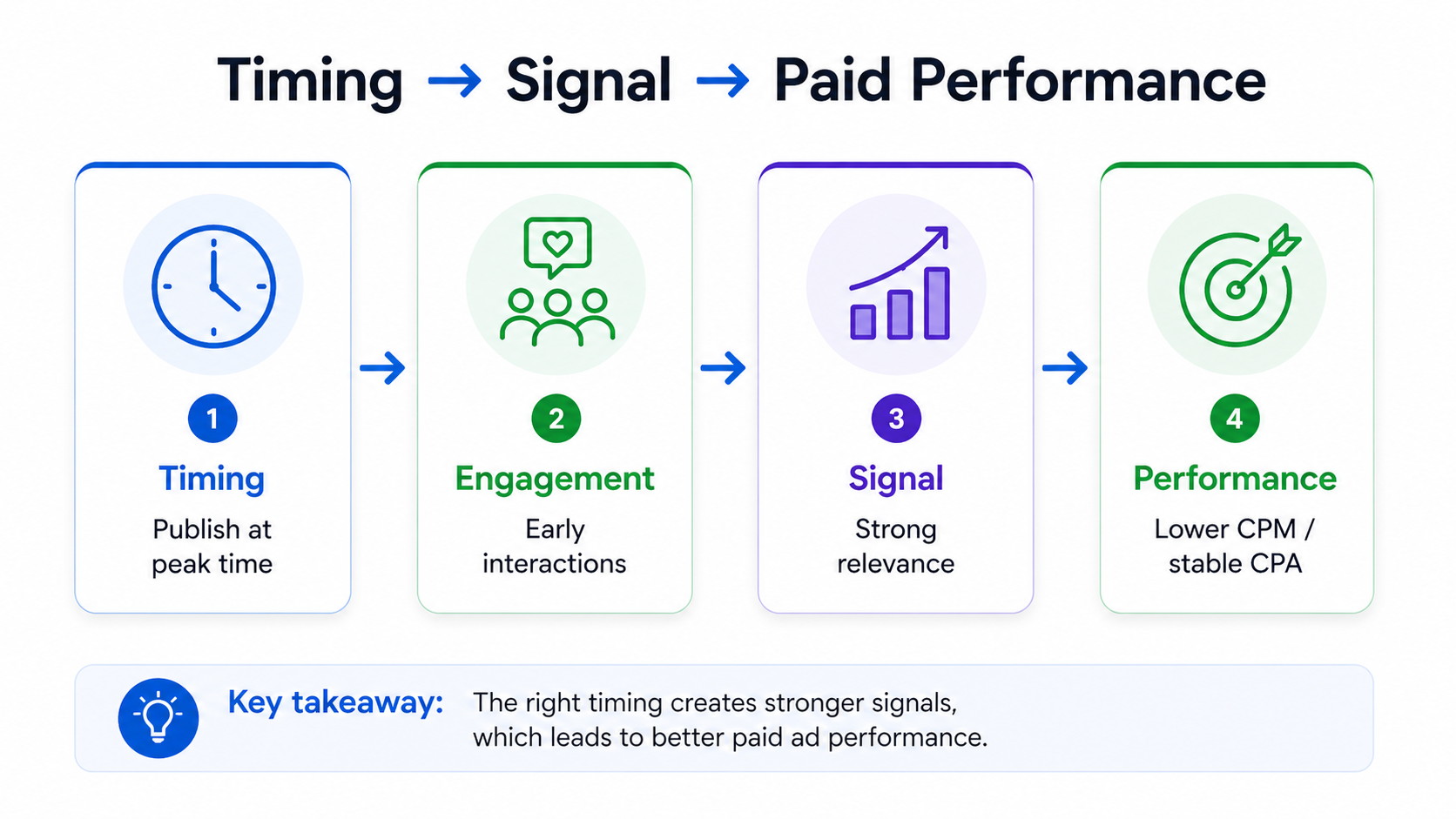
If your timing is inconsistent, those signals become unreliable. That’s when you start seeing unstable CPM, uneven CTR, and unpredictable CPA during scaling.
A structured posting system does the opposite. It creates repeatable patterns that Meta can learn from, which leads to more stable delivery over time.
Saving drafts improves content quality before it affects performance
Saving a post as a draft happens before any signals are generated. You create the post in Meta Business Suite, click “Finish later,” and store it under drafts until it’s ready.
This stage is where stronger advertisers separate themselves. Instead of publishing immediately, they refine the message, adjust the hook, and align the creative with campaign goals.
Teams that actively use drafts tend to produce better-performing content because they reduce avoidable mistakes before the post goes live. This typically results in:
- Clearer hooks that stop users from scrolling and improve early engagement.
- Better alignment between message and audience intent, which increases conversion potential later.
- More structured testing setups, where different angles are prepared in advance instead of improvised.
In Ads Manager, this shows up as more stable CTR and fewer creatives that fail during testing.
Scheduling builds consistent engagement signals over time
Scheduling allows you to control when your post enters the feed. You choose a specific date and time, or use Meta’s “Active times” suggestion based on audience behavior.
Consistency is what matters here. When you publish at similar times, Meta starts to recognize patterns in how your audience interacts with content.
That predictability makes performance easier to manage. You can compare posts more accurately and identify what actually drives engagement.
For example, a brand that consistently posts at 6 PM may notice that engagement peaks within the first hour. When they test a new creative at the same time, they can isolate whether performance changes come from the content itself — not from timing differences.
This is why structured teams often plan a Facebook ads calendar.
How scheduling timing affects paid campaign performance
The timing of your post determines how quickly it collects engagement signals. Those early signals influence how the content performs when promoted.
Posts published during strong activity windows tend to gain traction faster. That momentum carries into paid campaigns, where the system already sees the content as relevant.
In practice, this leads to:
- Lower CPM when boosting posts that already show strong engagement velocity.
- Faster learning phase stabilization, because the system has more initial data.
- More reliable performance when scaling the same creative into ads.
On the other hand, poorly timed posts often require more budget to achieve similar results. The system has less confidence in the content, so it delivers more cautiously.
Rescheduling breaks consistency and distorts performance data
Rescheduling allows you to change the publish time of an already scheduled post. You can do this from the Scheduled tab or Planner by selecting the post and choosing a new time.
While useful, this action disrupts the system you’ve built through consistent scheduling.
When timing changes frequently, you introduce variability that makes performance harder to interpret. The same post may perform differently simply because it entered the feed under different conditions.
This leads to several issues:
- Engagement patterns become inconsistent, making it difficult to establish benchmarks.
- Content testing loses accuracy, because timing variables are mixed into the results.
- Retargeting audiences become uneven in quality, depending on when users engaged.
For example, if two similar posts are published at different times due to rescheduling, one may appear to outperform the other. In reality, the difference may come from audience availability, not creative quality.
Cross-platform scheduling requires content adaptation
Meta Business Suite allows scheduling for both Facebook and Instagram, but the platforms behave differently. Users interact with content in distinct ways depending on the format and context.
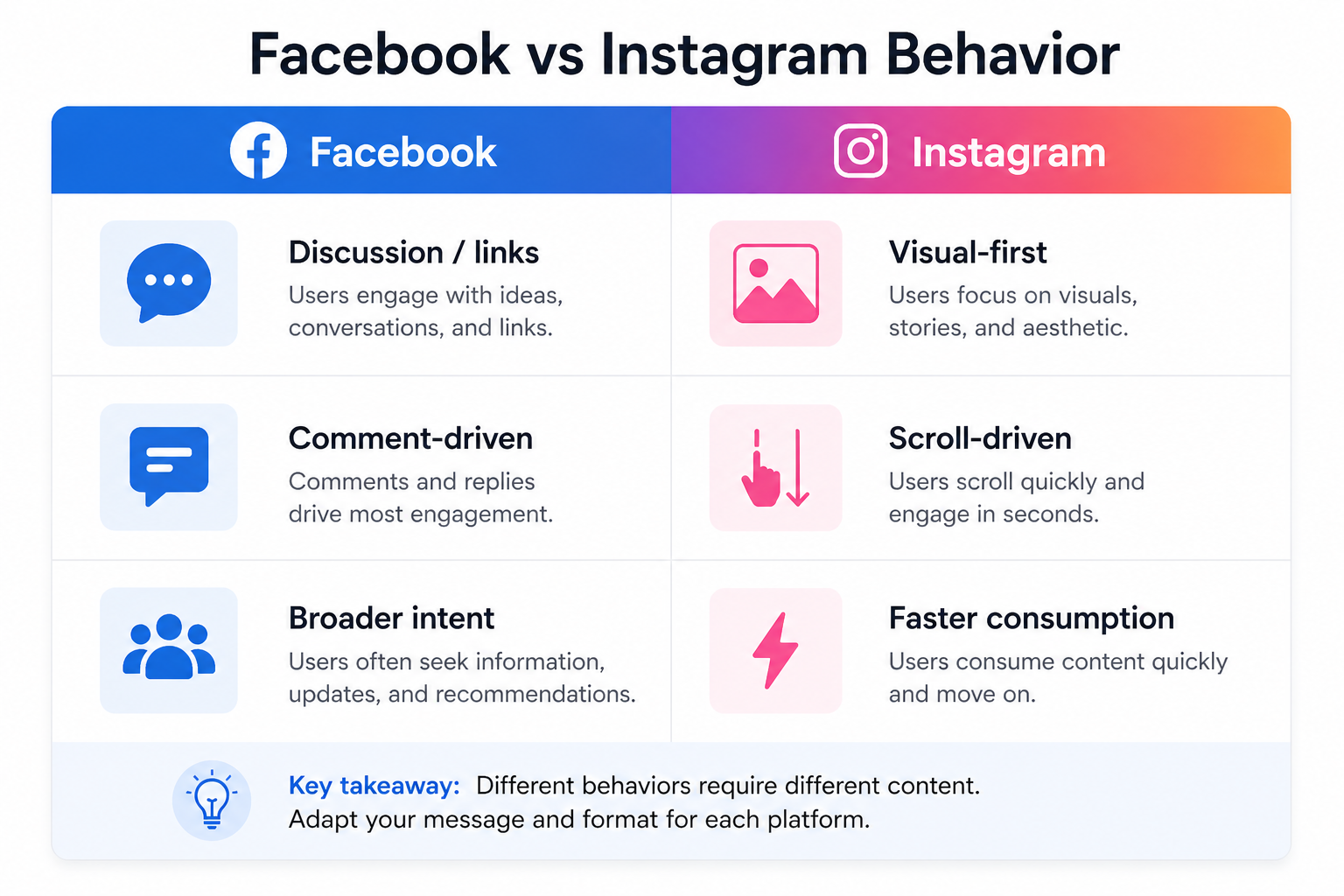
Facebook tends to reward posts that encourage discussion or link-based interaction. Instagram prioritizes visual clarity and native content formats.
If you schedule identical content across both platforms without adjustment, performance often splits. One platform may show strong engagement while the other underperforms.
This creates confusion when analyzing results and deciding what to scale.
To avoid this, it helps to review what to post on Facebook vs Instagram.
Why scheduling decisions affect audience quality
The timing of your posts influences who engages with them. That engagement determines the quality of audiences you later use in campaigns.
If your posts attract broad, low-intent engagement, your retargeting pools become weaker. When those audiences are used in ads, performance declines.
You’ll typically see patterns like:
- Low CPC but poor conversion rates, because the audience lacks intent.
- High lead volume with low qualification quality.
- Rising CPA when scaling campaigns.
This is why
organic and paid social need to work together.
Organic signals are not separate from paid performance — they feed directly into it.
Practical takeaway
Saving, scheduling, and rescheduling are not just operational tools. They shape how Meta collects and interprets engagement signals.
Use drafts to improve content before publishing. Use scheduling to build consistent patterns. Use rescheduling sparingly and only when timing clearly needs adjustment.
When timing and content are aligned, your data becomes cleaner — and your paid campaigns become easier to scale.