Boosting a Facebook post looks simple — pick a post, set a budget, publish. The platform even pre-fills creative and recommends audiences.
What’s less obvious is how that simplicity affects cost structure, delivery behavior, and ultimately your CPA.
Starting February 2024, there’s also a direct financial impact many advertisers overlook. If you boost posts through the Facebook iOS app, Apple may charge a 30% service fee on your total ad spend. That fee is retained by Apple, not Meta.
That means a campaign targeting a $20 CPA suddenly needs to absorb a hidden cost layer before optimization even starts.
Why boosted posts feel efficient but distort real performance
A boosted post inherits its creative from an organic post. That gives it an immediate advantage — existing engagement.
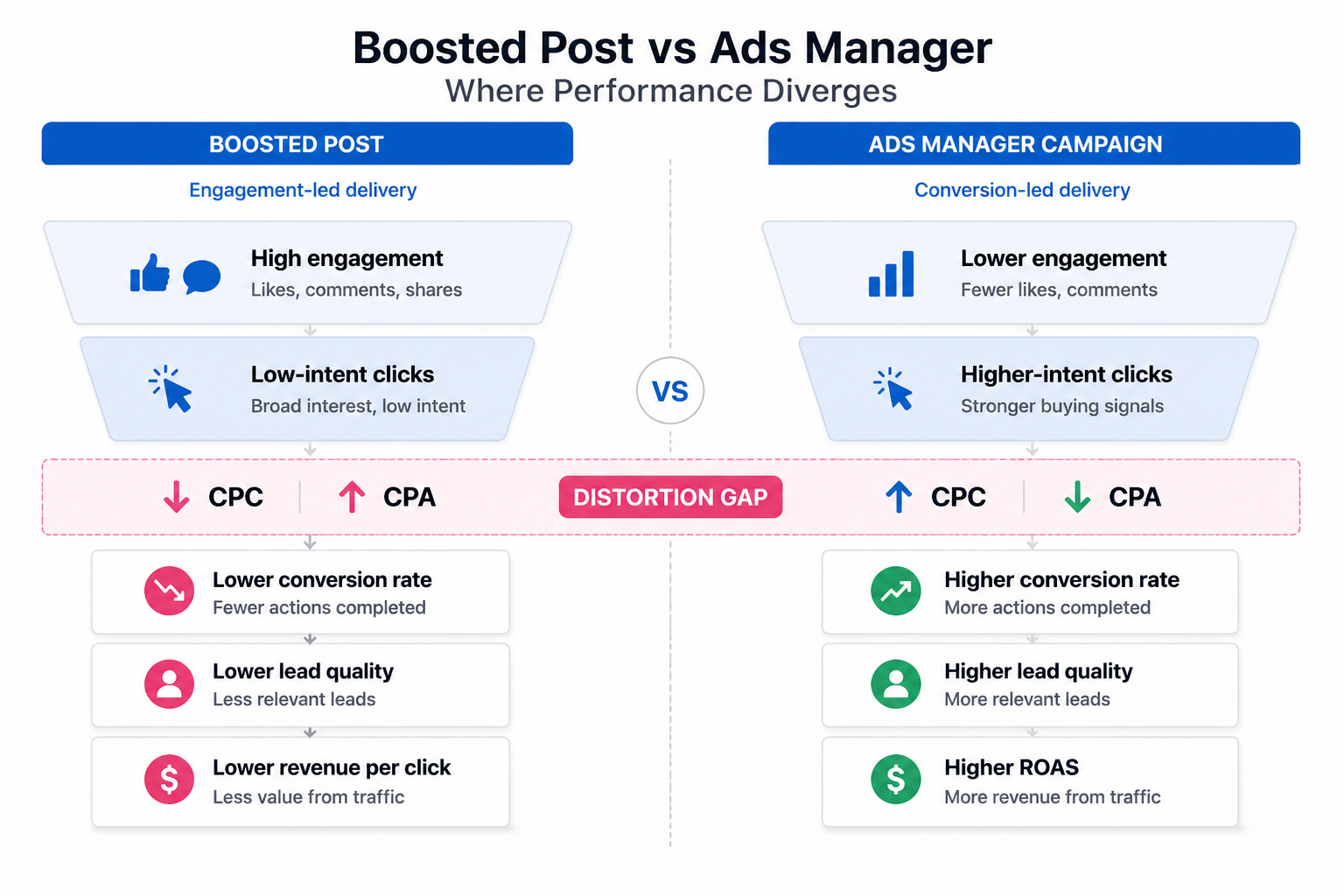
In Ads Centre, you’ll often see:
- Lower CPC compared to cold ads.
- Strong engagement rates.
- Stable CPM early in delivery.
But once traffic hits your funnel, the signal quality becomes clearer.
Users who like or comment on posts are not always users who convert. Meta’s delivery system will prioritize the behavior tied to your selected goal, but boosted posts often start from engagement-heavy signals.
You end up with traffic that looks efficient on-platform but underperforms in:
- Lead qualification rate.
- Conversion rate.
- Revenue per click.
That’s why many advertisers hit the same issue — strong top-of-funnel metrics, weak bottom-of-funnel results.
For a deeper breakdown, see when boosting Facebook posts becomes too limited.
The Apple fee changes your real CPA math
If you boost from iOS, the Apple service fee directly inflates acquisition costs.
Here’s what happens in practice:
- You set a $1,000 campaign budget.
- Apple takes 30% before delivery.
- Only ~$700 actually enters the auction.
Your Ads Manager metrics won’t clearly show this difference. You’ll see performance based on delivered spend, not total paid spend.
That creates a hidden distortion:
- Reported CPA may look acceptable.
- True CPA (including Apple fee) is significantly higher.
For performance teams, this matters immediately. A campaign that breaks even at $50 CPA becomes unprofitable if real cost climbs toward $65.
The fix is operational, not strategic — avoid boosting from iOS when performance matters.
How Meta’s automated boost settings influence delivery
When you boost a post, Meta simplifies campaign setup by bundling several decisions into automated defaults.
These include:
- Advantage+ creative automatically generating variations to improve engagement patterns, which can shift delivery toward visual interactions rather than conversions.
- Goal selection automation, where Meta may prioritize engagement or traffic if conversion signals are weak or missing.
- Advantage+ audience recommendations, expanding targeting beyond precise intent signals.
- Placement automation, distributing spend across Feed, Stories, and other surfaces without strict performance filtering.
These systems work best when Meta has strong conversion data. Without it, delivery tends to optimize for cheaper actions.
You can see this inside Ads Manager when:
- Spend shifts toward placements with low CPC but low conversion rate.
- Engagement increases while conversion events stagnate.
- Learning phase stabilizes without meaningful revenue growth.
If your objective is revenue, not reach, you need tighter control.
Boosting limits your ability to control campaign structure
Boosted posts run through Ads Centre, not a full Ads Manager build. That reduces friction — but also removes critical levers.
You lose granular control over:
- Conversion event prioritization.
- Funnel segmentation (cold vs warm vs retargeting).
- Detailed exclusions and audience layering.
- Structured A/B testing.
This creates a structural issue during scaling.
If a boosted post starts performing, you cannot easily isolate why. Was it the audience, the placement, the creative, or the goal? Without that clarity, scaling becomes guesswork.
That’s why serious acquisition campaigns should always start with structured setup. You can launch Facebook ads with a clear campaign goal instead of relying on boosted post defaults.
When boosting a Facebook post actually works
Boosting is not inherently inefficient. It works when the goal matches the format.
Strong use cases include:
- Promoting time-sensitive offers where speed matters more than optimization.
- Amplifying posts with clear commercial intent already visible in comments or shares.
- Driving local awareness where conversions happen offline.
- Testing whether organic content resonates beyond your existing audience.
A restaurant promoting a weekend event or a local service business announcing availability can benefit from this approach.
In these cases, engagement itself has business value.
The targeting problem most boosted posts run into
Boosted posts often rely on broad or lightly defined audiences.
That creates a familiar pattern:
- Reach expands quickly.
- Engagement stays high.
- Lead quality declines.
Meta optimizes toward the cheapest action available within your selected goal. If your audience includes low-intent users, the system will find them first.
This is where audience quality becomes more important than audience size.
LeadEnforce addresses this by building audiences from:
- Facebook groups.
- Instagram followers and engagers.
- Social profile signals.
Instead of letting Meta explore broadly, you give it a high-intent starting pool. That improves signal quality and reduces wasted spend.
For B2B or niche offers, this often matters more than creative.
How to evaluate a boosted post like a performance marketer
Do not stop at platform metrics.
A boosted post should be judged across the funnel:
- CPC — Are clicks cheap or just low-quality?
- Landing page views — Are users actually loading the page?
- Conversion rate — Are they taking meaningful action?
- Lead quality — Are they sales-qualified?
- ROAS — Does revenue justify spend?
Watch for this specific pattern:
Low CPC + low conversion rate = inefficient traffic
If that appears, the campaign is optimizing for attention, not intent.
That’s where low CPC does not always mean better conversions becomes critical to understand.
Final takeaway
Boosting a Facebook Page post is designed for accessibility, not precision.
It’s useful when speed, visibility, and engagement matter. It becomes expensive when you expect it to deliver predictable CPA or scalable ROAS.
Three rules keep it effective:
- Avoid boosting through iOS to prevent hidden 30% cost inflation.
- Only boost posts that already show buying intent, not just engagement.
- Move to Ads Manager when performance — not reach — is the objective.
Boosting is a distribution tool. It is not a replacement for campaign strategy.