Some Facebook video ads fail even when the product, targeting, and offer are strong. CTR stays weak, watch time collapses early, and CPA rises without an obvious explanation. Most advertisers blame the audience or the algorithm first. In reality, the creative itself often lacks visual momentum.
This problem appears constantly in Meta Ads accounts. The video technically contains movement, but nothing inside the ad feels active enough to hold attention. Users process the creative as background content instead of something worth watching.
The Problem: Your Video Ads Don’t Create Enough Visual Momentum
Many Facebook video ads feel slow because the movement inside them does not create progression. The visuals change, but the viewer never feels pulled forward through the ad.
This usually happens when advertisers rely too heavily on:
- talking-head clips;
- static product footage;
- repetitive framing;
- long uninterrupted scenes.
The result is predictable. Users scroll before the offer fully develops. Meta receives weaker engagement signals from the ad, which eventually hurts delivery efficiency and raises acquisition costs.
This becomes even more visible during scaling because weak creative energy compounds faster at higher spend levels.
Why Flat Video Ads Hurt CTR and CPA
Facebook and Instagram feeds reward fast attention shifts. Users constantly move between Reels, Stories, creator content, and short-form videos with aggressive pacing.
A flat ad breaks that rhythm.
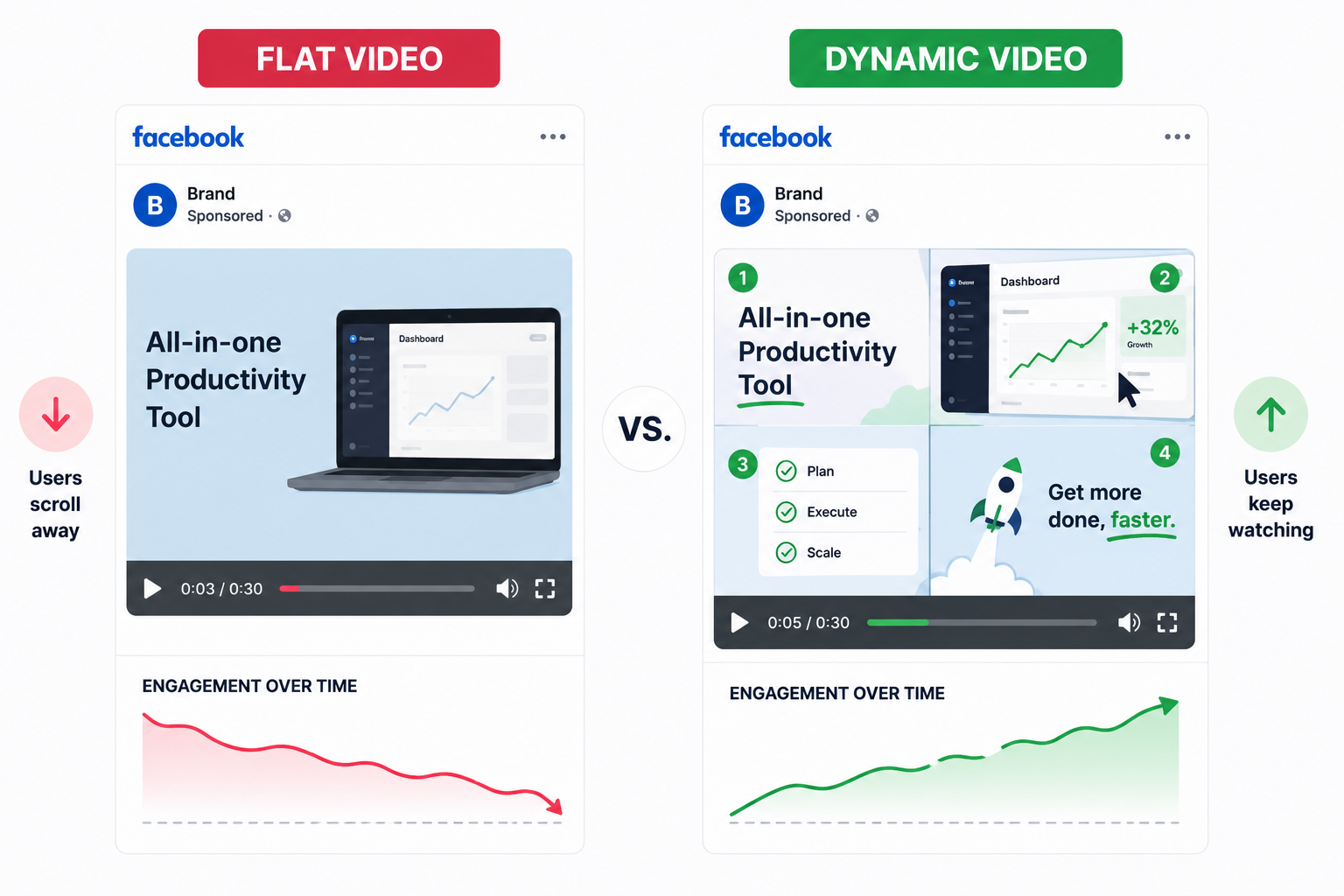
When users lose interest early, Meta sees:
- lower hold rates;
- weaker watch time;
- poor engagement quality;
- lower click intent.
Those signals affect delivery quality quickly. Over time, CPM rises because the platform sees weaker audience response. That eventually pushes CPA higher, even if the offer itself remains strong.
This is why advertisers spend so much time designing Facebook ads for fast-scrolling users. Attention loss happens faster than most brands realize.
Good Offers Still Need Strong Visual Direction
A strong offer does not automatically create strong creative. Many advertisers assume the product alone will carry the ad, especially in B2B or high-ticket campaigns.
Usually, it does not.
Video ads perform better when the creative continuously guides viewer attention. Without visual direction, the audience stops processing information after the first few seconds.
This problem usually appears when:
- the focal point never changes;
- scenes visually blend together;
- text placement lacks hierarchy;
- movement feels random instead of intentional.
Strong Facebook video ads constantly tell the eye where to look next. That is why understanding what people notice first in Facebook ads matters so much for video performance.
Why Some Videos Feel Slow Even When They Are Short
Many advertisers confuse short runtime with fast pacing.
A 15-second video can still feel painfully slow if the creative delays information too long. Users decide extremely quickly whether an ad deserves more attention.
Flat pacing usually comes from:
- delayed scene transitions;
- weak contrast between shots;
- motion without progression;
- slow information delivery.
This is one reason simple UGC-style ads often outperform polished brand commercials. The pacing feels immediate. Users understand the message faster because the ad moves with the feed instead of against it.
How to Fix Flat Facebook Video Ads
Most flat video ads do not require expensive re-shoots. The problem is usually structural, not production-related.
Small changes often improve performance significantly:
- shorten scenes more aggressively;
- introduce movement earlier;
- shift framing more frequently;
- add visual contrast between sections.
The goal is not constant chaos. The goal is continuous progression.
For example, LeadEnforce campaigns often perform better when targeting workflows, segmentation logic, or audience-building processes are shown dynamically instead of explained through static narration alone. Motion makes the system feel active and easier to understand.
Why Motion Graphics Often Improve Weak Creative
Many advertisers underestimate how much lightweight motion improves perceived energy.
Simple adjustments like animated headlines, zoom effects, cursor movement, and interface transitions can dramatically improve attention retention. They create visual rhythm without requiring large production budgets.
That is why many advertisers improve results by using motion graphics to improve Facebook ad engagement.
The purpose of motion graphics is not decoration. It is attention control.
Final Takeaway
Flat Facebook video ads usually fail because the creative does not maintain enough visual momentum to compete inside modern feeds.
Users scroll before the message develops fully. Engagement signals weaken. CPA rises even when the offer itself is strong.
The fix is usually not better cameras or bigger production budgets. It is:
- stronger pacing;
- clearer visual hierarchy;
- faster progression;
- more intentional movement.
The best Facebook video ads do not simply contain motion. They use motion to keep attention moving forward.