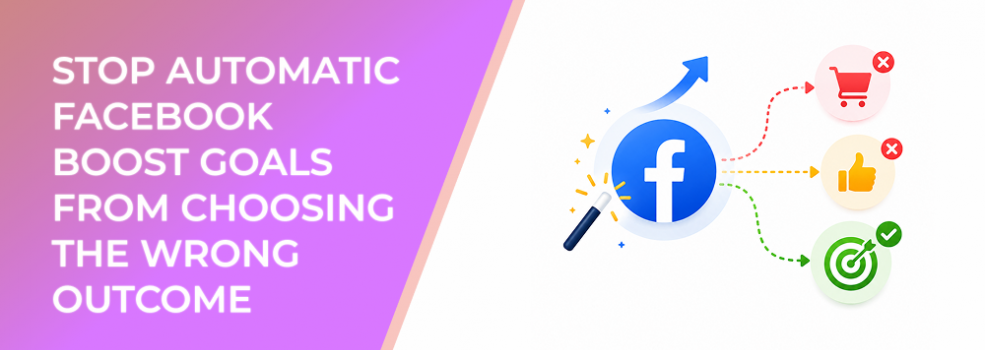
Automatic suggestions can make Facebook boosted posts feel easier. The platform helps you move quickly from a Page post to a paid promotion by guiding the setup flow and asking you to choose a goal that fits the ad type.
That convenience can be useful.
It can also create a performance problem.
When marketers let automatic boost goals define the campaign, they may end up optimizing for the easiest available action instead of the outcome the business needs. For agencies, SMBs, growth teams, and lead-generation marketers, that can mean more activity with less commercial value.
The Problem
The problem is allowing automatic or recommended boost goals to steer the campaign toward the wrong outcome.
An automatic goal may appear logical because it is based on the post, the Page, or the simplified setup flow. But the platform does not know your full business context. It does not know whether your sales team needs qualified leads, whether your ecommerce margin can support low-intent clicks, or whether your client expects pipeline instead of engagement.
If you accept the automatic goal without checking it, the campaign may optimize for a result that is easy to produce but hard to monetize.
That is how a boost can generate cheap clicks, reactions, or messages while still failing to improve CPA, CAC, ROAS, lead quality, or conversion rate.
Why This Problem Hurts Performance
Automatic goal selection hurts performance because optimization follows the selected outcome.
Meta describes performance goals as a way of telling the ad delivery system which result to get as efficiently as possible. That means the selected goal is not cosmetic. It is a delivery instruction.
If the automatic goal is engagement, the campaign may find engagement-prone users.
If it is traffic, the campaign may find click-prone users.
If it is messages, the campaign may find people likely to start conversations.
Those actions may be useful, but only when they match the business objective.
When they do not, campaign reporting becomes misleading. The dashboard may show progress, but downstream metrics show the truth: low conversion rate, poor sales qualification, unstable CPA, or weak ROAS.
Common Scenarios Where This Happens
A business owner boosts a post and accepts the suggested goal because the setup looks straightforward. The campaign gets reactions, but no new bookings.
A startup wants signups but allows a traffic-style boost goal because website visits seem like a reasonable first step. The campaign drives visitors, but few complete the form.
An agency wants to move quickly and accepts the automatic recommendation to launch a client campaign. The client later asks why the boost produced engagement but not lead volume.
A B2B marketer promotes an educational post and lets the interface optimize toward social interaction. The comments are thoughtful, but they come from peers and existing followers, not buyers.
The pattern is the same: the automatic goal was convenient, but it did not match the business outcome.
Why the Problem Happens
This happens because automatic suggestions reduce friction.
For many advertisers, that is helpful. A simplified workflow lowers the barrier to launching. But performance marketing requires more than launching. It requires controlling what the campaign is designed to learn.
Another cause is unclear ownership. One person creates the post, another approves spend, and another reports results. If no one defines the outcome before setup, the automatic goal fills the gap.
A third cause is overtrust in platform convenience. Advertisers assume suggested settings are equivalent to strategic recommendations. They are not. They may be useful defaults, but they still need human review.
The Solution
Stop treating automatic boost goals as decisions. Treat them as suggestions.
Before launching, run the automatic goal through a simple outcome check.
First, define the intended result. Is the campaign supposed to create awareness, engagement, traffic, messages, leads, bookings, purchases, or qualified sales conversations?
Second, define the KPI. Reach, engagement rate, CTR, cost per message, CPL, CPA, conversion rate, CAC, and ROAS all tell different stories.
Third, compare the automatic goal to the intended KPI. If the goal does not directly support the KPI, do not accept it.
Fourth, check whether the post can realistically support that outcome. A post designed for discussion may not be ready for lead generation. A product post without value, urgency, or CTA may not be ready for sales.
Fifth, decide whether the boosted-post workflow is enough. If the campaign requires conversion optimization, structured testing, audience exclusions, funnel segmentation, or deeper reporting, a full Ads Manager campaign may be the safer choice.
Risks and Considerations
Rejecting automatic goals can improve control, but it does not remove every performance risk.
A manually selected goal can still underperform if the audience is weak, the post is unclear, the offer is not compelling, or the landing page does not match the promise. Goal control is only one part of campaign quality.
Also, some automatic suggestions may be reasonable for simple campaigns. If your real objective is visibility or light engagement, a suggested engagement-style goal may fit. The point is not to reject automation blindly. The point is to verify it before spend begins.
Prerequisites and Dependencies
To override automatic goal logic effectively, you need clear campaign intent, funnel-stage clarity, a defined KPI, and agreement on how success will be judged.
You also need enough discipline to separate platform metrics from business metrics. Cheap clicks are not automatically efficient traffic. More comments are not automatically demand. More messages are not automatically qualified pipeline.
The team should know what happens after the interaction. If someone clicks, where do they go? If someone messages, who responds? If someone submits a form, how is quality evaluated?
Practical Recommendations
Create a pre-launch rule: no automatic boost goal is accepted without a business-outcome check.
Use this question before every boost:
“What will this goal cause Meta to look for, and is that the behavior we actually want?”
If the answer is unclear, pause.
For awareness, optimize for visibility and judge the campaign by reach quality and response.
For engagement, optimize for meaningful interaction and judge comment quality, shares, saves, or relevant reactions.
For traffic, judge post-click behavior, not only CPC.
For leads or sales, avoid shallow goal selection and consider a more structured campaign if the boost workflow does not provide enough control.
Final Takeaway
Automatic boost goals are convenient, but convenience is not strategy.
A Facebook boosted post should not be launched just because the platform suggests a goal. Define the business outcome first, then choose the goal that supports it. When marketers control the optimization instruction, they reduce the risk of paying for activity that does not move the business forward.
Related LeadEnforce Articles
- Choosing the Right Facebook Ad Objective: What Most Advertisers Get Wrong — Explains why advertisers should control the objective instead of letting the platform choose.
- Should You Boost a Facebook Page Post? Performance Pros, Risks, and Better Uses — Covers boosted-post limits and automation risks.
- How to Start a Facebook Ad From Your Page Without Skipping Key Settings — Helps advertisers check key settings before launch.