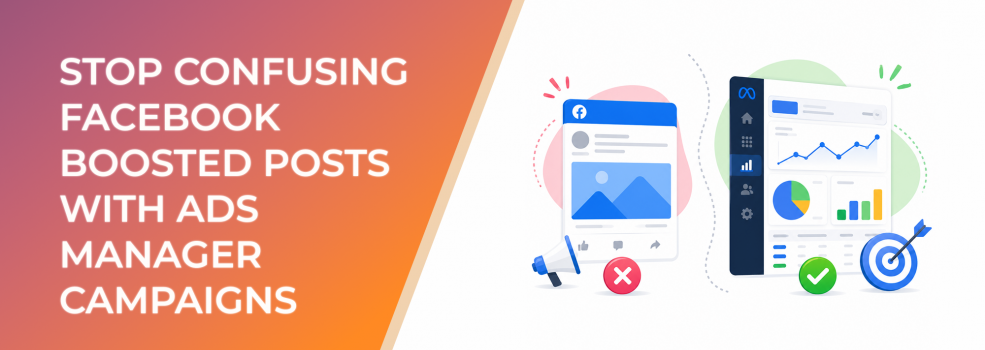
Many Facebook advertisers use “boosted post” and “ad campaign” as if they mean the same thing.
That confusion causes real performance problems.
A boosted post is a fast way to put budget behind existing content. An Ads Manager campaign is a more structured way to build, test, optimize, and measure ads against a defined outcome. Both can appear as ads. Both can spend budget. Both can reach people across Meta placements. But they are not the same strategic tool.
Meta’s indexed source lesson is about creating ads from a Facebook Page, and Meta Help snippets clarify that a boosted post is still considered an ad while ads created through Ads Manager and Business Suite offer more advanced customization.
If marketers do not separate these concepts, they often judge the wrong format by the wrong metrics.
The Problem
The problem is treating a boosted post like a full Ads Manager campaign.
That usually shows up in three ways.
First, the advertiser expects conversion-campaign results from an engagement-oriented boost.
Second, the advertiser reports reach, reactions, or low CPC as if those numbers prove CPA, ROAS, or lead quality.
Third, the advertiser tries to scale a boosted post without enough control over the variables that matter: audience, objective, creative, placements, exclusions, budget allocation, and conversion signals.
This creates a mismatch between setup and expectation.
A boosted post can be useful. But when it is confused with a full campaign, it gets blamed for not doing a job it was never structured to do.
Why This Problem Hurts Performance
Confusion between boosted posts and Ads Manager campaigns hurts performance because it creates bad decisions at every stage.
Budget is allocated to the wrong format. Campaigns are judged by the wrong KPIs. Creative is promoted without a clear test. Audiences are expanded without enough qualification. Clients receive reports that show activity but not business impact.
This can make a campaign look successful while the underlying economics are weak.
For example, a boosted post may generate comments and reactions at a low cost. That can be useful for visibility. But if the campaign goal is qualified leads, the advertiser should be looking at lead quality, booked calls, conversion rate, CPL, CPA, CAC, and pipeline impact.
When the reporting metric does not match the business goal, the advertiser learns the wrong lesson.
The result is wasted budget, slower optimization, and campaign decisions based on surface activity instead of performance signal.
Common Scenarios Where This Happens
A small business owner boosts a popular post and assumes they have launched a full Facebook ad campaign.
An agency boosts client content to show quick wins, then struggles when the client asks why revenue did not improve.
A startup promotes a founder update because it has strong engagement, but there is no conversion path, landing page, or retargeting plan.
A B2B marketer boosts an educational post and expects demo requests from people who were only engaging with the topic.
An ecommerce team boosts a product image and expects the same optimization behavior they would get from a sales campaign built in Ads Manager.
In each case, the advertiser is not necessarily using the wrong tool. They are using the tool with the wrong expectation.
Why the Problem Happens
The confusion happens because boosted posts look like ads.
They use budget. They can reach people beyond existing followers. They can appear in paid placements. They can generate measurable results. That makes them feel like full campaigns.
But a boosted post usually starts with existing content and a simplified setup flow. An Ads Manager campaign starts with a more complete campaign structure.
Ads Manager campaigns allow advertisers to think in layers: objective, ad set, audience, placement, budget, optimization, creative, and measurement. Meta also documents objective selection as an Ads Manager decision that should align with the business goal.
The problem is not that one format is “real advertising” and the other is not. The problem is that they serve different levels of strategic control.
A boost is closer to paid distribution.
An Ads Manager campaign is closer to a performance system.
The Solution
The solution is to use separate definitions before spending.
A Facebook boosted post is an existing post with paid budget behind it. It is best understood as a simple distribution format. It is useful when the goal is reach, engagement, visibility, social proof, local awareness, or quick content amplification.
An Ads Manager campaign is a structured advertising build. It is best understood as an optimization format. It is useful when the goal is lead generation, sales, purchases, retargeting, audience testing, creative testing, conversion optimization, or scalable performance.
Use this rule:
If the main question is “How do we get this post seen by more people?” a boosted post may fit.
If the main question is “How do we generate a measurable business result efficiently?” use Ads Manager.
This distinction also changes the KPIs.
For boosted posts, useful metrics may include reach, engagement rate, shares, comments, profile visits, and directional traffic.
For Ads Manager campaigns, useful metrics may include CPA, CAC, ROAS, qualified lead rate, conversion rate, purchase rate, pipeline contribution, and post-click behavior.
Once the format and KPI are aligned, the campaign becomes easier to evaluate.
Risks and Considerations
Do not dismiss boosted posts completely.
They can be useful when speed and visibility matter. A local event announcement, content launch, community post, or strong organic post may not need the complexity of a full campaign.
But do not use boosted posts as a replacement for structured acquisition.
If the campaign needs qualified leads, revenue, predictable CPA, or scalable ROAS, boosted-post simplicity becomes a limitation.
Also avoid overcorrecting. Some marketers move every campaign into Ads Manager and create unnecessary complexity. If the objective is simple, complexity may not improve performance.
The goal is not to always choose the more advanced tool. The goal is to choose the tool that matches the business outcome.
Prerequisites and Dependencies
To stop confusing boosted posts with Ads Manager campaigns, your team needs shared definitions.
Everyone involved should know the difference between visibility, engagement, traffic, leads, and sales. They should also know which metrics prove each outcome.
You also need a clear campaign brief before launch. That brief should define the objective, target audience, budget, creative asset, expected result, and primary KPI.
For full campaigns, you need a stronger setup: audience structure, offer clarity, conversion path, creative variations, measurement plan, and enough budget to generate useful signal.
Without those prerequisites, even the right format can produce confusing results.
Practical Recommendations
Create a simple internal decision rule.
Use boosted posts for content distribution.
Use Ads Manager campaigns for performance optimization.
Before every campaign, ask what the budget is supposed to prove. If the answer is “more people should see this post,” a boost may be enough. If the answer is “we need qualified leads, purchases, or measurable pipeline,” build a full campaign.
Separate reporting dashboards by format. Do not compare boosted-post engagement metrics directly with conversion-campaign economics.
Educate clients and stakeholders before launch. Explain that a boosted post is not a shortcut to a full acquisition system.
Most importantly, stop using “ad” as a generic label. Name the format clearly: boosted post, Page-created ad, or Ads Manager campaign. Clear language leads to clearer decisions.
Final Takeaway
Boosted posts and Ads Manager campaigns both have value, but they should not be treated as interchangeable.
A boosted post is useful for fast distribution. An Ads Manager campaign is better for structured optimization. Once marketers understand that difference, they can set better expectations, choose better KPIs, and stop wasting budget on campaigns built for the wrong job.
Related LeadEnforce Articles
- Boosted Posts vs Meta Ads: What Actually Drives Better CPA and ROAS — Breaks down the control difference between boosted posts and full Meta ads.
- Use Boosted Posts for Visibility Without Confusing Them With Conversion Campaigns — Explains why visibility tools should not be judged like conversion campaigns.
- Why Facebook Boosted Posts Often Waste Budget Without Clear Campaign Goals — Shows how vague goals cause boosted posts to optimize toward weak business outcomes.
- When a Facebook Boosted Post Fits Your Campaign Goal — and When It Does Not — Helps marketers decide when a boosted post is appropriate and when it is not.