The wrong Facebook ad format often gets chosen because marketers ask the wrong question.
They ask, “Should we boost this post or run an ad?”
The better question is, “What campaign goal are we trying to achieve?”
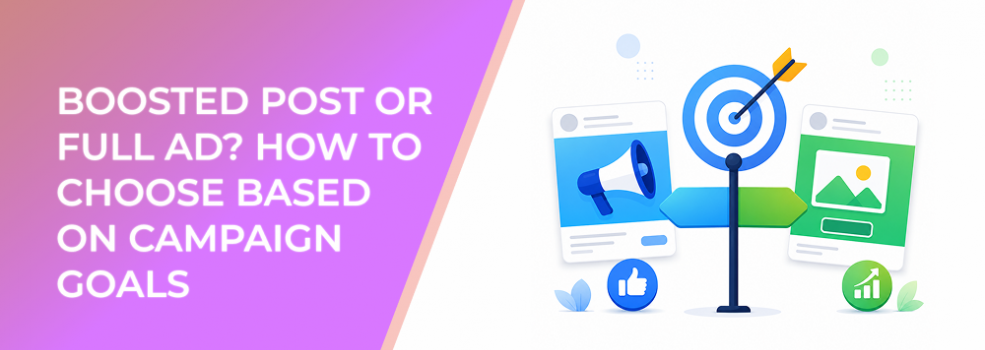
A boosted post can work well when the goal is simple visibility or engagement. A full Meta campaign is usually the better choice when the goal is qualified leads, sales, conversions, structured testing, or scalable performance.
Meta’s own documentation points advertisers toward choosing campaign objectives that align with business goals, which is the core idea behind this decision.
Format choice should come after goal clarity, not before it.
The Problem
The problem is choosing between a boosted post and a full ad based on convenience, habit, or platform prompts instead of campaign goals.
A post performs well organically, so someone boosts it. A manager asks for leads, so the team assumes any paid promotion can support the request. An agency wants to move quickly, so it uses the simplest launch path. A business owner wants sales, but starts with a content boost because the button is available.
That approach skips the most important step: defining the desired outcome.
A boosted post and a full campaign may both spend money, but they are not equally suited to every goal.
If the goal is attention, a boosted post may work.
If the goal is acquisition, a full campaign usually gives the advertiser more control.
Why This Problem Hurts Performance
Goal mismatch damages performance because Meta optimizes based on the instructions and signals the advertiser provides.
If you set up a campaign for engagement, the platform looks for people likely to engage. That does not necessarily mean those users will buy, book, subscribe, or request a demo.
If you set up a traffic-oriented promotion, you may get clicks. That does not necessarily mean the traffic will convert.
If you build a full campaign with a lead or sales objective but the offer, audience, or landing page is weak, the campaign may still struggle.
The goal affects the objective, audience, creative, CTA, landing page, measurement plan, and optimization path. When the format does not match the goal, marketers end up with low-value activity, weak conversion rates, unstable CPA, poor lead quality, and unclear ROAS.
The cost is not only wasted spend. It is wasted learning.
Common Scenarios Where This Happens
A local business wants more event visibility and overcomplicates the setup when a simple boosted post could have reached the right community quickly.
A B2B SaaS company wants demo requests but boosts an educational post that was designed for discussion rather than lead capture.
An ecommerce brand wants purchases but boosts a lifestyle post without a strong product CTA or conversion-focused campaign structure.
An agency wants to test a new offer but uses a boosted post, then cannot tell whether the audience, creative, or offer caused the result.
A startup wants fast traction and runs a full campaign before clarifying whether the first goal is awareness, traffic, waitlist signups, or paid acquisition.
In each case, the campaign format is chosen before the goal is defined.
Why the Problem Happens
This problem happens because boosted posts are easy to launch and full campaigns can feel unnecessarily complex.
The platform makes boosting accessible. That is useful for marketers who need speed, but it can lead teams to treat boosted posts as a universal shortcut.
Another cause is vague goal language. “Get more attention,” “increase traffic,” “drive interest,” and “grow sales” sound practical, but they are not specific enough to choose the right format.
The third cause is metric bias. Teams often gravitate toward the metrics that appear fastest: impressions, reach, engagement, and CPC. But fast metrics are not always the best metrics. For lead generation, sales, and ROAS, post-click behavior matters more.
Finally, many marketers underestimate funnel stage. Cold awareness, warm consideration, lead capture, and purchase campaigns require different structures. A single boosted post cannot carry every stage equally well.
The Solution
The solution is to choose the format by goal.
Awareness and Reach
If the goal is visibility, a boosted post can be appropriate.
Use a boost when you want more people to see a strong post, announcement, event update, local promotion, community message, or thought-leadership asset. The primary KPI should be reach, impressions, engagement quality, or audience response.
A full campaign may still be useful for larger awareness plans, but a boost can be enough for simple distribution.
Engagement and Social Proof
If the goal is engagement, a boosted post can work when the post already shows meaningful traction.
Look for comments, shares, saves, questions, or other signs that the content resonates. Do not rely only on likes.
Use a full campaign if you want to test multiple creative angles, separate audiences, or build a more deliberate engagement funnel.
Website Traffic
If the goal is traffic, the choice depends on what the traffic must do.
A boosted post may work for directional traffic or content discovery. A full campaign is better when the landing page has a clear next step, such as booking, subscribing, requesting a quote, or viewing a product.
Judge traffic campaigns by landing page views, conversion rate, and downstream behavior, not CPC alone.
Leads and Sales
If the goal is qualified leads, purchases, bookings, demos, trials, or measurable revenue, use a full campaign.
These goals need stronger control over objective selection, audience structure, creative testing, conversion location, budget allocation, and measurement.
A boosted post may help warm an audience before a lead or sales campaign, but it should not be the entire acquisition strategy.
Testing and Scaling
If the goal is learning or scaling, use a full campaign.
Testing requires control over variables. You need to know whether the result came from the audience, creative, offer, CTA, placement, or landing page. Boosted posts often make that harder.
Use this simple rule: choose a boosted post for attention; choose a full ad for acquisition.
How LeadEnforce Helps
LeadEnforce is relevant when the campaign goal requires a full ad because audience quality matters.
For awareness, a broad boosted post may be acceptable. But for leads, sales, B2B prospecting, affiliate offers, niche ecommerce, or agency client campaigns, the audience needs to be more intentional.
LeadEnforce helps advertisers build audiences from Facebook groups, Instagram followers and engagers, LinkedIn professional data, and custom social-profile links. Its custom audience feature describes building audiences from social profile links, while its Facebook, Instagram, and LinkedIn feature pages focus on group members, profile followers, and professional data.
That makes it useful after the goal decision is made.
For example, if the goal is B2B lead generation, the campaign may benefit from LinkedIn-derived professional audience inputs. If the goal is ecommerce prospecting, Instagram follower-based audiences can help test users connected to relevant brands, creators, or niches. If the goal is community-driven demand, Facebook group-based audiences can help replace broad interest guessing with more relevant source communities.
LeadEnforce does not decide the campaign goal for you. It supports the audience strategy once you know the goal requires a more controlled campaign.
Risks and Considerations
Do not assume a full campaign is always the answer.
If the campaign only needs visibility, a full build may add unnecessary complexity. If the budget is very small, a full campaign may not generate enough signal to evaluate multiple variables.
Do not assume boosted posts are harmless either. A boosted post can waste money if the audience is too broad, the content lacks a next step, or the team expects conversions from a visibility setup.
If LeadEnforce is used, source selection matters. A high-intent audience still needs a relevant offer, clear creative, enough audience size, and a conversion path that matches the campaign goal.
Also consider policy and compliance requirements. Audience targeting, ad copy, landing pages, and data usage should follow Meta policies and applicable rules.
Prerequisites and Dependencies
Before choosing the format, define the campaign goal in one sentence.
Then define the primary KPI. For awareness, that may be reach or engagement quality. For traffic, it may be landing page views or click-to-conversion rate. For leads, it may be qualified lead rate or booked calls. For sales, it may be purchase rate, CPA, CAC, or ROAS.
You also need a clear ICP, a strong offer, enough budget to test, and a destination that matches the promise made in the ad.
If LeadEnforce is part of the workflow, identify relevant Facebook groups, Instagram profiles, LinkedIn criteria, or social-profile sources before building the audience.
Practical Recommendations
Do not decide by asking whether boosted posts or full ads are better.
Decide by campaign goal.
Use boosted posts for simple visibility, engagement, social proof, local awareness, and message validation.
Use full campaigns for leads, sales, retargeting, structured testing, conversion optimization, and scaling.
When goals are mixed, separate them. Run a visibility boost to amplify content, then run a structured campaign to convert interested users.
Document the goal, format, KPI, and expected learning before launch. That one step will prevent most format-choice mistakes.
When a full campaign is the right choice, improve the audience input before increasing spend. LeadEnforce fits there: after the goal is clear and before the campaign depends on broad or generic targeting.
Final Takeaway
A boosted post is not better or worse than a full ad. It is simply built for a different kind of goal.
Use boosted posts when the goal is attention. Use full Meta campaigns when the goal is acquisition, conversion, or scalable performance. The more commercial the goal, the more control the campaign usually needs.
To test more relevant audiences for goal-based full campaigns, join the free 7-day LeadEnforce trial period.
Related LeadEnforce Articles
- When a Facebook Boosted Post Fits Your Campaign Goal — and When It Does Not — Closely matches the goal-first decision framework in this article.
- Match Facebook Boosted Posts to the Right Outcome Before You Spend — Helps advertisers connect boosted-post choices to specific outcomes.
- Choose the Right Facebook Page Ad Goal Before You Spend Budget — Useful for Page-created ads where goal selection affects delivery behavior.
- Why Facebook Boosted Posts Often Waste Budget Without Clear Campaign Goals — Explains how unclear goals turn boosted posts into budget traps.
- Use Boosted Posts for Visibility Without Confusing Them With Conversion Campaigns — Helps separate visibility goals from conversion expectations.