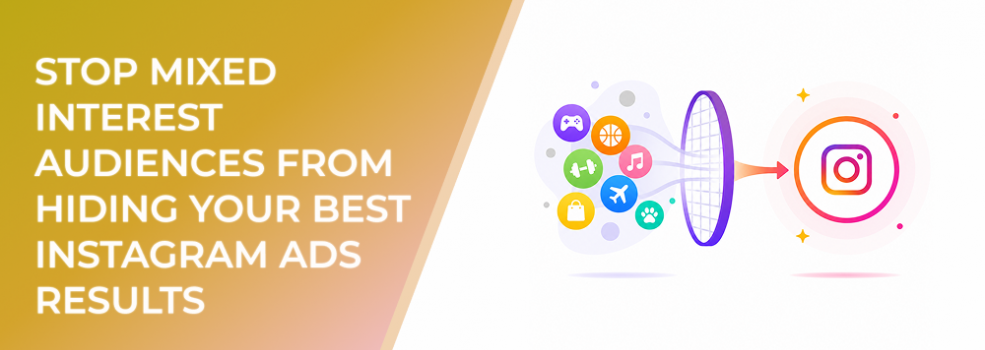
Mixed interest audiences can make Instagram ads look worse than they really are.
A campaign may contain one strong buyer segment and three weak segments inside the same ad set. The strong segment drives quality leads or purchases. The weak segments generate cheap clicks, passive engagement, or poor-fit traffic. In reporting, all of that gets blended into one average.
The advertiser sees a mediocre result and assumes the audience is average.
But the real issue is not always audience quality. Sometimes the best audience is hidden inside a mixed interest stack.
The Problem
The problem is that mixed interest audiences hide your best Instagram ads results.
Many advertisers combine multiple interests to increase audience size. They may add competitors, broad category interests, influencers, behaviors, and demographic filters into one ad set. That setup can deliver, but it does not reveal which signal is working.
The result is a reporting blind spot.
If the campaign produces a $65 CPA, you do not know whether one segment could have produced a $35 CPA while another produced a $120 CPA. If lead quality is inconsistent, you do not know whether the issue comes from broad interests, competitor followers, passive content consumers, or a poor-fit demographic slice.
Blended audiences produce blended metrics. Blended metrics hide useful decisions.
Why This Problem Hurts Performance
This problem hurts performance because advertisers optimize against averages instead of causes.
A mixed audience can make a good segment look mediocre. It can also make a bad segment look acceptable because it is being carried by stronger users inside the same ad set.
That affects budget efficiency. You may keep paying for weak users because they are hidden inside the total result. You may also underinvest in high-intent users because their performance is diluted by lower-quality traffic.
The business impact can show up as unstable CPA, rising CAC, weak ROAS, inconsistent lead quality, polluted retargeting pools, and slower scaling.
For lead-generation teams, the damage can be especially frustrating. Ads Manager may show acceptable CPL, but sales may report that only a small portion of leads are qualified. Without separating audience signals, it is hard to know which users created the problem.
Common Scenarios Where This Happens
An ecommerce brand targets “sustainable fashion,” several competitor brands, fashion influencers, and discount shopping interests in one Instagram ad set. Purchases happen, but discount-focused users lower average order quality.
A SaaS advertiser targets entrepreneurs, marketing tools, startup founders, business podcasts, and agency owners together. The campaign gets demo requests, but many are too small or too early-stage.
An agency builds one large “interest stack” for a client because the client wants fast delivery. The campaign gets volume, but nobody can identify the highest-intent sub-audience.
A local service business targets a broad city radius plus several lifestyle interests. The campaign generates inquiries, but many come from users who are not serious buyers.
An affiliate marketer combines content-consumer interests and buyer-adjacent interests. Clicks look cheap, but payout-driving actions are inconsistent.
Why the Problem Happens
Mixed interest audiences happen because advertisers want enough reach and fast learning.
They worry that smaller segments will not deliver. They also assume Meta can sort through the audience and find the right people automatically. Sometimes it can. But if the audience inputs are too mixed, the campaign may learn from the easiest responders, not the best buyers.
Another reason is convenience. It is faster to build one large audience than to create separate test groups. But that convenience creates a measurement tradeoff.
The problem also comes from unclear audience hypotheses. If the advertiser has not defined why each interest belongs in the campaign, it becomes easy to add more options without understanding what each one is supposed to prove.
The Solution
The solution is to separate mixed interests into distinct audience test groups.
Start by auditing the current audience. Break every interest, profile, behavior, and source into a theme. Then ask what each theme represents.
For example:
- Competitor intent: people connected to brands similar to yours.
- Category interest: people broadly interested in the product category.
- Creator influence: people connected to niche influencers or educators.
- Community intent: people participating in groups or communities around the problem.
- Professional fit: people who match job role, industry, or company context.
- Warm engagement: people who already interacted with relevant content.
Do not test all themes together. Build one ad set per hypothesis.
A simple structure might include:
- Ad set 1: broad category audience.
- Ad set 2: competitor-adjacent audience.
- Ad set 3: niche creator or community audience.
- Ad set 4: professional-fit or high-intent custom audience.
Keep the creative and offer consistent. The goal is to find whether audience quality changes performance.
Evaluate results beyond top-level click metrics. Look at CPA, conversion rate, ROAS, lead qualification, booked calls, purchase quality, sales acceptance, and CAC. The best audience is not always the one with the cheapest click.
How LeadEnforce Helps
LeadEnforce helps advertisers build more distinct audience groups when standard interest targeting is too vague.
For Instagram campaigns, LeadEnforce can help create audiences from Instagram followers, Instagram engagers, and relevant social-profile sources. It can also support audience creation from Facebook groups, LinkedIn-derived professional data, and custom social-profile data.
That makes it easier to move from a mixed interest stack to a structured audience test.
Instead of combining “fitness,” “wellness,” “supplements,” and several influencers into one audience, a marketer could test competitor followers, niche profile followers, and broader category interests separately. Instead of targeting all “business owners,” a B2B marketer could compare a professional-fit audience against a broader entrepreneurial content audience.
LeadEnforce does not decide which segment is best. It gives advertisers cleaner source-based audiences to test against performance data.
Risks and Considerations
Splitting audiences can create budget fragmentation if you test too many groups at once. Start small.
Some segments may be relevant but too small to deliver efficiently. Others may generate strong clicks but weak conversions. A competitor audience may need clearer differentiation. A creator audience may require creative that matches the audience’s expectations.
Avoid overcorrecting from one test. A segment that loses once may still work with a better offer, different funnel stage, or stronger creative.
Also remember that audience quality is only one part of performance. Weak landing pages, unclear pricing, low-quality conversion signals, poor creative, or a weak offer can make even a strong audience look bad.
Prerequisites and Dependencies
You need a clear business outcome before splitting audiences. Decide whether the campaign is optimizing for purchases, qualified leads, booked calls, pipeline value, or another measurable action.
You need enough budget to compare segments fairly. If each ad set receives too little spend, the test will still be hard to read.
You also need a naming convention. Label audiences by theme and source, not by vague internal shorthand.
If LeadEnforce is used, you need relevant source profiles, communities, professional criteria, or custom social-profile lists that map to real buyer intent.
Practical Recommendations
Do not launch mixed interest stacks without knowing what each component is supposed to prove.
Create a short audience hypothesis before each test. For example: “Competitor followers should produce better lead quality than broad category interests because they already pay attention to similar solutions.”
Compare audiences on downstream business quality, not just delivery cost.
Use exclusions where appropriate so warm users, existing customers, or known poor-fit leads do not distort cold prospecting results.
Use LeadEnforce when your standard interests are too broad to isolate buyer signals. It is most useful before launch, when you need cleaner audience sources for a more readable test.
Final Takeaway
Mixed interest audiences hide the truth.
They can make strong segments look average and weak segments look acceptable. The fix is to split audience signals into clear, testable groups and judge each one by the business outcome it produces.
To create cleaner Instagram audience groups from followers, engagers, communities, professional data, and custom social-profile sources, join the free 7-day LeadEnforce trial period.
Related LeadEnforce Articles
- Instagram Ad Targeting Breaks When Audience Signals Are Read Incorrectly — Explains why weak or misread signals can push delivery toward low-intent users.
- Marketing Audiences vs Buying Audiences: The Real Gap — Helps distinguish broad interest audiences from audiences more likely to buy.
- How to Find Better Facebook Ads Audiences With Broad vs Narrow Targeting Tests — Useful for structuring audience comparisons instead of relying on blended performance.
- Change Broad Facebook Ad Targeting Before It Wastes Budget — Connects broad targeting problems to wasted spend and weak relevance.