For years, digital advertisers relied on well-defined audience segments—interests, behaviors, and demographic clusters—to predict which users were most likely to convert. But this approach is rapidly becoming outdated. With privacy changes, reduced cross-app tracking, and increased reliance on machine learning, platforms like Meta now prioritize signals, not segments, to understand user intent.
This shift represents one of the biggest changes in performance marketing since the introduction of pixel tracking. Understanding how signals work—and how to feed the algorithm the right ones—can dramatically improve campaign efficiency.
Why Segments Are Losing Power
Segments were built around predicted behaviors: a user with a specific interest might buy a certain product. But today, this model breaks down for several reasons:
-
Data gaps from privacy regulations reduce the platforms' ability to maintain accurate segments.
-
Cross-device fragmentation makes user-level tracking unreliable.
-
Machine-learning models outperform static segmentation when fed large quantities of real-time behavioral signals.
A 2024 internal report from Meta indicated that machine-learning models trained on real-time event signals outperform interest-based targeting by up to 32 percent in incremental conversions.
What Counts as a “Signal” Today?
Signals include any measurable user action that helps the system understand intent. These can be:
-
Website or app events (views, add‑to‑cart, purchases)
-
Engagement behaviors across Meta surfaces
-
Conversion value and funnel-stage indicators
-
Real-time auction feedback such as click probability
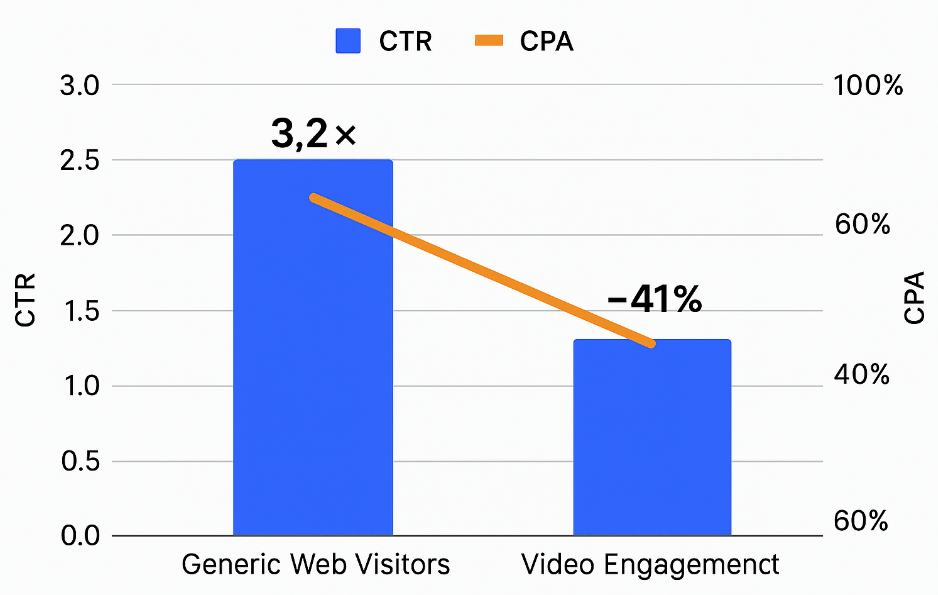
Retargeting based on video engagement delivers 3.2× higher CTR and 41% lower CPA compared with standard web-visitor retargeting
Meta’s machine learning evaluates millions of these micro‑signals per second. Studies show that campaigns optimized for purchase events rather than broad interest segments can improve ROAS by between 20 and 45 percent.
How Signal-Based Optimization Works
Instead of starting with a predefined audience, advertisers now define an outcome—such as purchases, leads, or value optimization—and allow the system to identify users most likely to complete that outcome based on signal patterns.
The engine continuously learns:
-
Which users exhibit behaviors similar to past converters
-
Which creative assets generate the strongest downstream actions
-
Which placements deliver the most predictive signals
This creates a feedback loop where more conversion signals produce faster and more accurate optimization.
What Marketers Should Do Now
To excel in a signal-driven ecosystem, marketers must shift from granular targeting to mastering data quality and conversion flow.
1. Strengthen Conversion Tracking
Platforms need event density to learn effectively. Advertisers should ensure:
-
All key funnel events are tracked
-
Signals fire with high accuracy and minimal delays
-
Event prioritization matches campaign objectives
Brands that implement complete conversion schemas typically see up to 25 percent higher optimization accuracy.
2. Optimize for High-Value Signals
Move beyond “landing page views.” Consider:
-
Purchase value optimization
-
Lead scoring signals
-
Deeper funnel events like “add payment info”
High-value signals improve the algorithm’s ability to predict your best customers.
3. Let the System Broaden Delivery
Overly restrictive targeting fragments signal distribution. Broader audiences help machine learning discover new converters faster.
4. Feed the System with Strong Creatives
Creatives are signals too. The system analyzes them for:
-
Engagement likelihood
-
Relevance to similar converters
-
Expected conversion probability
High-performing creative clusters improve outcomes even when audience inputs are minimal.
The Future: Fully Signal-Driven Measurement
As platforms move toward aggregated, privacy-resilient measurement, predictive signals—not user-level identity—will define performance.
Expect:
-
Fewer manual targeting tools
-
More modeling and probabilistic attribution
-
Greater emphasis on server-side signals and API-based events
Marketers who adapt early will see stronger results in a world where machine learning understands intent better than any manual segmentation ever could.
Recommended Articles to Read Next
To deepen your understanding of performance advertising and data-driven optimization, consider reading: