A lot of Facebook ads lose conversions because the CTA is too vague.
The creative may look strong. The targeting may work. The headline may get attention. But the final action still feels weak because the CTA does not clearly explain what the user gets after clicking.
This usually happens when advertisers rely on generic CTA copy like “Learn More,” “Get Started,” or “Sign Up.”
Those buttons are not automatically bad, but they often fail to create strong intent. Users click out of curiosity instead of genuine interest, which usually leads to lower conversion rates and weaker lead quality.
The problem is not the click itself. The problem is unclear expectation. The solution is making the CTA feel like a natural continuation of the ad instead of a generic instruction.
Why Generic CTA Copy Creates Weak Intent
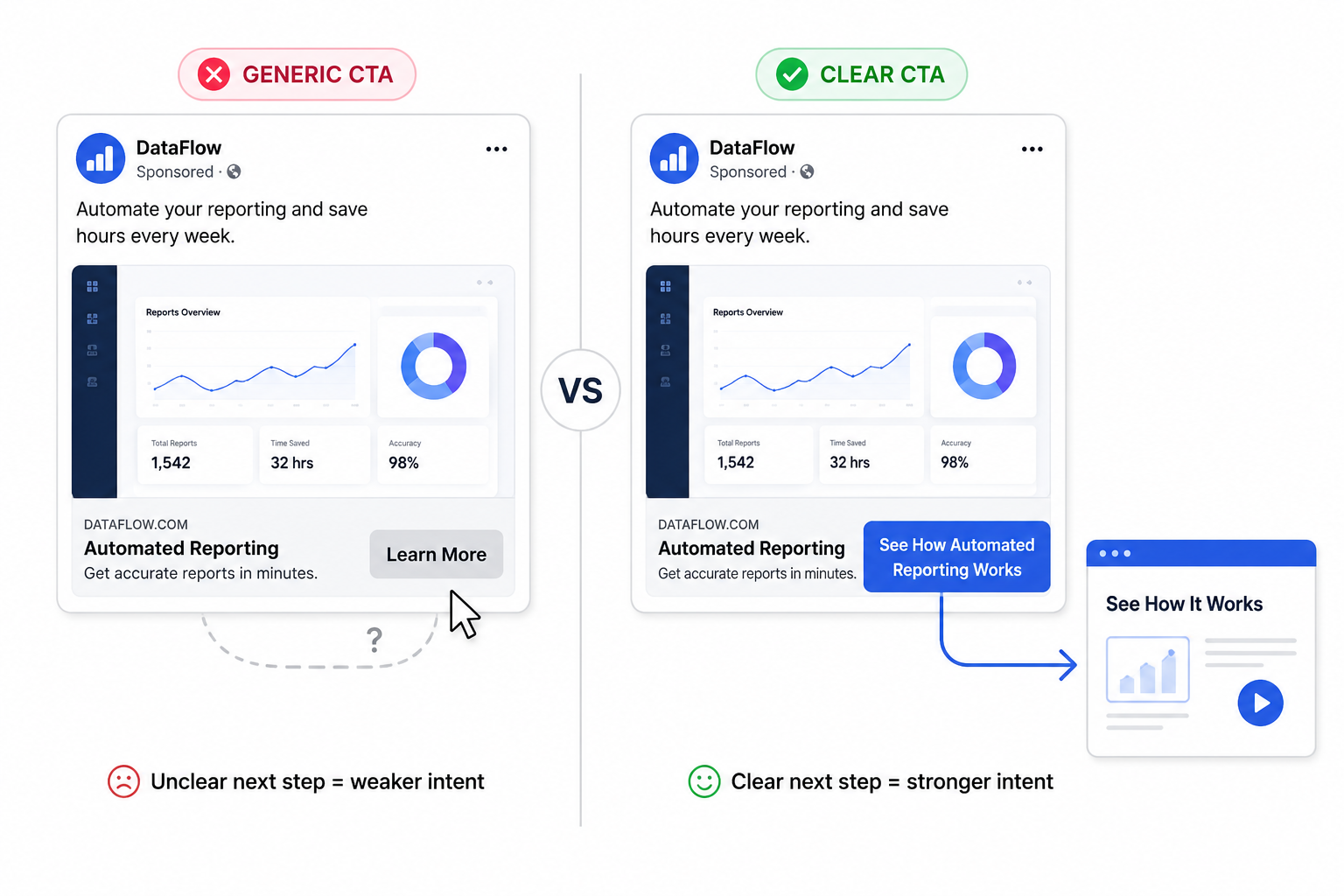
A CTA shapes how users interpret the click. For example, imagine a B2B software ad promoting automated reporting.
- One version says: “Learn More.”
- Another version says: “See How Automated Reporting Works.”
The second CTA performs better in many campaigns because it tells the user exactly what happens next. That clarity reduces hesitation before the click.
Facebook users move quickly through the feed. If the CTA feels unclear, users either avoid clicking or click without strong intent.
That usually creates traffic that looks good inside Ads Manager but performs poorly deeper in the funnel.
Common symptoms include:
- high CTR with weak conversion rate;
- rising CPA during scaling;
- strong traffic volume with weak lead quality;
- low landing page engagement after the click.
Many advertisers blame targeting when the real issue is weak directional language inside the CTA.
The Most Common CTA Mistakes in Facebook Ads
Most weak CTAs fall into predictable patterns.
Here are the mistakes advertisers repeat most often:
- The CTA describes an action but not a benefit.
“Submit” explains what the user does, but not why it matters. - The CTA feels disconnected from the ad.
An educational ad suddenly switches into an aggressive “Buy Now” CTA. - The CTA creates uncertainty.
“Learn More” gives almost no context about what happens after the click. - The CTA asks for too much commitment too early.
Cold audiences rarely respond well to hard-sales CTAs before understanding the offer. - The CTA sounds identical to every other ad.
Generic language blends into the feed instead of reinforcing the message.
Most of these problems reduce conversion intent before the user even reaches the landing page.
Why CTA Problems Often Hide Behind Good CTR
Weak CTA copy can still generate clicks. That is why many advertisers miss the problem early on.
For example, a lead generation ad may use a strong headline and clean visual. The ad gets attention, so CTR looks healthy. But the CTA simply says “Get Started.”
The user clicks without fully understanding what happens next.
- Are they booking a demo?
- Downloading a guide?
- Entering a sales funnel?
- Requesting pricing?
That uncertainty creates friction immediately after the click.
The campaign may continue generating traffic, but Meta starts optimizing around weak intent behavior instead of strong conversion behavior.
This is one reason advertisers should learn how to match ad messaging to buyer awareness levels because CTA language should change depending on how familiar the audience already is with the offer.
How Better CTA Copy Improves Facebook Ad Performance
Strong CTAs reduce mental effort.
The user should immediately understand:
- what happens next;
- what value they receive;
- how much commitment is required.
The best CTAs usually continue the same idea already introduced inside the ad.
For example:
- Weak CTA: “Learn More”. Stronger CTA: “See the Full Strategy”.
- Weak CTA: “Get Started”. Stronger CTA: “Calculate Your Savings”.
- Weak CTA: “Sign Up”. Stronger CTA: “Start Your Free Trial”.
- Weak CTA: “Book Now”. Stronger CTA: “Reserve Your Consultation Spot”.
The stronger versions work better because they reduce ambiguity. The user understands the purpose of the click before taking action.
That usually improves both conversion rate and traffic quality.
Why CTA Strategy Changes Across Funnel Stages
Different audiences require different levels of commitment. Cold audiences usually respond better to lower-friction CTAs because they are still learning about the problem.
Warm audiences can handle more direct CTAs because they already recognize the offer.
For example:
- Cold traffic often responds better to: “Watch the Demo,” “See How It Works,” or “Download the Guide.”
- Warm audiences often respond better to: “Start Your Trial,” “Book a Consultation,” or “Request Pricing.”
Using the wrong CTA for the wrong stage usually lowers efficiency.
This is also why advertisers benefit from studying copywriting triggers that improve action rates because small wording changes often reshape user behavior dramatically.
How to Audit Whether Your CTA Is Weak
A simple test is asking: would the user clearly understand what happens after clicking?
If the answer is unclear, the CTA probably needs improvement.
Another useful method is checking whether the CTA could appear on almost any ad in any industry. If the answer is yes, the language is probably too generic.
Strong CTAs feel tied directly to the offer.
Advertisers trying to improve this area should also review stronger Facebook ad headline formulas because CTA performance often depends on the clarity established earlier in the ad.
Final Takeaway
Weak CTA copy hurts Facebook ad performance because it creates unclear intent.
Users may understand the ad itself but still feel uncertain about what happens next. That uncertainty lowers conversion rates, weakens optimization signals, and increases wasted ad spend over time.
The strongest CTAs do more than tell users to click.
They explain the value of the next step, reduce hesitation, and continue the same message already introduced in the ad.
When the CTA feels clear and specific, Facebook campaigns usually generate better-quality traffic and become easier to scale profitably.