
B2B advertising on Meta platforms looks similar to B2C at first glance. The targeting tools are identical, but the decision psychology is fundamentally different.
Your audience is not scrolling for entertainment. They are filtering risk, protecting budgets, and defending future decisions internally, which shapes how they interpret every impression.
Why B2B Decisions Are Slower on Meta
A consumer can purchase alone within minutes, while a B2B buyer usually needs alignment across several stakeholders.
Most purchases involve managers, finance teams, and operational leads, so the person who clicks your ad often gathers information rather than approving the deal.
This structure creates several realities you must respect:
-
Multiple internal audiences; your message must resonate with evaluators and budget owners, because marketing seeks growth while finance seeks cost control.
-
Career exposure; a failed vendor decision affects internal credibility, so buyers prefer solutions that feel defensible and stable.
-
Extended timelines; outcomes are measured quarterly, which makes instant promises feel unreliable.
If your creative speaks only about features, it ignores the internal pressure shaping the evaluation process.
How Risk Dominates B2B Psychology
In B2B environments, perceived risk often outweighs perceived gain, so decision-makers assess downside exposure before potential upside.
Every Meta ad is filtered through this lens, even if the buyer never states it directly.
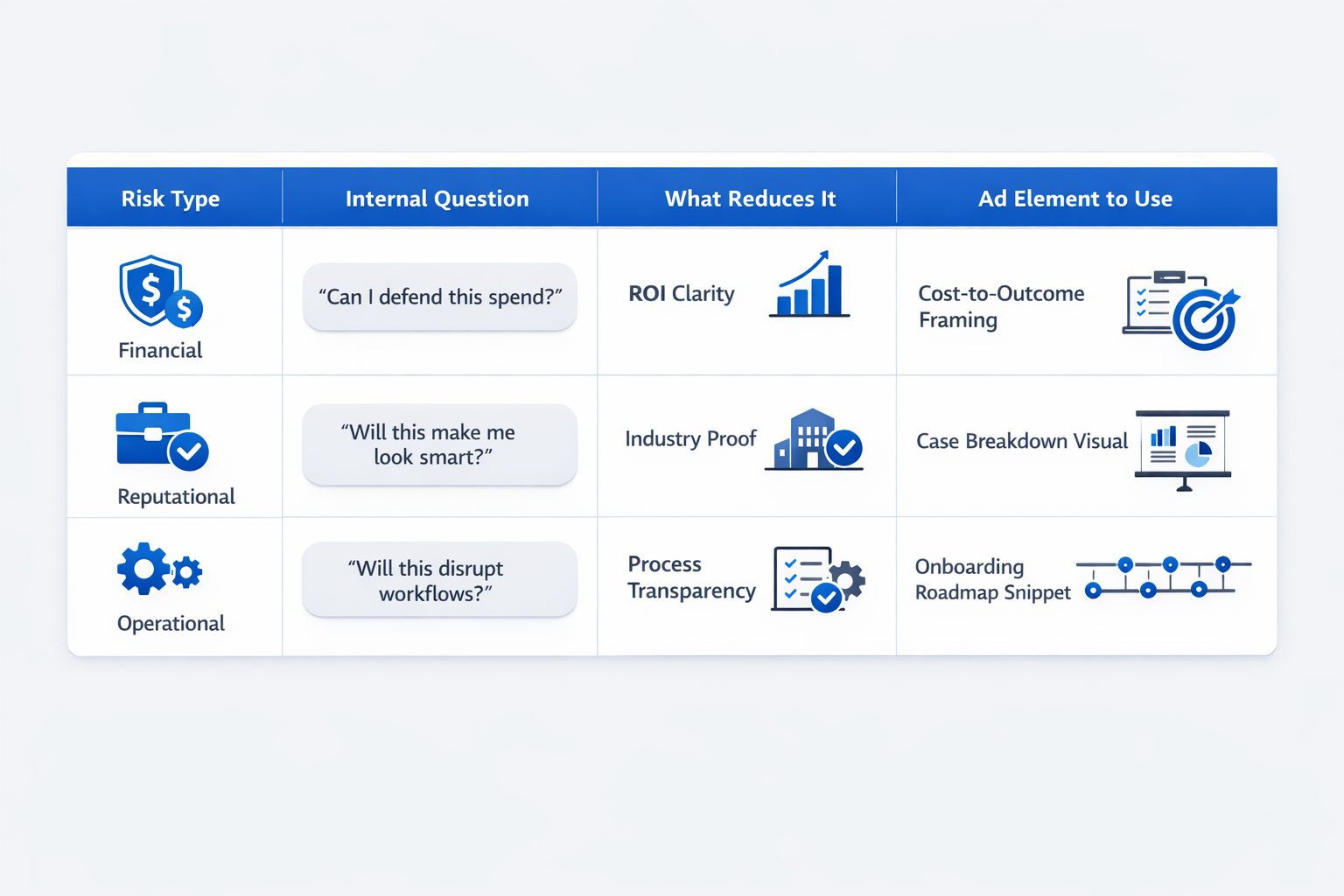
Financial Risk
Budget ownership creates accountability, and subscription tools accumulate significant annual costs that require justification.
Ads that mention price without linking to measurable impact increase resistance, while ROI framing tied to revenue efficiency or acquisition cost reduction reduces friction.
Support financial safety with:
-
Transparent pricing ranges; hidden costs trigger skepticism and stall conversations.
-
ROI mapping; connect performance metrics to pipeline value or sales velocity.
-
Cost stability signals; emphasize predictable spend rather than short-term spikes.
For a deeper view of cost sensitivity in Meta campaigns, review what impacts Facebook ad costs the most, which explains how volatility shapes perception.
Reputational Risk
Managers protect internal credibility, so they avoid tools that appear experimental or poorly documented.
Broad claims rarely reduce reputational anxiety, but structured case evidence does.
Strengthen credibility with:
-
Detailed case summaries; describe starting conditions, structural changes, and measured results.
-
Industry alignment; highlight similar company size or operational context.
-
Workflow clarity; show reporting systems and process transparency.
Social validation also matters, especially when it is specific and contextual, which is explored in how social proof influences Facebook ad performance.
Operational Risk
Adopting new software disrupts workflows, and teams worry about integration complexity and training time.
If your creative ignores implementation friction, evaluation slows down because uncertainty remains unresolved.
Reduce operational concern by clarifying:
-
Onboarding timelines; define milestones for the first 30 days.
-
Internal workload; specify asset preparation and communication requirements.
-
Integration compatibility; mention CRM and tracking connections directly.
B2B campaigns that account for these factors tend to align better with structured funnel design, as discussed in how to build a full-funnel strategy with Facebook and Instagram ads.
The Internal Dialogue Behind Every Click
B2B decision-makers run silent checkpoints while scrolling Facebook or Instagram, and these checkpoints determine whether they engage.
The internal script often includes:
-
Is this relevant to my active KPIs; if not, it is ignored immediately.
-
Does this appear credible; vague headlines reduce trust within seconds.
-
Can I justify exploring this; if justification feels weak, the scroll continues.
Your ad must pass these checks quickly while preserving clarity.
Status Preservation
Professionals want to appear informed and strategic, so ads that provide practical insight outperform aggressive sales angles.
Educational framing strengthens internal status because it positions the evaluator as proactive rather than reactive.
Examples that reinforce status include:
-
Benchmark comparisons; these support informed discussions with leadership.
-
Diagnostic frameworks; these suggest structured improvement.
-
Funnel gap analyses; these clarify where revenue leakage occurs.
For more detail on funnel structure thinking, review Facebook ads funnel strategy from audience identification to conversion, which connects messaging to stages.
Cognitive Load Management
Executives process high volumes of information daily, so dense copy increases friction and weakens response rates.
Short, structured statements supported by clear numbers reduce mental effort and improve message retention.
Improve cognitive efficiency by:
-
Using specific percentages instead of abstract claims.
-
Limiting visual clutter in creative assets.
-
Highlighting one core benefit per variation instead of stacking claims.
Clarity signals competence and reduces skepticism.
Emotional Drivers in Rational Environments
B2B buyers present decisions as rational, yet emotional drivers still shape evaluation speed and confidence.
These emotions are defensive rather than impulsive.
Fear of Loss
Loss aversion accelerates evaluation because highlighting existing inefficiencies makes inaction feel costly rather than neutral.
Quantifying wasted spend from poor segmentation or audience overlap turns abstract risk into visible financial leakage.
The mechanics behind this dynamic are explored further in under related psychology-driven articles such as “The Psychology of Clicks,” which explains why perceived loss sharpens attention.
Desire for Control
Decision-makers value predictability because stable systems reduce stress and internal scrutiny.
Messaging that emphasizes reporting transparency, optimization cycles, and documented testing frameworks reinforces a sense of control.
Support control perception with:
-
Clear dashboard references; define reporting cadence and metric hierarchy.
-
Defined optimization processes; explain how adjustments occur systematically.
-
Documented experimentation rules; show disciplined variable isolation.
Predictable systems feel safer to approve.
Social Proof as Insurance
In B2B, social proof functions as risk insurance because it signals that others validated the decision first.
Generic testimonials rarely persuade serious buyers, but specific metrics tied to industry context reduce doubt.
Increase persuasive strength with:
-
Named industries or vertical categories.
-
Before-and-after structural breakdowns.
-
Quantified improvements over defined time frames.
Specificity transforms proof into internal leverage.
How Meta Context Changes B2B Perception
Meta platforms are social environments where business messages compete with personal updates and entertainment content.
This contrast affects both attention and skepticism.
Pattern Interruption With Authority
You need visual distinction without sacrificing professionalism, because loud design often reduces perceived competence.
Clean layouts with sharp headlines and structured hierarchy perform better in B2B contexts than overstimulating creatives.
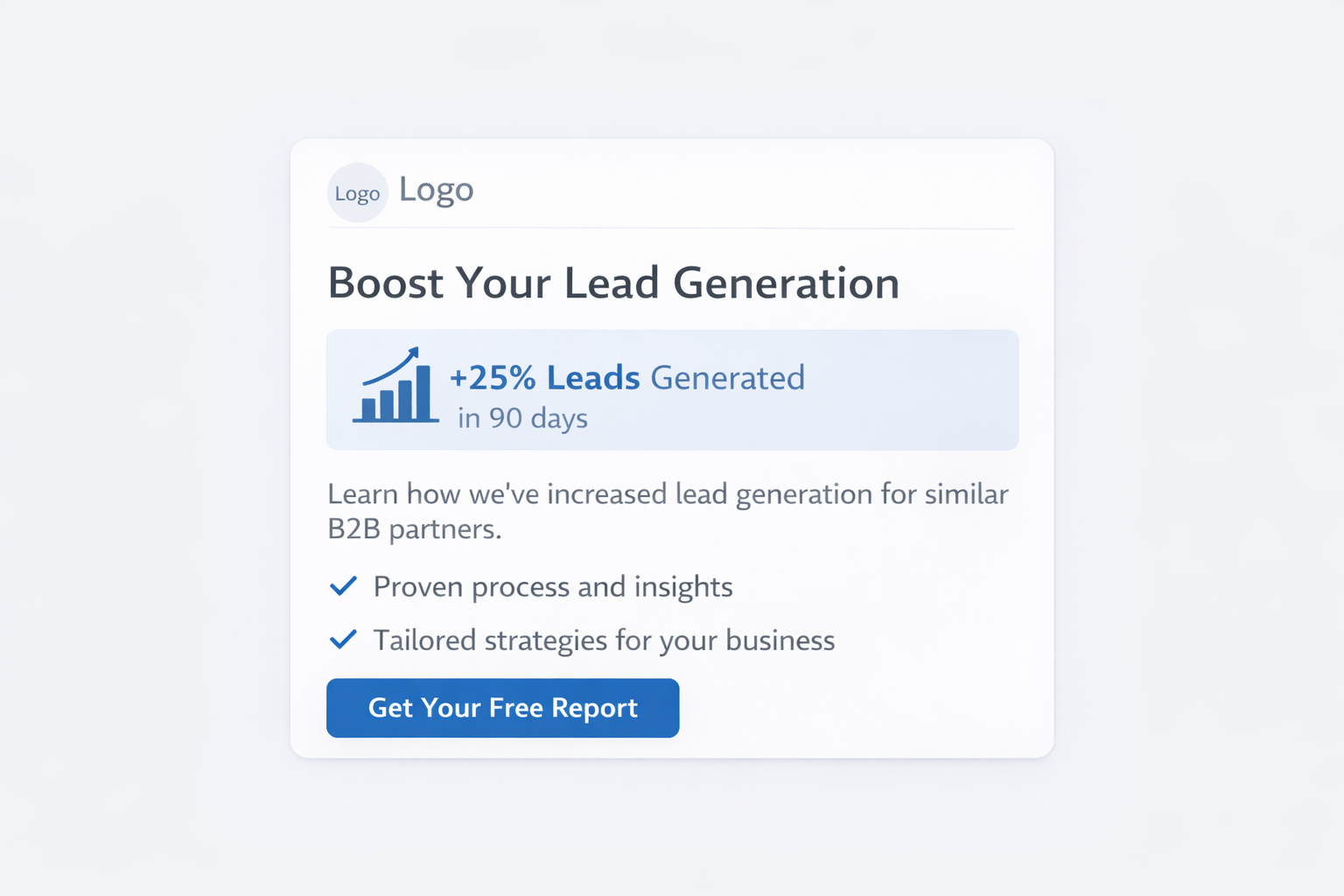
Effective visual principles include:
-
Minimal color palettes that preserve readability.
-
Structured information flow; headline, proof point, supporting detail.
-
Consistent typography that reinforces stability.
Authority emerges from clarity rather than decoration.
Micro-Commitments Over Hard Conversions
High-ticket B2B offers rarely convert on first exposure, so intermediate steps reduce psychological resistance.
Use actions that feel exploratory instead of transactional:
-
Downloading a diagnostic checklist that supports internal research.
-
Accessing a campaign audit template for evaluation discussions.
-
Reviewing a structured case breakdown for stakeholder alignment.
Each micro-commitment lowers internal approval barriers and builds momentum.
The Role of Data in Persuasion
B2B buyers trust structure, and structured data provides the backbone for defensible decisions.
However, raw statistics rarely persuade alone because context determines whether numbers survive internal review.
Why Raw Metrics Fail
Many Meta ads display isolated performance claims that lack persuasive depth.
Common weaknesses include:
-
Reporting vanity metrics; impressions rarely influence procurement decisions.
-
Ignoring baselines; a percentage lift without starting context feels incomplete.
-
Hiding time frames; short testing windows raise stability concerns.
Decision-makers want durable performance rather than temporary spikes.
Structuring Data for Internal Justification
Your lead often forwards your proof internally, so data must support that transfer.
Increase internal usability by:
-
Including clear time horizons; show sustained results across multiple months.
-
Connecting metrics to revenue impact; link lower CPL to pipeline growth.
-
Referencing operational context; specify funnel type, budget size, or industry.
Transferable data reduces internal friction and shortens approval cycles.
Quantifying Risk Reduction
Performance growth attracts interest, while risk reduction secures approval because it addresses the primary psychological barrier.
Highlight stability indicators such as:
-
Month-over-month variance reduction that demonstrates predictability.
-
Budget reallocation efficiency across funnel stages.
-
Lower structural errors such as fewer disapproved ads.
These signals align with how B2B stakeholders evaluate long-term viability.
Implications for Meta Campaign Structure
Psychology should inform campaign architecture because structure itself communicates competence and stability.
A fragmented account signals instability, while a disciplined framework signals control.
Prospecting Stage
At this stage, surface hidden inefficiencies that decision-makers may not recognize yet.
Effective angles include:
-
Diagnostic insights exposing audience overlap or segmentation waste.
-
Benchmark comparisons against industry averages.
-
Opportunity cost calculations tied to underperforming funnels.
The objective is problem recognition rather than immediate demo booking.
Consideration Stage
Buyers now evaluate feasibility and internal compatibility, so operational clarity becomes central.
Strengthen this stage with:
-
Transparent onboarding outlines and milestone timelines.
-
Integration specifics covering CRM, analytics, and tracking setup.
-
Tactical case breakdowns detailing structural changes and results.
Operational depth builds confidence before procurement discussions.
Conversion Stage
Hesitation centers on execution risk, so structured reassurance accelerates approval.
Support final action with:
-
First-month roadmaps specifying deliverables and checkpoints.
-
Resource clarity outlining required internal participation.
-
Defined success metrics and reporting cadence.
When implementation feels controlled and measurable, internal resistance declines.
Final Thoughts
B2B marketing on Meta is rarely about louder messaging because decision-makers respond to risk reduction, clarity, and defensible data.
When your campaigns reduce uncertainty, provide transferable proof, and align with structured internal evaluation, performance improves consistently.