We’re introducing a practical guide to identifying, measuring, and eliminating audience overlap in paid advertising campaigns. This article outlines the structural causes of internal competition, quantifies its financial impact, and provides an actionable framework to protect budget efficiency across platforms.
Audience overlap occurs when multiple campaigns, ad sets, or targeting segments compete for the same users within a single advertising account. Instead of expanding reach, campaigns enter internal auctions against each other. The result is inflated CPM, unstable CPA, learning phase resets, and distorted performance reporting.
Internal competition is particularly common in multi-product companies, multi-region accounts, agencies managing multiple funnels, and B2B advertisers using layered targeting filters.
Eliminating overlap is not a tactical optimization. It is a structural necessity for scalable media buying.
The Financial Impact of Audience Overlap
Internal competition has measurable consequences:
-
Studies of Meta ad accounts show CPM increases of 10–25% when audience overlap exceeds 30%.
-
Accounts with overlapping retargeting pools experience CPA volatility up to 32% higher than segmented accounts.
-
Google Ads reports indicate that overlapping keyword groups can reduce Quality Score stability, increasing CPC by 15–20%.
-
In B2B campaigns, duplicated company targeting across campaigns can reduce impression efficiency by more than 18%.
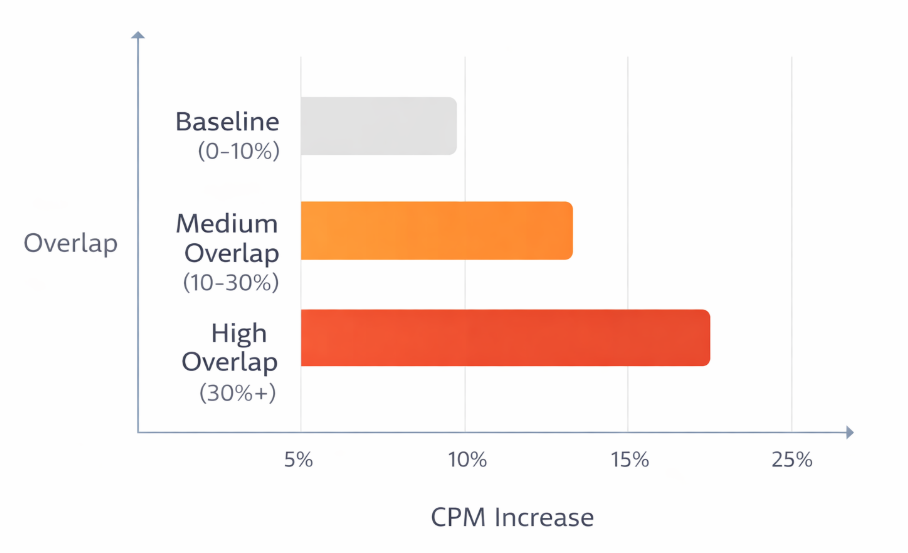
Audience Overlap vs. CPM Increase — Higher audience duplication correlates with significant rise in ad CPM
When multiple campaigns bid on the same user, the platform does not “optimize internally.” It simply runs an auction. The highest bid wins. Often, that winner is another campaign from the same account.
Where Audience Overlap Typically Happens
1. Retargeting Campaign Stacking
Multiple retargeting campaigns targeting:
-
Website visitors (30 days)
-
Website visitors (60 days)
-
Content viewers
-
CRM uploads
If exclusion logic is not sequential, users may fall into several pools simultaneously.
2. Lookalike and Similar Audience Expansion
Lookalike audiences built from overlapping seed lists often share 40–70% similarity in smaller markets.
3. Multi-Funnel B2B Campaigns
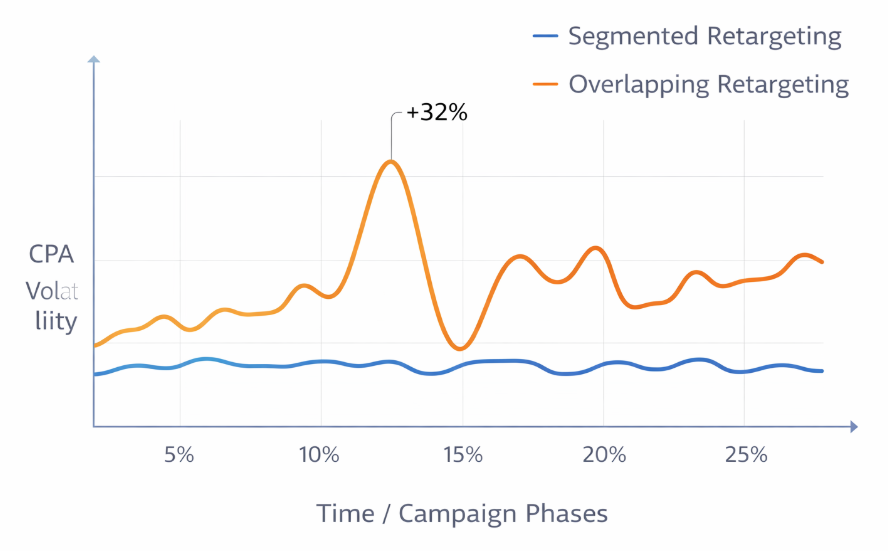
CPA Volatility Comparison — Overlapping retargeting audiences show more fluctuation than segmented ones, up to 32% higher
In B2B targeting, separate campaigns may include:
-
Company size filters
-
Industry filters
-
Job title filters
Without cross-campaign exclusion, the same decision-maker can be targeted multiple times by different campaign objectives.
4. Geographic + Interest Layering Conflicts
Broad geo campaigns running alongside niche interest-based campaigns in the same region frequently compete for identical users.
How to Measure Audience Overlap
Platform-Level Diagnostics
-
Use built-in audience overlap tools (where available) to compare saved audiences.
-
Analyze delivery reports for unusual CPM inflation across similar segments.
Structural Audit Approach
-
Export all campaign targeting parameters.
-
Normalize audience definitions.
-
Map intersections.
-
Quantify duplication rate.
A duplication rate above 20–25% in prospecting or 30% in retargeting is typically a red flag.
Framework to Prevent Internal Competition
1. Implement Hierarchical Exclusions
Structure campaigns in priority tiers:
Tier 1: High-intent (bottom-funnel)
Tier 2: Mid-funnel engagement
Tier 3: Prospecting
Each lower tier must exclude all higher-tier audiences.
2. Consolidate Over-Segmented Campaigns
If multiple campaigns share more than 35% audience similarity, consolidate them. Platform algorithms perform better with larger, statistically significant data pools.
3. Centralize Company and Contact Targeting
In B2B advertising, company targeting must be centrally governed to avoid duplicated firmographic filters across campaign groups.
4. Control Budget Fragmentation
Small budgets across many overlapping segments intensify auction pressure. Fewer, broader segments with exclusion logic outperform micro-segmentation in most cases.
5. Standardize Naming and Documentation
Create a structured naming taxonomy reflecting:
-
Funnel stage
-
Audience source
-
Exclusion logic
Lack of documentation is one of the primary causes of overlap in scaling accounts.
B2B-Specific Considerations
In account-based marketing environments, overlap risk increases because:
-
Multiple stakeholders from the same company are targeted.
-
Company-level and contact-level filters are applied simultaneously.
-
Sales-driven uploads may duplicate existing targeting lists.
A centralized data orchestration approach is essential to ensure company-level deduplication before campaign activation.
Signs You Have an Overlap Problem
-
Rising CPM without market explanation
-
CPA instability despite creative consistency
-
Learning phase resets after minor changes
-
High frequency combined with stagnant reach
-
Multiple campaigns reporting conversions from the same narrow segment
Operational Checklist
Before launching any new campaign:
-
Confirm exclusion from all higher-priority campaigns.
-
Audit company or CRM duplication.
-
Validate that audience similarity is below 30%.
-
Ensure budget allocation does not fragment statistical power.
Quarterly:
-
Run a full audience intersection audit.
-
Consolidate underperforming segments.
-
Review funnel-tier exclusions.
Conclusion
Audience overlap is not a platform flaw. It is a structural misconfiguration. As advertising ecosystems become more automated, the cost of internal competition increases.
Advertisers who implement exclusion hierarchies, centralize targeting governance, and regularly audit duplication protect both performance stability and media efficiency.
Eliminating overlap does not reduce reach. It restores control.
Recommended Reading
A systematic approach to audience architecture transforms paid media from fragmented experimentation into scalable infrastructure.