Most lookalike audiences don’t fail because of targeting settings — they fail because of what you feed into them.
If your seed is built from raw leads or early funnel conversions, the algorithm is learning from incomplete signals. It doesn’t know which users actually turned into revenue, so it optimizes for the closest visible proxy: people who fill out forms.
That’s where CRM data changes the equation. It gives the algorithm access to what actually matters — outcomes, not just actions.
Why Lead-Based Lookalikes Lose Quality
A common pattern: strong early performance, then gradual decline.
| Stage | Lead-Based (Weak) | CRM-Based (Strong) |
|---|---|---|
| Input | All leads mixed together | Qualified + closed deals only |
| Signal | Blurred, low-intent data | Clean, outcome-based data |
| Optimization | Finds form fillers | Finds likely buyers |
| Expansion | Drifts into weak segments | Stays within high-intent users |
| Result | Unstable quality, rising CPL | Consistent quality, better efficiency |
The root issue is simple. Lead-based seeds mix very different users:
-
High-quality prospects who convert into customers.
-
Low-intent leads who never engage with sales.
-
Irrelevant users who slipped through targeting.
The platform treats all of them the same.
So when the lookalike expands, it follows the easiest signals — not the most valuable ones.
That’s why campaigns can look fine in Ads Manager but still underdeliver in revenue terms. If you’ve seen that disconnect, it’s similar to what’s explained in Why Doesn't It Work?
What CRM Data Changes
CRM data shifts optimization from form fills to real outcomes.
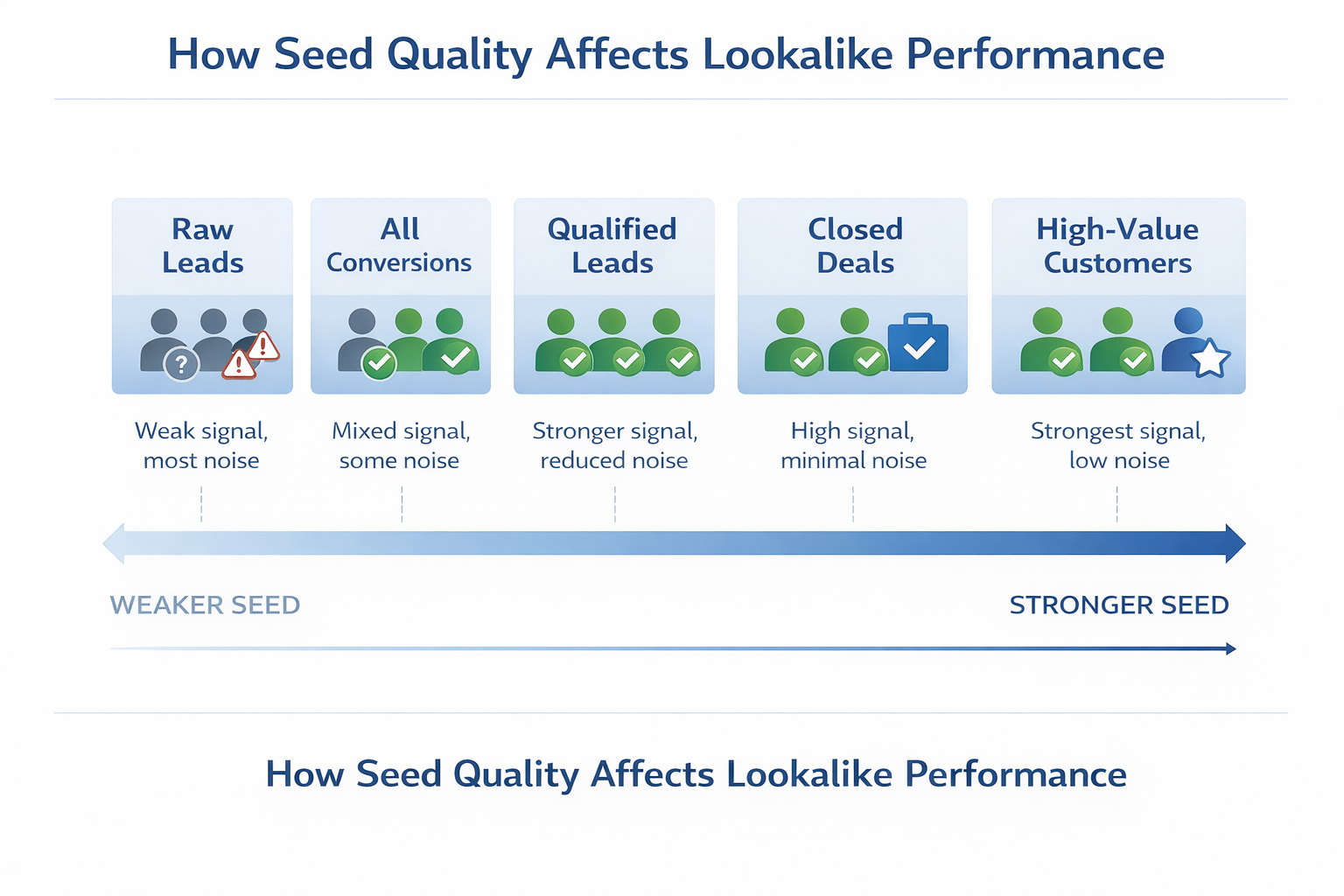
Instead of modeling generic conversions, you’re training the system on:
-
Leads that passed qualification.
-
Deals that actually closed.
-
Customers with meaningful value.
That changes how the algorithm behaves in auctions.
A few practical examples:
-
Qualified leads outperform raw leads
Once you remove unqualified entries, delivery becomes more consistent. -
High-value customers reshape targeting
The system starts favoring users with similar buying patterns, not just similar click behavior. -
Fast conversions signal intent
Leads that close quickly often belong to stronger behavioral clusters.
The result isn’t just better targeting — it’s more stable scaling.
How to Prepare CRM Data Properly
Uploading CRM data alone isn’t enough. Structure matters.
Focus on real outcomes
Build seeds from:
-
Closed-won deals.
-
Sales-qualified leads.
-
High-value opportunities.
If sales wouldn’t want more of that lead type, don’t include it.
Keep data recent
Old data introduces noise.
As a rule:
-
Use the last 90–180 days where possible.
-
Expand only if your market hasn’t changed.
Clean the dataset
Small errors reduce match quality and distort the model.
Before uploading:
-
Remove duplicates.
-
Standardize emails and phone numbers.
-
Exclude internal or test data.
This ties directly into broader targeting fundamentals — covered in How to Define Your Target Audience.
Segment by intent or value
Instead of one large seed, test a few focused ones:
-
High-value customers.
-
Recently closed deals.
-
Qualified but not yet closed leads.
Smaller, cleaner datasets often outperform larger mixed ones.
Practical Strategies That Improve Results
Once the foundation is solid, a few adjustments can make a noticeable difference.
-
Remove bad segments from the seed
If certain industries or lead types never convert, exclude them before building the audience. -
Use timing as a filter
Leads that convert quickly usually signal higher intent — they’re strong candidates for seed data. -
Test value-based lookalikes
If possible, pass revenue data so the algorithm prioritizes higher-value users. -
Scale more carefully than usual
Even with better seeds, aggressive budget increases can push delivery into weaker segments. Gradual scaling works better.
If scaling tends to break your campaigns, The Science of Scaling Facebook Ads Without Killing Performance goes deeper into this.
When CRM-Based Lookalikes Don’t Work
If performance doesn’t improve, the issue is usually in the data:
-
Too little volume after filtering.
-
Inconsistent CRM qualification standards.
-
Mismatch between targeting and actual customer profile.
In most cases, fixing the seed is more effective than adjusting campaign settings.
Key Takeaway
Lookalikes are only as good as the data behind them.
When you shift from raw lead data to CRM-based outcomes, the algorithm stops chasing easy conversions and starts finding users who are actually worth acquiring.
That’s where most of the performance gain comes from.