Most teams try to fix low SQL rates by adjusting forms, tweaking lead scoring, or pushing sales to follow up faster.
Sometimes that helps a bit. But when the problem keeps coming back, it usually starts earlier — inside targeting.
If the system is feeding your funnel the wrong people, everything downstream becomes a filtering exercise. You’re not really improving performance; you’re compensating for poor input.
The only reliable way to increase SQL rate is to control who enters the funnel in the first place.
What Are Sales Qualified Leads?
In this article, we’re focusing on sales qualified leads (SQLs) — leads your sales team actually wants to talk to.
Not just anyone who fills out a form.
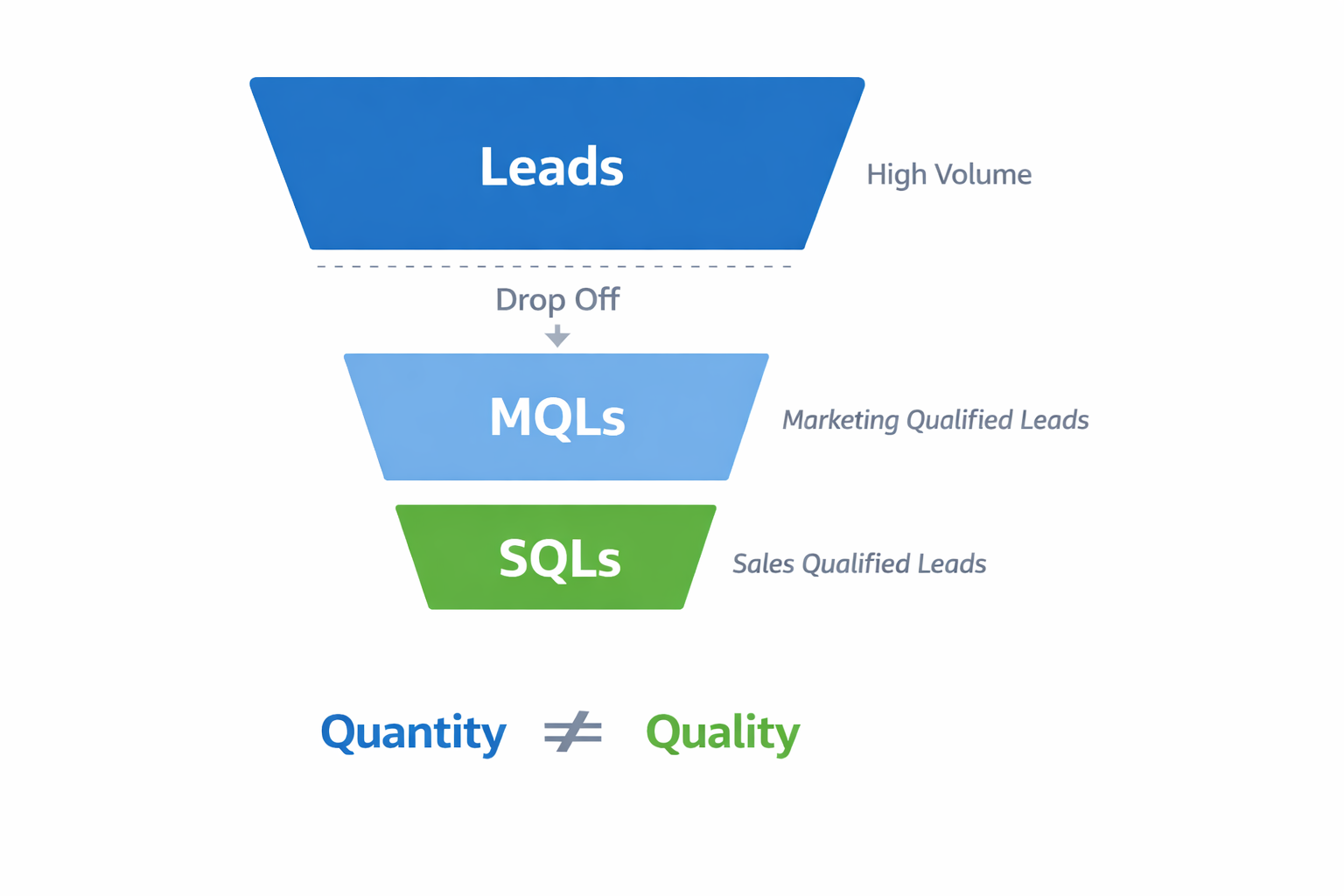
These are people who match your ICP, show real intent, and have a realistic chance of becoming customers.
That difference is where most targeting problems begin.
Ad platforms optimize for what they can measure quickly. A form submission is easy to track, but qualification isn’t. So unless you guide the system, it will gradually drift toward users who convert easily rather than those who are actually likely to buy.
When CPL Looks Fine but the Pipeline Gets Worse
This is where things get tricky.
From the ad account’s perspective, everything can look fine. Cost per lead is stable, CTR looks healthy, and conversions keep coming in.
But sales starts noticing something else. Leads don’t convert. Fewer demos happen. Pipeline quality drops.
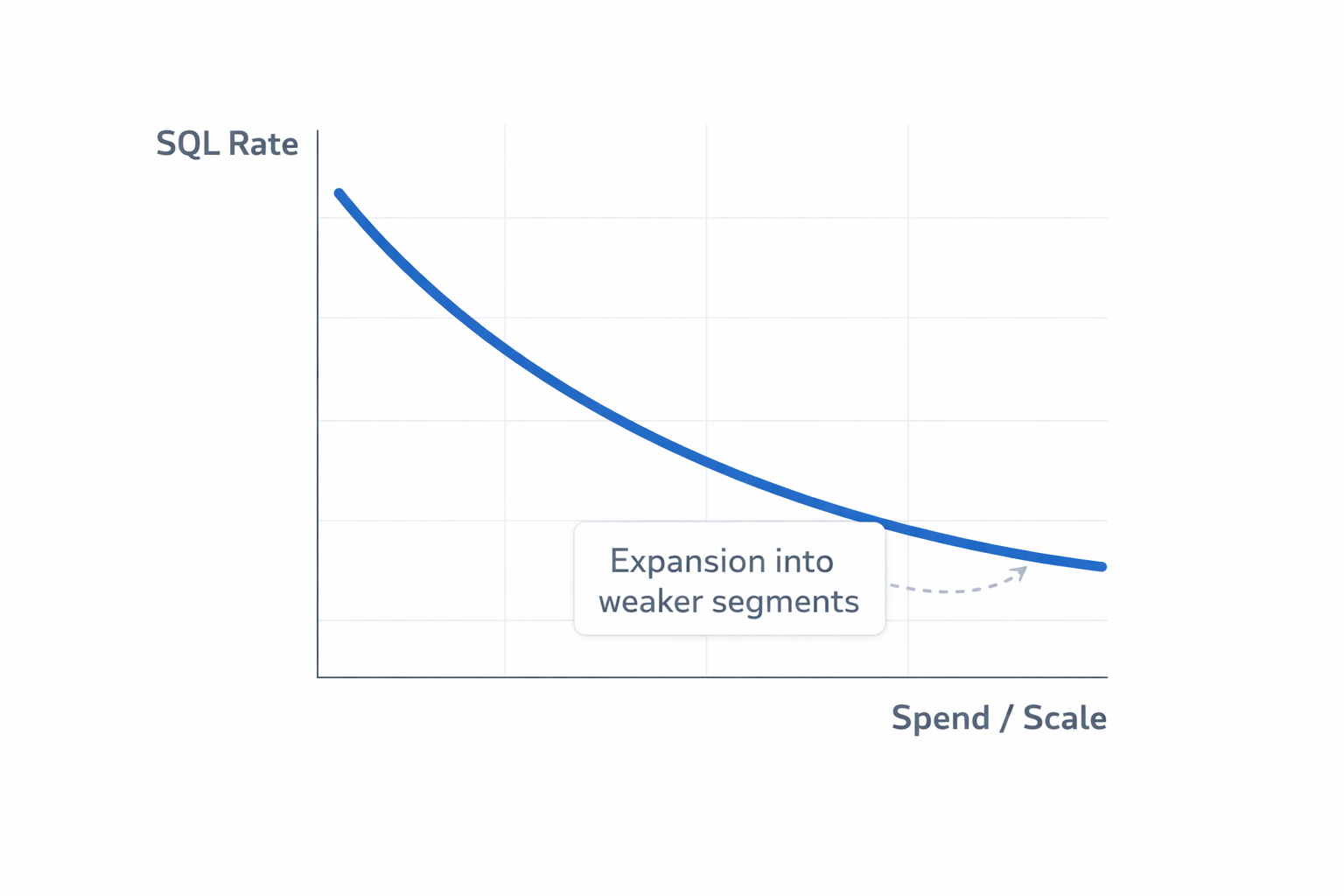
This shift rarely happens overnight. It builds gradually as campaigns scale.
As the algorithm looks for more volume, it begins expanding into cheaper auctions and broader audiences. In doing so, it increasingly prioritizes users who are easier to convert — and those users often have weaker intent.
From a performance dashboard, this can look like efficiency. From a revenue perspective, it’s a slow decline.
You’re still generating leads, but fewer of them are worth pursuing.
This pattern is very similar to what’s explained in When Facebook Ads Look Fine but Don’t Drive Results.
The System Is Doing Exactly What You Asked
If your campaign is optimized for leads, the platform isn’t making a mistake. It’s following the signal you gave it.
It learns from recent conversions and looks for more people like them. In practice, that means prioritizing users who submit forms quickly, resemble previous converters, and can be acquired at a lower cost.
What it does not account for is whether those users are actually valuable to your business.
There’s no built-in understanding of company fit, decision-making authority, or genuine buying intent. So the system fills that gap with the closest measurable proxy.
A common scenario illustrates this well. A few low-intent users convert early in a campaign, the algorithm interprets that as a strong signal, and delivery quickly shifts toward similar users. Within a short time, that pattern becomes dominant.
At that point, you’re not just receiving weaker leads — you’re actively reinforcing the behavior that produces them.
How Targeting Decisions Lower Lead Quality
Most SQL rate issues don’t come from a single obvious mistake. They emerge from small decisions that compound over time.
Lookalike audiences are a good example. When you build them from all leads, you combine very different signals into one dataset. A low-intent download and a high-intent demo request are treated equally, which results in a blurred model that doesn’t accurately represent either.
If you want to understand the mechanics behind this, What Is Lookalike Targeting and How It Boosts ROI explains how seed quality directly affects outcomes.
Exclusions are another common issue. Many campaigns remove customers but continue targeting users who have already proven to be low-quality leads. As a result, the system keeps rediscovering the same type of user.
Scaling timing also matters. Increasing budget before enough high-quality signals are collected forces the algorithm to generalize. And when it generalizes, it tends to move toward easier conversions rather than better ones.
What Changes When Targeting Is Set Up Properly
When targeting is aligned with actual revenue outcomes, campaigns start behaving differently.
You may notice that growth feels slower at first. That’s expected, because the system is no longer taking shortcuts to generate easy conversions.
What you gain instead is consistency.
Rather than seeing a wide mix of lead quality, you start to recognize patterns — similar companies, comparable deal sizes, and more predictable sales conversations.
This usually comes from improving the input signal.
Using CRM-based audiences built from sales qualified leads, late-stage opportunities, or closed deals gives the algorithm a much clearer understanding of what “good” looks like.
At the same time, exclusions become more intentional. Removing disqualified leads doesn’t just clean up targeting; it prevents the system from relearning patterns that you already know don’t work.
This idea is closely related to Audience Quality vs Quantity: What Drives Better Long-Term Results?
Expansion still happens, but it becomes more controlled. You start narrow, confirm that quality holds, and only then expand outward.
Practical Ways to Improve SQL Rate Without Losing Volume
You don’t need a complete rebuild to improve results. In many cases, a few focused adjustments are enough to shift performance.
Separating campaigns by signal strength is a good starting point. Keeping high-quality audiences isolated prevents them from being diluted by broader targeting.
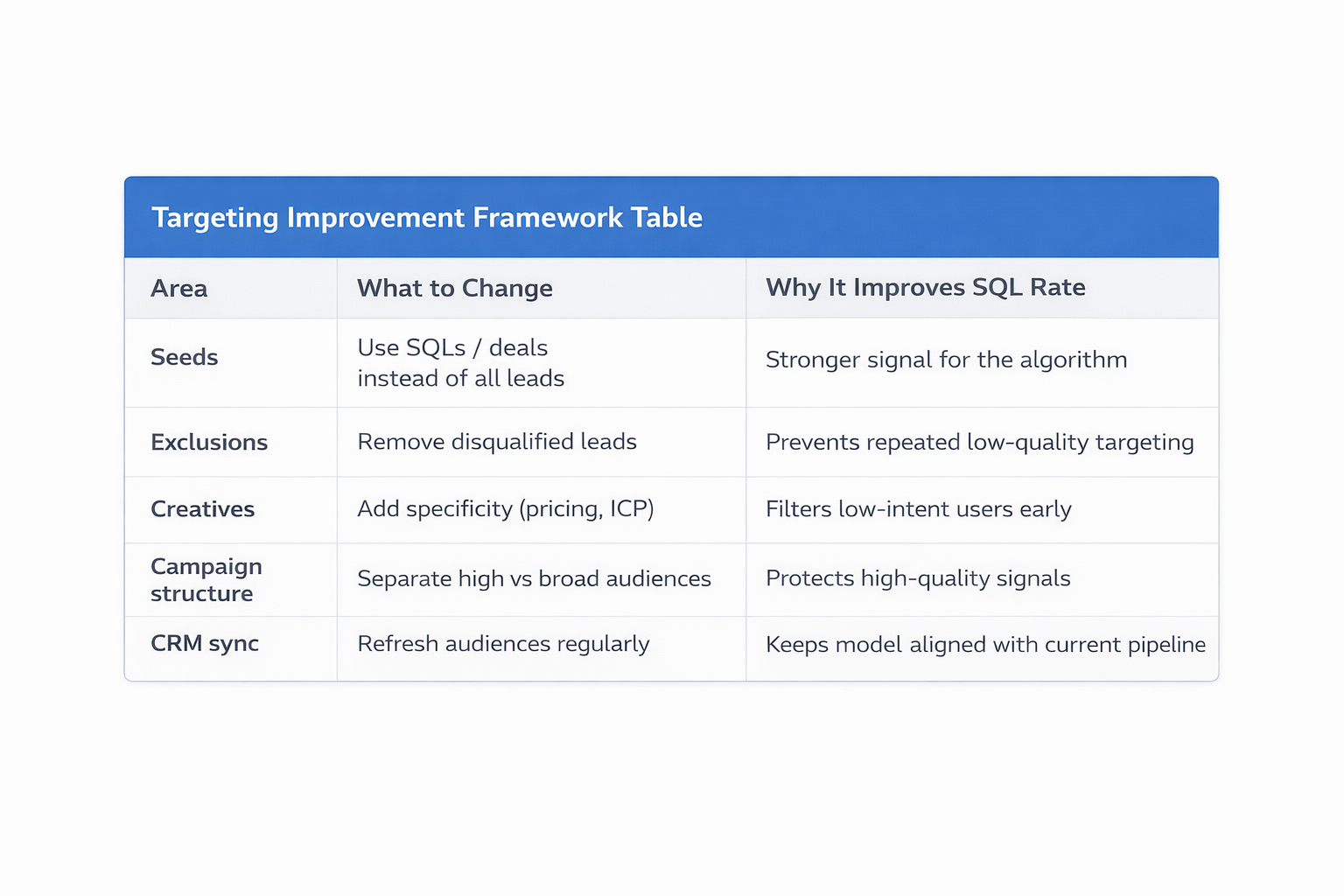
Creative also plays a larger role than it might seem. The way you frame your offer directly influences who clicks. When messaging is too broad, it attracts users with vague intent. Adding specificity — such as pricing context, company size, or clear use cases — naturally filters out low-quality traffic before it enters the funnel.
Geography and company filters are often underused. If your best deals consistently come from certain segments, your targeting should reflect that reality.
Keeping CRM audiences updated is another simple but effective lever. Feeding the system recent SQLs and closed deals helps maintain alignment with current pipeline quality.
If you want a structured way to refine this, How to Define a Target Audience for Marketing: a Step-by-Step Guide.
How to Recognize When Targeting Is the Problem
Before making changes, it’s worth confirming that targeting is actually the bottleneck.
A few patterns tend to show up consistently:
-
SQL rate declines as spend increases.
-
Cost per lead remains stable while cost per SQL rises.
-
Frequency grows without improving downstream results.
-
Some audiences clearly outperform others under similar conditions.
These signals usually point to the same issue: the system is expanding into weaker segments.
If that’s happening, adjustments to landing pages or forms won’t solve the core problem.
The Shift That Actually Improves SQL Rates
At the core, this comes down to what you ask the system to optimize for.
If you optimize for lead volume, the platform will maximize submissions and scale toward users who convert easily.
When you shift the signal closer to qualification — through better inputs, exclusions, and feedback loops — the system starts to behave differently. It becomes more selective in how it bids, expands more carefully, and focuses on users who resemble actual customers.
You may see a short-term drop in lead volume as a result, but what replaces it is a far more stable and valuable pipeline.
Practical Takeaway
If SQL rates are dropping, don’t start by fixing what happens after the lead is created. Start earlier.
Ask yourself: who is the system being trained to find?
If the answer is “anyone who fills out a form,” then the outcome is already set. Change the signal. Tighten the inputs. Control how expansion happens.
Once targeting reflects real qualification, most downstream problems become much easier to solve — or disappear entirely.