If you're running Facebook or Instagram ads, you already know how hard it is to reach the right people. Not just anyone — but people already thinking about buying. That’s where Facebook Groups can give you a huge edge.
These groups are full of users asking questions, sharing advice, and looking for solutions. With the right tools and approach, you can reach these high-intent users before your competitors do.
Let’s break down exactly how to use Facebook Groups for smarter, more profitable targeting.
Why Facebook Groups are so valuable for advertisers
People join Facebook Groups to solve problems, learn, or connect with others like them. These aren't passive users. They're engaged and focused — and that makes them ideal for targeting.
Consider a few examples:
-
A user in a group called "Keto Meal Plans & Recipes" isn’t just casually interested in health — they’re actively managing their diet.
-
Someone in "Freelance Web Designers – Jobs & Tips" is either looking for clients or improving their business — possibly both.
-
A parent in "ADHD Support for Moms" is searching for real answers — including products, tools, or services.
These users are more likely to click, engage, and convert — because they're already in the mindset to act.
What is LeadEnforce?
LeadEnforce is a powerful tool that helps advertisers create custom audiences from public Facebook Groups and Instagram accounts. You can build these audiences based on real group members — people already interested in specific topics.
Why does this matter?
Because Meta's native targeting options don't let you reach group members directly. But with LeadEnforce, you can.
For example:
-
Selling tools for Etsy sellers? Target people from "Etsy Product Photography Tips" or "Handmade Business Marketing."
-
Running a coaching program for freelancers? Target "Freelance Copywriters & Marketers" or "VA Mastermind Group."
-
Launching a wellness product? Target "Natural Baby Mamas" or "Holistic Moms Network."
You don’t need to guess someone’s intent — you can target users based on their actual group memberships.
How to find Facebook Groups with high buying intent
Not all groups are worth your ad dollars. Some are too broad, spammy, or inactive. Here's how to find the ones that will actually drive results.
| Criteria | Good Group Example | Why It Works |
|---|---|---|
| Niche + specific goal | “Etsy SEO Help for Sellers” | Shows business intent + monetization goal |
| Active, helpful discussion | Daily posts, replies, product threads | Real-time conversations, not ghost town |
| Product-related questions asked | “What’s the best CRM for solopreneurs?” | Buying intent is explicit |
1. Choose groups where people discuss buying decisions
Look for conversations that show intent, such as:
-
"What's the best CRM for solo coaches?";
-
"Any laptop recommendations for video editing?";
-
"Which organic baby lotion works for eczema?"
These types of posts signal users who are researching before making a purchase.
Avoid groups that are filled with memes, self-promotion, or vague conversations — they rarely convert well.
2. Go niche: Target specific problems or goals
The narrower the group, the stronger the intent. Generic groups often lead to wasted ad spend.
Instead of:
-
"Dog Lovers Worldwide" — too broad and unfocused;
-
"Moms Group Chat" — unclear intent;
-
"Fitness Motivation" — high volume but low buyer readiness.
Try:
-
"Raw Feeding for German Shepherds" — reflects a specific lifestyle and purchase behavior;
-
"Senior Dog Support & Supplements" — points to ongoing needs and spending;
-
"Keto for PCOS Support Group" — combines dietary focus with a medical condition;
-
"Minimalist Moms Baby Registry" — suggests upcoming purchase decisions.
The more specific the group, the more aligned your product can be to the member’s actual needs.
3. Check group activity and engagement
Before targeting, scroll through the group. Ask:
-
Is the group active? Look for daily or weekly posts.
-
Are users commenting and helping each other? Look for genuine engagement.
-
Is there room for product discussion? Some groups allow recommendations, others don’t.
If a group is quiet or heavily moderated against outside content, it might not be a good audience.
How different businesses can target better with group-based audiences
Here’s how this works across different industries — with real examples.
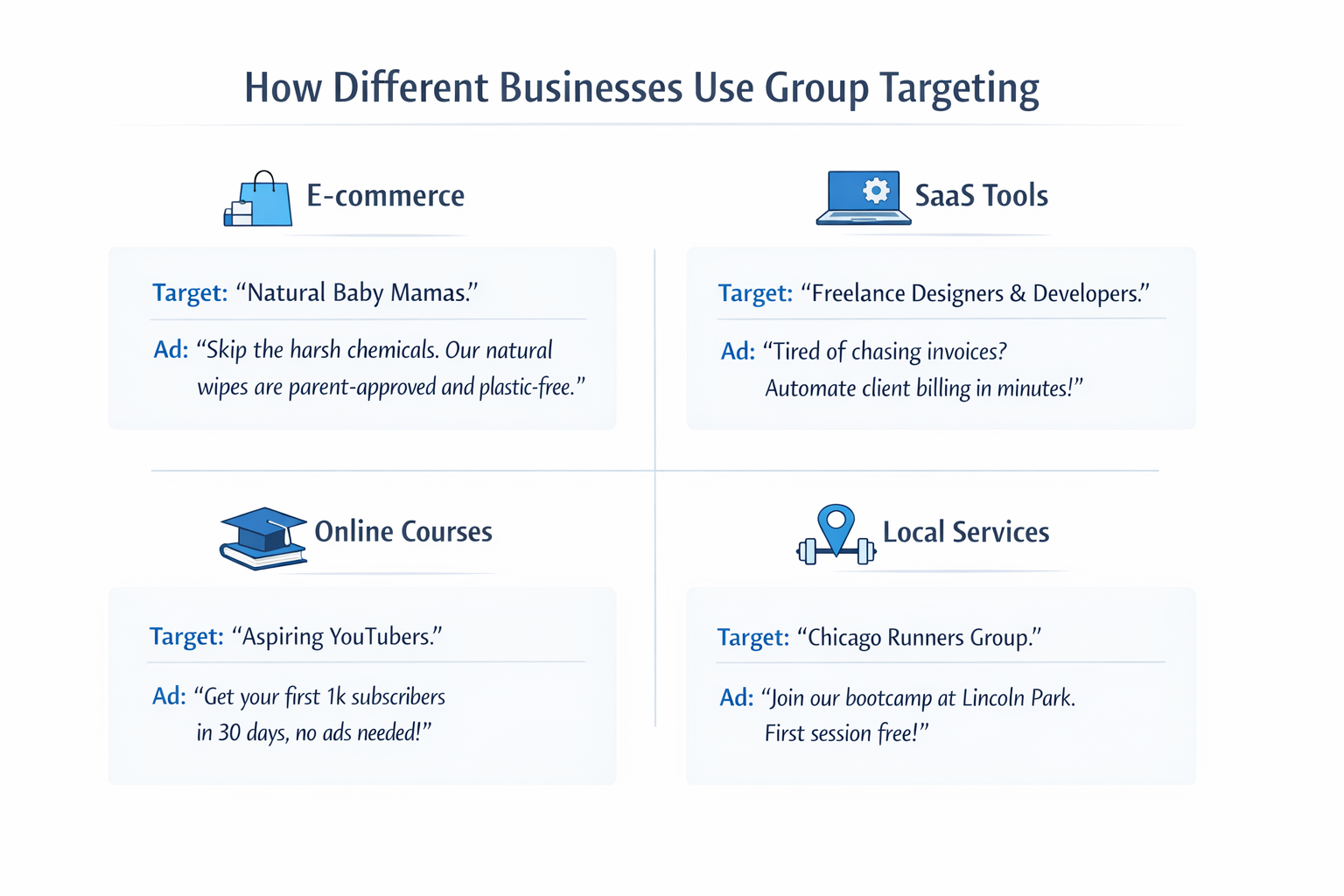
E-commerce brands
Product: Eco-friendly laundry detergent.
Group targets:
-
"Zero Waste Living – Tips & Products";
-
"Plastic-Free Home Swaps";
-
"Non-Toxic Moms – Product Reviews."
Why it works: Members are already searching for safer, eco-friendly alternatives. Your product solves a problem they’re discussing daily.
Ad idea:
"Skip the chemicals. Our zero-waste detergent cleans deep, smells fresh, and leaves no plastic behind. Try it risk-free today."
SaaS tools
Product: Email automation for solo businesses.
Group targets:
-
"Solopreneurs Automate Everything";
-
"Online Business Tools & Tech Support";
-
"Notion for Freelancers & Creators."
Why it works: These users are looking to save time, grow, and reduce admin work. Your tool meets that need.
Ad idea:
"Still sending client emails manually? Our app helps solopreneurs automate follow-ups in 5 minutes — no tech skills needed."
Courses and info products
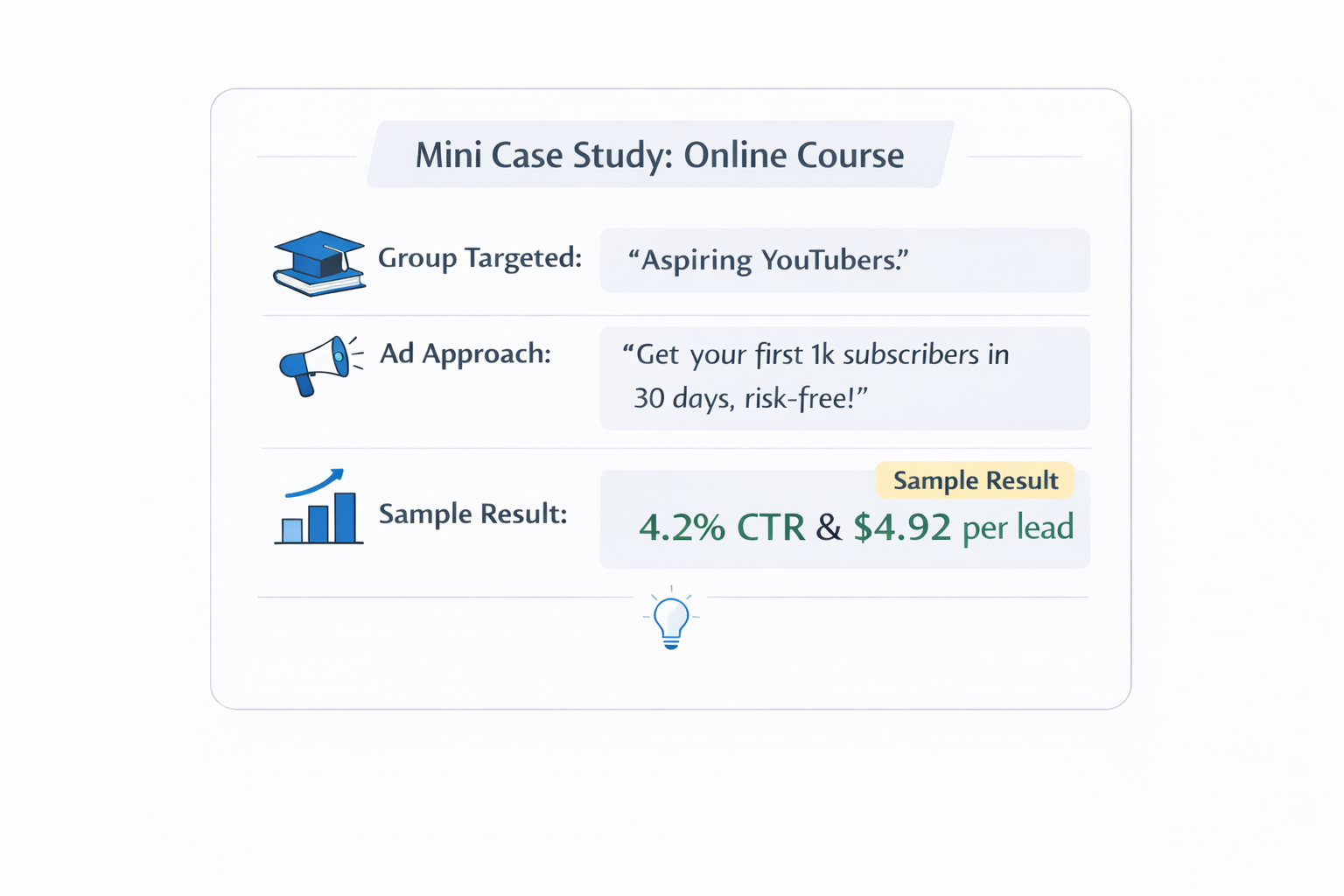
Product: Digital course on growing a YouTube channel.
Group targets:
-
"Aspiring YouTubers – Learn & Grow";
-
"Video Creators Mastermind";
-
"Monetize Your Channel Fast."
Why it works: Members are eager to grow and monetize. They want real strategies — and will pay for them.
Ad idea:
"Struggling with views and subs? Our 6-week course shows how new creators hit 1k subscribers with zero ad spend."
Local service businesses
Business: Personal trainer in Austin.
Group targets:
-
"Austin Moms Who Lift";
-
"Texas Runners Unite";
-
"ATX Fitness Events & Challenges."
Why it works: Geo-targeted + interest-based = powerful intent. These users care about health and live in your service area.
Ad idea:
"Live in Austin? Join our small group training for women — first week is free, no pressure, no mirrors."
How to use LeadEnforce effectively
Once you’ve chosen the right groups, use LeadEnforce to turn them into custom audiences and launch campaigns. Here’s how to do it well.
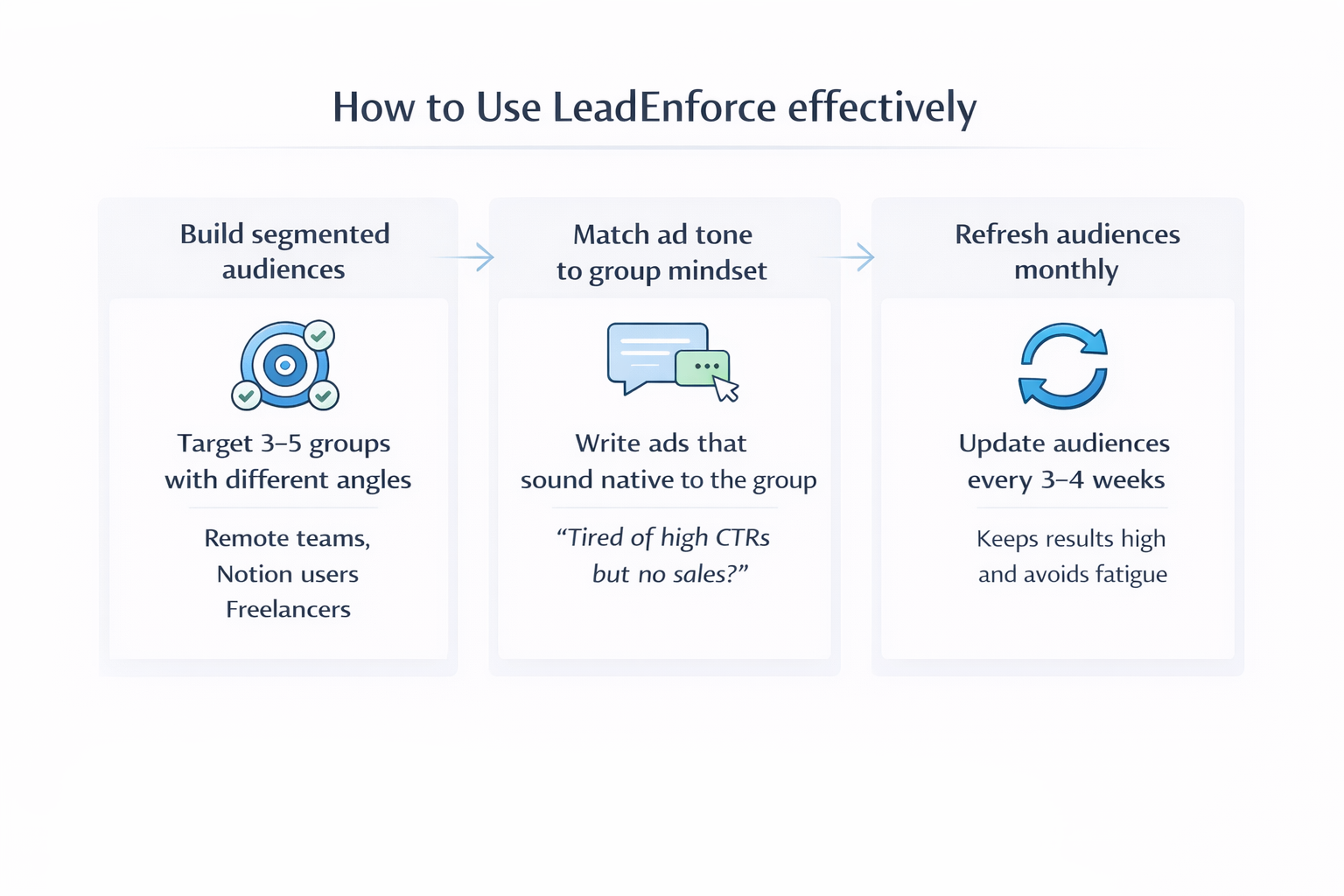
1. Build multiple audience segments
Don't just pick one group and hope for the best. Start with 3–5 groups that cover different angles or needs.
Example:
If you sell a project management tool:
-
Target one group focused on "Remote Teams";
-
Another on "Notion Users";
-
And another on "Time Management for Freelancers."
Compare performance, then scale the winner.
2. Customize your ad to match the group mindset
Your copy should sound like it belongs in the group. That’s how you stop the scroll.
If targeting: "Facebook Ads Troubleshooting".
Don’t say:
"Grow your business with our all-in-one ad solution."
Do say:
"Tired of high CTRs but no sales? It’s not your creative — your funnel’s broken. Here’s how to fix it."
When you speak the group’s language, your ad feels more like help than promotion.
3. Refresh your audience regularly
People leave groups. New members join. For best results, rebuild your LeadEnforce audience every 3–4 weeks.
This keeps your targeting fresh and avoids ad fatigue. It also gives you new data to test and optimize.
Mistakes to avoid with Facebook Group targeting
Even with the right tools, it’s easy to go off track. Here are common errors:
-
Targeting groups with low intent, like hobby fan pages or meme groups;
-
Using generic, non-specific ad creatives, even when the audience is niche;
-
Targeting groups too small to scale — aim for groups with at least 2k–5k members to start.
Take time to research. It pays off in better ROAS and lower customer acquisition costs.
Final thoughts
Facebook Groups are one of the most underused but most powerful targeting options on Meta’s ad platform. They let you reach people who are actively solving problems, comparing products, and getting ready to buy.
With LeadEnforce, you can build custom audiences based on group members — and show them highly relevant ads that speak directly to what they care about.
This isn’t about guessing. It’s about meeting users exactly where they are, with a message that fits.