Getting clicks on your ads is just the beginning. If people visit your site but don’t buy, your real problem starts after the click.
This happens more often than most advertisers expect. You launch a Facebook or Instagram campaign, get strong traffic, and even decent engagement. But when you check sales? Almost nothing.
Here’s why that happens — and what to do about it.
High intent doesn’t mean high trust
Just because someone clicks your ad doesn’t mean they’re ready to pull out their wallet. Many users are curious, not committed.
Maybe they like the product, but they aren’t sure if it’s the right one. Or they need more time, more confidence, or just a better reason to act now.
What stops them?
People hesitate when the page doesn't give them the information or confidence they need to buy.
Some common gaps:
-
Weak or generic reviews. “Great quality” or “I love it” doesn’t mean much. Add real, specific testimonials like: “My eczema cleared up after 5 days of using this cream. Worth every penny.”
-
No clear reason to choose you. If your store looks like dozens of others selling similar items, people bounce. Show what makes you different. Is it faster delivery? Better quality? Local production?
-
Missing answers to doubts. Buyers often wonder, “Will it fit me?”, “Can I return it?”, or “Is it worth the price?” If they can’t find quick, clear answers, they leave.
Tip: Add a "Why choose us" section on your product page. Include visuals, FAQs, or icons that explain what makes you better — not just cheaper.
For more on how to build landing pages that reduce bounce and boost trust, check out 7 Tips to Optimize Your E-commerce Landing Page.
The audience may not be ready to buy — yet
You could be showing great ads... to the wrong people. If someone doesn’t know they need your product yet, they won’t buy no matter how strong the creative is.
Let’s say you're selling a posture corrector. If your ad reaches people who’ve never thought about back pain, they may scroll past or click out of curiosity — but they won’t purchase.
| Signal | What it Means | What to Test Next |
|---|---|---|
| High bounce rate | Visitors leave quickly — low interest or wrong expectations | Test different hooks or creatives; align landing page with ad promise |
| Low time on site (< 30 sec) | Users aren’t engaging — unclear value or confusing layout | Improve above-the-fold messaging; simplify product presentation |
| No add-to-cart or scroll behavior | Audience not in buying mindset yet | Target a warmer segment (e.g., group followers); use educational or problem-aware ads |
| High CTR, zero sales | Ad attracts attention but not purchase intent | Check if offer is too aggressive for cold users; add a soft call-to-action |
| Frequent “Save” or “Share” clicks | Interest is there, but intent is delayed | Retarget with urgency (e.g., reviews, stock alerts, discount-based follow-ups) |
Signs your audience isn’t warm enough:
-
High click-through rate but no sales;
-
Short page sessions (under 30 seconds);
-
Very few add-to-cart or initiate checkout events.
These are signs that the interest is there, but purchase intent isn’t.
What to test instead:
-
Warm audience retargeting. Create campaigns for people who watched over 50% of your video ad, or saved a product post. These users have already shown intent.
-
Use interest-based custom audiences. With tools like LeadEnforce, you can target followers of niche Facebook groups or Instagram pages. For example, target people who follow fitness rehab accounts if you’re selling joint support products.
-
Awareness-based hooks. If your audience is cold, use educational angles: “4 signs your office chair is ruining your back” works better than “Buy our cushion now.”
Tip: Run two campaigns — one for cold traffic with an educational hook, and one for retargeting warm users with urgency-based offers or bundles.
Want to build these smarter segments? See How LeadEnforce Simplifies Audience Segmentation for Better Ad Results.
The funnel has friction
Many advertisers spend weeks testing ad creatives but never touch their product page. That’s a mistake.
Even if people want to buy, they’ll quit if the process feels confusing, clunky, or slow.
Common conversion killers:
-
Slow mobile load time. If your site takes more than 3 seconds to load, you’ll lose over half your mobile visitors. Test your page speed on tools like PageSpeed Insights or GTmetrix.
-
Cluttered checkout process. Too many pop-ups, unclear buttons, or surprise form fields can cause people to give up. Keep the checkout flow clean, linear, and short.
-
Hidden or late-added costs. People hate seeing unexpected shipping fees after they've added to cart. It’s better to show the total cost upfront — or offer free shipping above a certain threshold.
Tip: Use heatmaps (like Hotjar or Microsoft Clarity) to see where users drop off. You might find they’re abandoning at a promo code field or getting stuck on a payment page.
You’ll find more troubleshooting ideas in Reducing Drop-Off: Fixing E-Commerce Ads That Get Clicks But No Sales.
You’re optimizing for clicks — not purchases
Getting a great click-through rate feels good. But if those clicks aren’t leading to sales, you’re wasting budget.
This happens when you only look at surface metrics: CTR, impressions, even CPC. But what about what happens after the click?
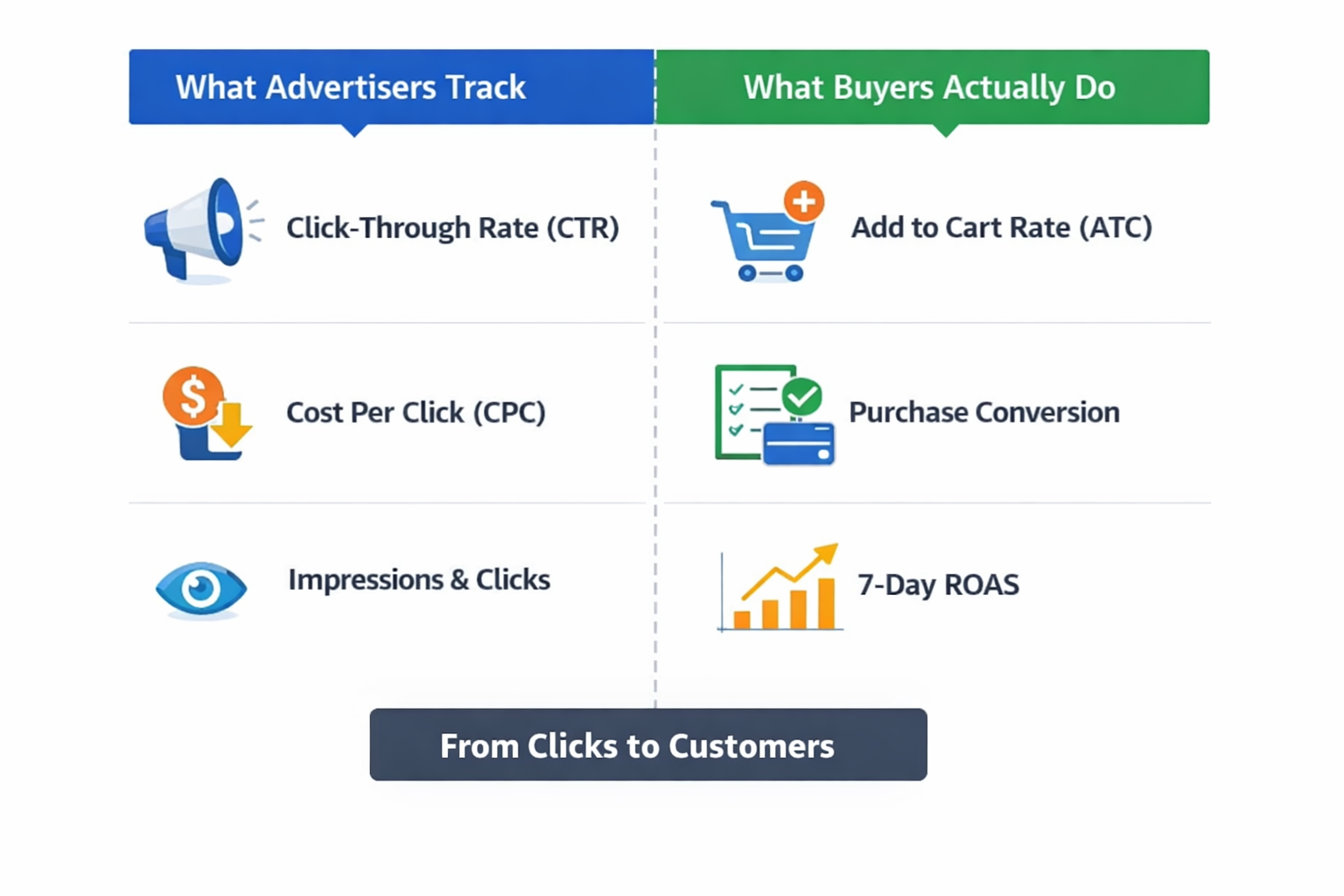
Metrics that tell a better story:
-
Add-to-cart rate. Are people taking the first buying step?
-
Initiate checkout. This shows serious buying intent — more than just curiosity.
-
7-day vs 1-day attribution. Not all buyers convert right away. Especially true for products over $50 or with longer decision cycles.
Tip: Always compare your short-window performance (1-day view, 1-day click) with longer attribution windows (7-day, 28-day). You may discover hidden winners.
To understand how delayed results and attribution gaps affect reporting, explore The Attention-Recall Gap: Why Clicks Don’t Equal Conversions.
Your ad is asking too much, too soon
Many e-commerce ads go straight for the sale: "Buy now" or "Shop the collection." But what if your user isn’t even aware of their problem yet?
That’s like proposing marriage on the first date.
Instead, lead with something relatable. Something that makes them stop and think, "Yes, that’s me."
Better performing ad styles:
-
Story-style hooks. Start with: “I used to dread looking in the mirror until I tried this...”
-
Problem-first carousel. Slide 1: “Still struggling with foot pain?” Slide 2: “Here’s what most shoes miss.” Slide 3: “Our insoles fix it — here’s how.”
-
UGC-style video with real talk. A shaky, iPhone-style video with someone talking casually about the product often outperforms polished brand videos.
Tip: On Meta Ads, test a low-budget UGC-style campaign alongside your main one. Sometimes the rough, real-looking ad brings better results.
Bonus tip: segment based on buyer stage
Not all website visitors are the same. Some are browsing, some are comparing, and some just need a nudge to finish the purchase.
Use retargeting to match the message to the moment:
-
First visit: Show benefits, reviews, and use cases.
-
Second visit (no add to cart): Show FAQs, guarantees, or limited-time offers.
-
Added to cart but didn’t buy: Show social proof, testimonials, or urgency (e.g., “Only 4 left in stock”).
Tip: Dynamic product ads with tailored creatives work great here. Set up conditional messages based on user behavior to personalize each touchpoint.
If you want step-by-step help, see the Retargeting Strategies That Double Your ROAS.
Final thoughts: don’t just fix ads — fix the whole journey
Most advertisers jump from creative to creative, hoping the next ad will perform better. But that skips over the real issue: why people aren’t buying.
If you understand your audience’s hesitations, remove friction in the funnel, and match your message to their mindset — your conversions will improve.
Remember: getting traffic is easy. Turning that traffic into real buyers? That’s where smart marketers stand out.