Most targeting problems don’t show up inside Ads Manager. They show up two weeks later — when sales starts rejecting leads.
If you’re only optimizing toward platform signals like CPL or CVR, you’re training the system on incomplete feedback. Sales feedback closes that loop. Without it, targeting drifts toward what is easy to convert, not what is valuable to close.
This article explains how to operationalize sales feedback so it actually improves targeting — not just reporting.
Why Targeting Degrades Without Sales Input
A campaign can look stable while quietly losing relevance.
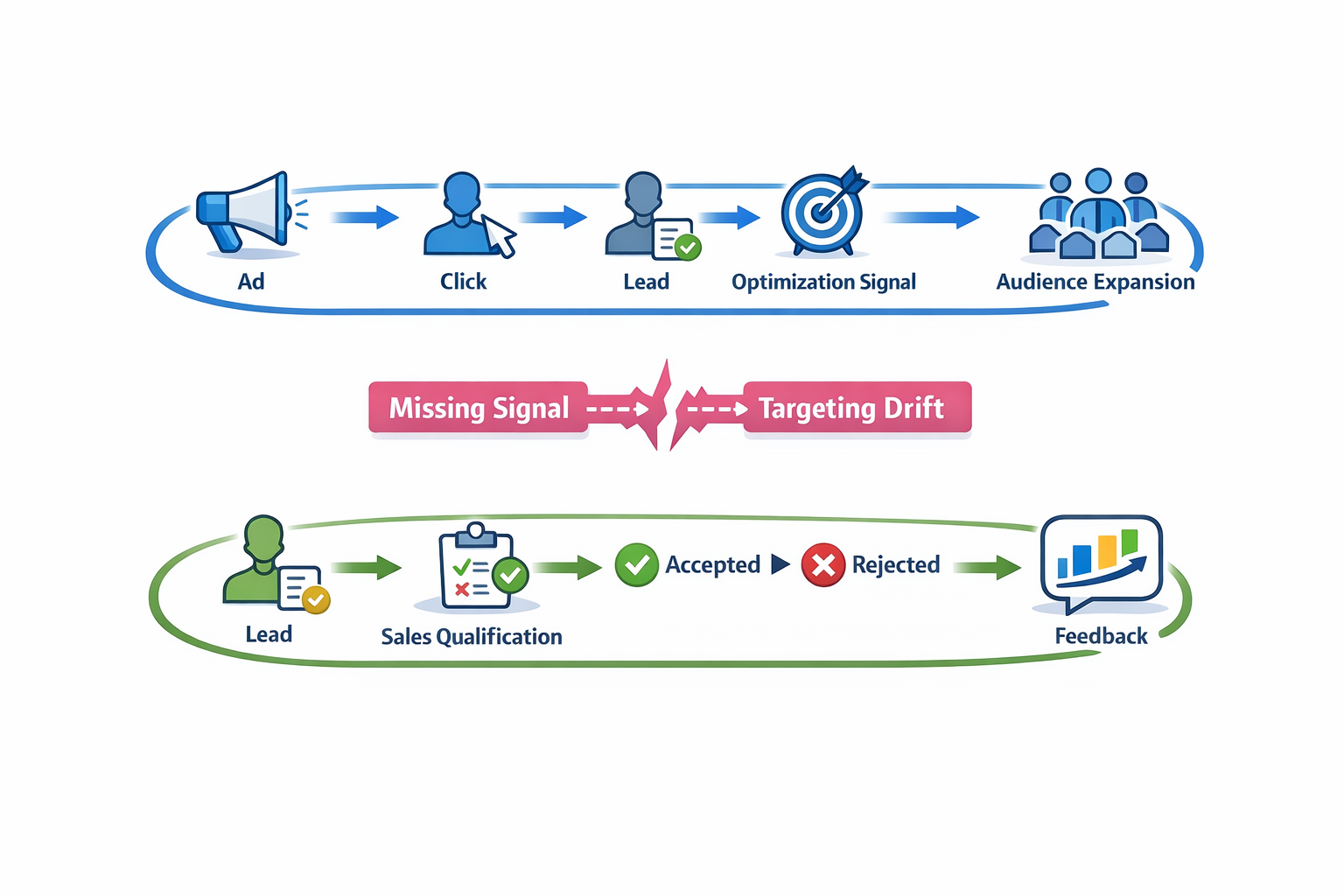
You’ll often see this pattern:
-
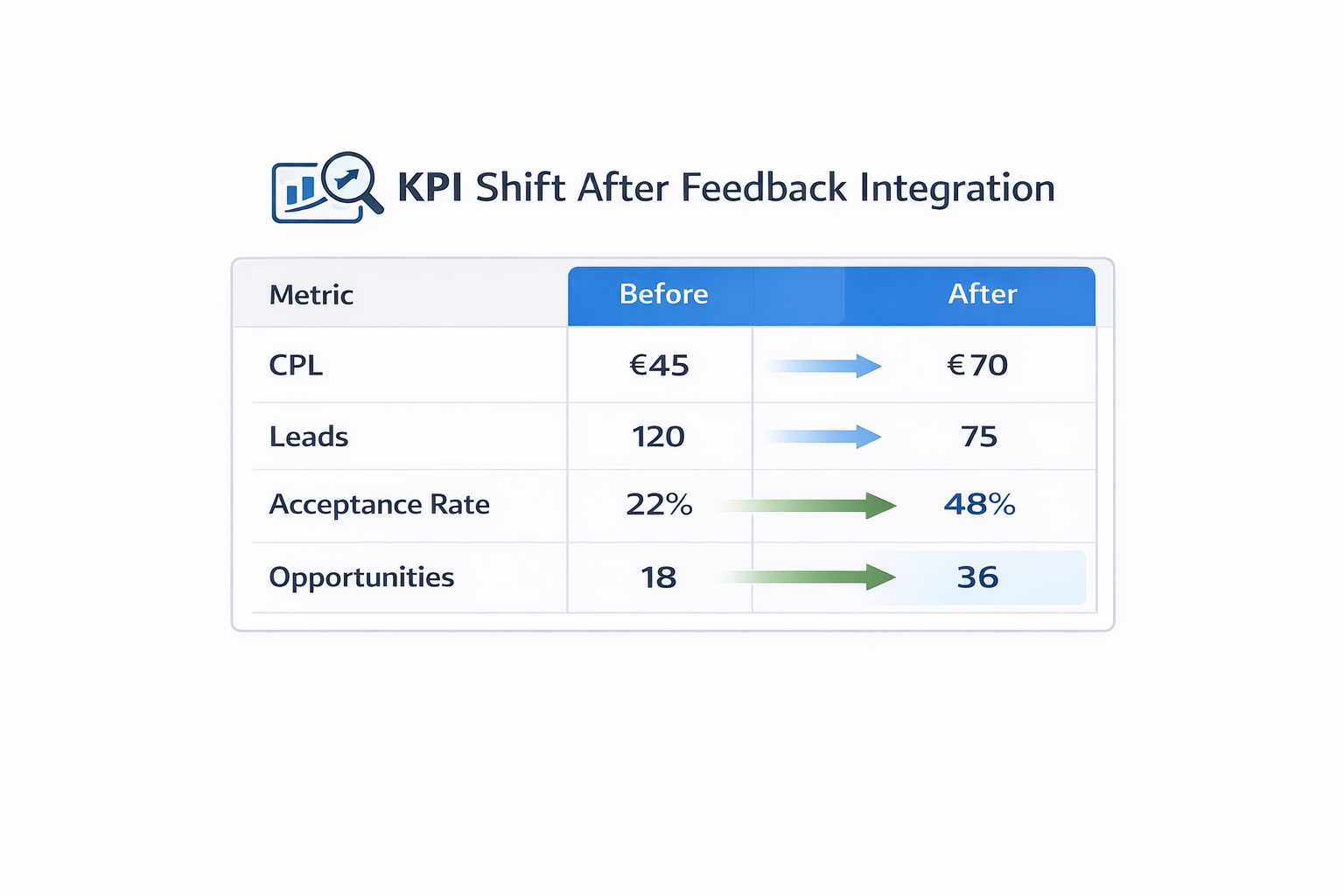
CPL decreases over time, which suggests improving efficiency.
-
Lead volume increases as the algorithm finds easier conversions.
-
Sales acceptance rate drops because the leads no longer match ICP.
The mechanism is straightforward.
Meta’s delivery system optimizes toward conversion probability within the defined event. If your event is a form fill, the algorithm learns which users are most likely to submit forms — not which ones will convert into pipeline.
Over time, it shifts toward:
-
lower-friction users,
-
broader behavioral clusters,
-
audiences with weaker commercial intent.
You’re not “losing targeting precision.”
You’re training the system on the wrong signal.
This is the same pattern described in fixing audience misalignment in Facebook ads.
Where Most Teams Break the Feedback Loop
Sales feedback often exists, but it doesn’t influence targeting decisions.
Typical failure points include:
-
Feedback lives in CRM notes and never gets structured into usable data.
-
Marketing reviews acceptance rate weekly but doesn’t connect it to specific campaigns or audiences.
-
Rejected leads are treated as noise instead of a pattern.
You can spot this gap when:
-
campaigns scale despite declining pipeline contribution,
-
targeting changes are based on CTR or CPL fluctuations,
-
sales complaints repeat without triggering adjustments.
This is why relying only on surface metrics creates blind spots — explained well in analyzing Facebook ad performance beyond CTR and CPC.
Structuring Sales Feedback for Targeting Use
To make feedback actionable, you need to convert it into structured signals that map to campaign variables.
Start with classification.
Instead of generic “qualified / unqualified,” define categories tied to targeting decisions:
-
ICP match (yes / no) — based on firmographics and role.
-
Intent level (high / medium / low) — based on sales interaction.
-
Disqualification reason — standardized tags such as “wrong industry,” “too small,” “no budget,” or “student/research.”
Then connect this data to campaign dimensions:
-
campaign or ad set,
-
audience type (broad, lookalike, interest-based),
-
creative or offer variation.
This approach aligns with how audience intelligence improves Facebook targeting.
Without this mapping, feedback stays descriptive. With it, it becomes diagnostic.
Aligning Targeting With Real Buyer Intent
Sales feedback often reveals that the wrong people are responding to the offer — not that targeting is inherently wrong.
For example:
-
If sales hears “just exploring,” your messaging may be too generic.
-
If leads misunderstand pricing or scope, your positioning is too broad.
In this case, targeting adjustments alone won’t fix the issue.
You need to:
-
increase specificity in the offer,
-
introduce friction that filters out low-intent users,
-
clearly signal who the product is for — and who it isn’t.
This directly connects to how high-performing lead generation ads are structured.
Key Takeaway
Targeting improves when the optimization signal reflects real buying behavior.
If sales feedback isn’t structured, connected to campaigns, and fed back into optimization, the system will continue learning from incomplete signals — and your targeting will follow.