Low-priced products often fail on Facebook Ads not because of targeting issues, but because the economics don’t support the platform’s optimization model.
You can get clicks. You can even get conversions. But the system still under-delivers, scales poorly, or becomes unstable after a few days.
This is not a creative problem or a tracking issue. It’s a structural mismatch between product pricing and how Meta’s auction operates.
Why Low-Priced Products Struggle in Meta’s Auction
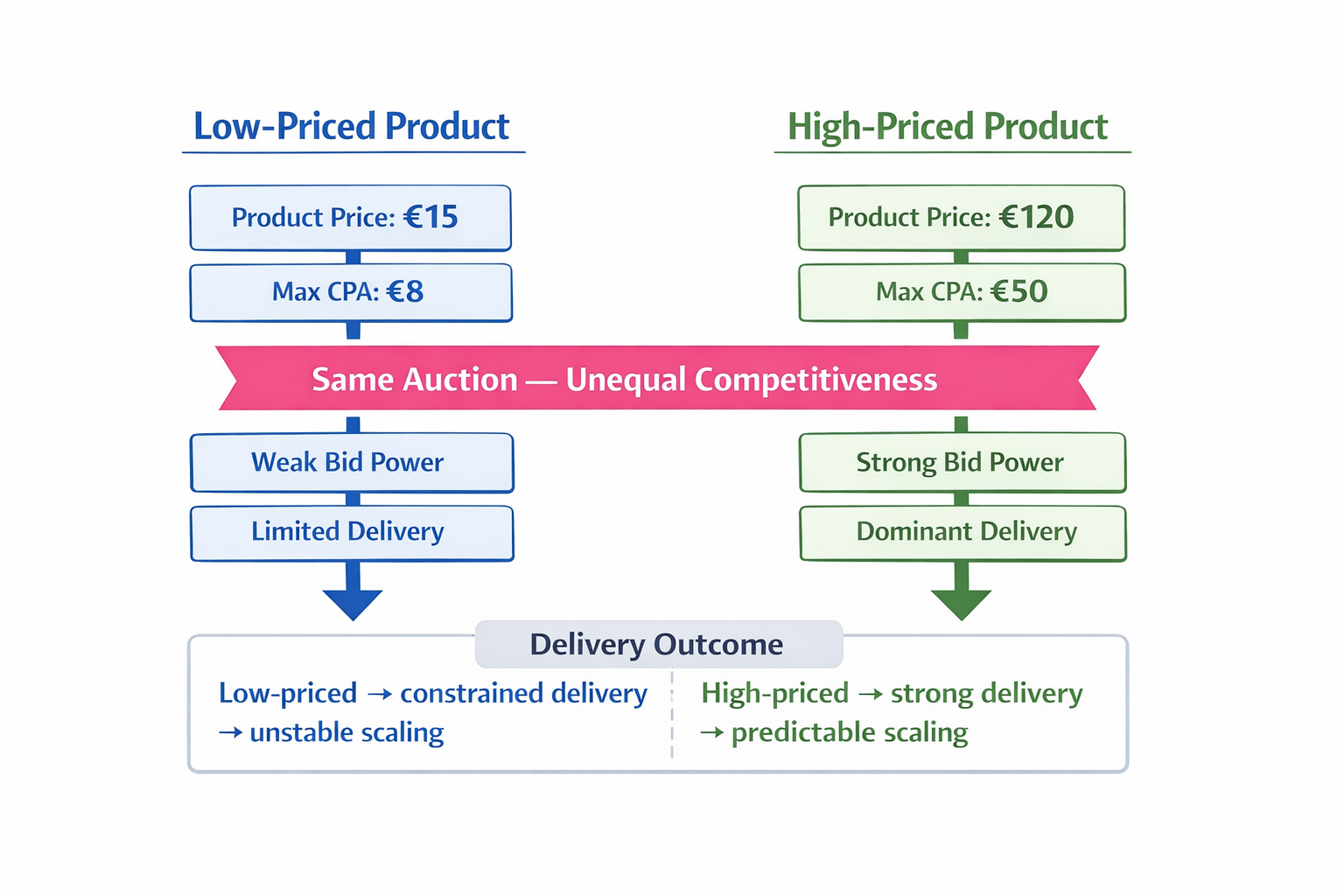
If your product sells for €10–€30, you’re entering the same auction as advertisers selling €200+ products.
The platform doesn’t adjust expectations based on your price. It optimizes for conversion signals and value density, not affordability.
Here’s what happens in practice:
-
You compete against higher-value advertisers, meaning they can afford higher CPMs and still stay profitable.
-
Your allowable CPA is extremely low, often below €5–€10, which leaves almost no margin for fluctuation.
-
The algorithm struggles to prioritize your ads, because even successful conversions generate weak value signals.
This dynamic is tied to how Meta distributes impressions in auctions, which is explained in Facebook Ad Auction: Do Ad Sets Compete Against Each Other?
The Core Constraint: Value Density Per Conversion
Meta’s system evaluates how much value each conversion represents, not just whether it happened.
Low-priced products send weak signals.
Here’s why that matters:
-
A €15 purchase doesn’t justify aggressive bidding, so your ads lose auctions more frequently.
-
The algorithm receives limited feedback strength, making it harder to confidently expand targeting.
-
Optimization becomes fragile, especially during scaling or audience expansion.
You’ll often see this pattern in Ads Manager:
-
Stable results for 2–3 days.
-
Sudden CPM increase.
-
Drop in conversions despite similar spend.
That’s not randomness. It’s the system reallocating delivery toward higher-value advertisers.
Why Scaling Breaks Faster Than Expected
Low-priced products can work at small spend.
Scaling exposes the problem.
At higher budgets:
-
You enter broader auction segments, where competition is stronger and less predictable.
-
Frequency increases faster, because the algorithm can’t find enough high-probability buyers.
-
Conversion rates drop, even if your funnel hasn’t changed.
This is the same pattern described in What to Do When Facebook Ads Stop Scaling Beyond a Certain Point — performance doesn’t decline randomly, it weakens as the system expands into lower-quality traffic.
The Hidden Issue: Optimization Thresholds
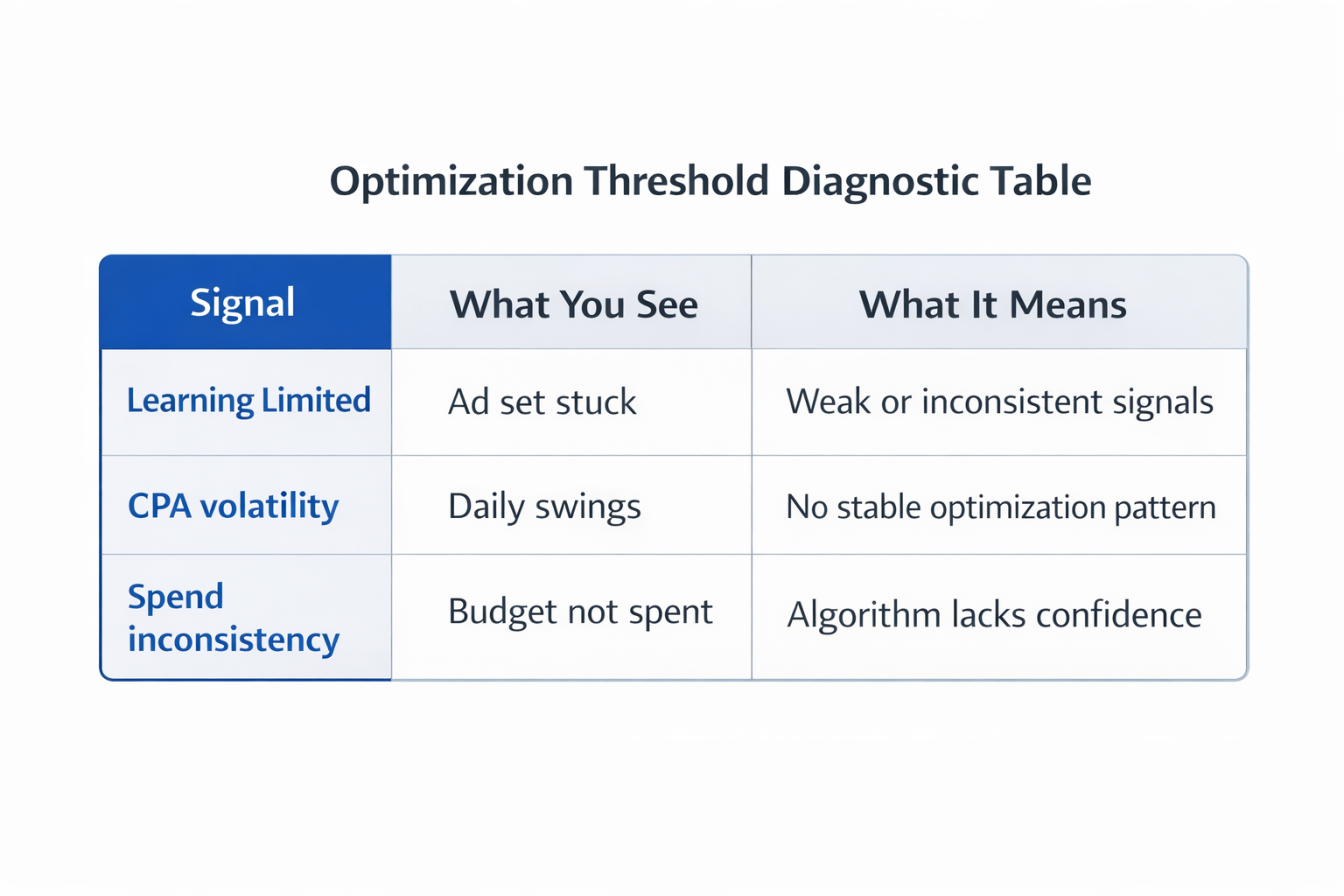
Meta needs consistent, high-quality conversion signals to stabilize delivery.
Low-priced products struggle here.
What actually happens:
-
You generate conversions, but not enough high-confidence patterns for the algorithm to learn from.
-
Learning phases reset frequently, especially after budget or creative changes.
-
Delivery becomes inconsistent, because the system never fully exits exploration mode.
If you’re seeing “Learning Limited” often, it’s worth reviewing What Does “Learning Limited” Mean in Facebook Ads? — the issue is rarely setup, and almost always signal strength.
When Cheap Products Still Work (And Why)
Low-priced products can work — but only under specific conditions.
1. Strong Impulse Demand
If the product solves an immediate, obvious problem:
-
Simple accessories with clear utility.
-
Problem-solution products demonstrated visually.
-
Low-friction “try it now” offers.
High conversion rate compensates for low price.
2. Bundling That Increases AOV
Single items rarely scale.
Bundling changes the economics entirely:
-
“Buy 2, get 1 free” increases order value without raising perceived cost.
-
Starter kits turn a €12 product into a €35 purchase.
-
Volume discounts improve margin per transaction.
This is why increasing order value is critical, as outlined in How E-Commerce Stores Can Use Facebook Ads to Increase Average Order Value.
Higher AOV = stronger signals = better delivery.
3. Post-Purchase Monetization
If you only measure first purchase, you’re missing the model.
Low-priced front-end offers can work when:
-
You upsell immediately after purchase.
-
You run email or SMS retention flows.
-
You drive repeat purchases within 30–60 days.
The ad system sees weak value, but your backend revenue compensates.
The Most Common Mistake: Forcing Direct Profitability
This is where most campaigns fail.
Advertisers expect:
→ Immediate profitability from a €10–€20 product.
But:
-
CPMs are rising across most audiences.
-
Click costs have a natural floor.
-
Conversion rates are capped by user behavior.
If your margin per order is €5–€10, there is no buffer for volatility.
How to Make Low-Priced Products Work on Facebook Ads
The solution is not better targeting.
It’s changing how value is structured.
Shift from Product-Level to Offer-Level Thinking
Instead of selling a single item:
-
Combine products into higher-value bundles.
-
Add bonuses that increase perceived value without increasing cost significantly.
-
Introduce thresholds, such as free shipping over €30.
You’re changing how the algorithm evaluates your business, not just the offer.
Use Conversion Events That Reflect Real Value
If you optimize for low-value purchases, performance stays limited.
Instead:
-
Optimize for higher-value events, such as bundle purchases.
-
Separate campaigns for entry-level vs high-value buyers.
-
Use value-based optimization where possible.
This shifts optimization toward profitable behavior, not cheap conversions.
Accept That Scaling Requires Margin Buffer
Scaling requires tolerance for:
-
CPM volatility.
-
Creative fatigue.
-
Audience expansion inefficiencies.
If your model doesn’t allow for that:
Performance will collapse as soon as you increase spend.
Practical Takeaway
Before adjusting targeting, ask:
Is the value per conversion strong enough for the auction you’re entering?
If not, no amount of optimization will fix it.
You need to:
-
Increase average order value.
-
Strengthen conversion signals.
-
Or improve backend monetization.
Once those are in place, performance becomes stable and scalable.