Many Instagram advertisers diagnose performance problems from the wrong metrics.
The campaign starts slowing down, CPA rises, and conversions become inconsistent. The advertiser checks CTR, CPM, CPC, and frequency first. Sometimes those numbers still look healthy.
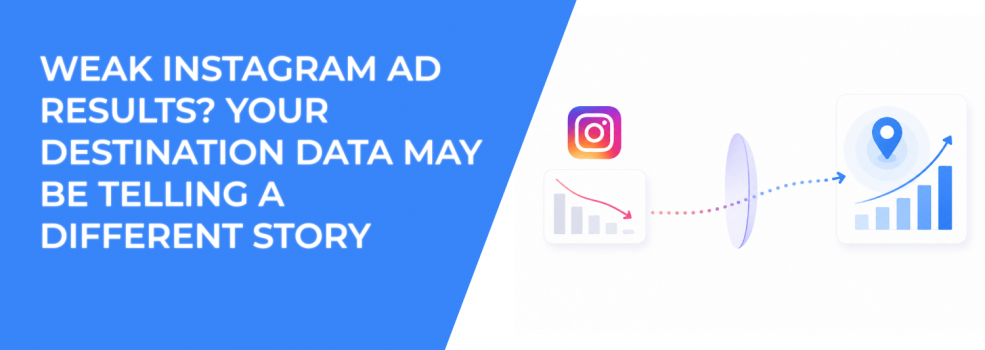
The real problem often appears somewhere else: destination behavior.
Users may still click the ad while quietly avoiding the action the campaign actually needs. They open profiles instead of product pages. They tap into DMs but disappear immediately afterward. They visit landing pages and exit within seconds.
Those patterns reveal intent problems long before the top-line metrics collapse.
Problem: Instagram Campaign Metrics Often Hide Weak Destination Behavior
Instagram users do not interact with every destination equally.
A profile visit usually signals curiosity or trust validation. A website tap signals willingness to leave Instagram and continue exploring the offer. A DM start often shows hesitation, clarification needs, or service interest.
When those behaviors get blended together inside broad click metrics, advertisers lose visibility into what users actually wanted after seeing the ad.
This creates misleading optimization decisions.
For example, a campaign may generate:
- strong CTR;
- low CPC;
- rising outbound clicks;
- weak purchases or low-quality leads.
At first glance, the traffic looks efficient.
But destination data may show that most users are tapping into low-commitment paths instead of progressing toward conversion. The campaign is producing activity without producing enough commercial intent.
That is why click-through rate can be misleading in Instagram campaigns where destination behavior is ignored.
The issue becomes more expensive during scaling. Meta starts optimizing toward the interaction pattern receiving the strongest early engagement signals. If low-intent destination taps dominate delivery, the algorithm gradually expands toward users likely to repeat the same weak behavior.
At that point, advertisers often see what looks like random instability:
- conversion rates fluctuate;
- CPA increases unpredictably;
- lead quality weakens;
- performance changes despite stable creatives.
The destination data usually explains the pattern earlier than Ads Manager’s top-line metrics do.
Solution: Use Destination Response Data to Diagnose Intent Problems Earlier
Destination behavior helps advertisers understand where the user journey breaks.
Instead of measuring clicks as one aggregated action, track how users behave across different destination types and compare the quality of those interactions.
The most useful destination comparisons usually include:
- profile visits versus website visits;
- DM starts versus form submissions;
- product-page taps versus add-to-cart behavior;
- landing page views versus bounce rates.
These differences matter because each destination reflects a different level of buying intent.
For example, a campaign generating large numbers of profile visits may not actually have a targeting problem. Users may simply need more trust signals before converting. Another campaign may produce strong website traffic but weak on-site engagement because the landing page creates friction immediately after the click.
This is where good numbers hide bad performance inside Instagram campaigns.
Destination data also helps isolate which part of the funnel is failing.
If users willingly enter DMs but refuse forms, the issue may be qualification friction. If users tap product pages but abandon checkout immediately, the issue may be pricing, page speed, or weak offer positioning. If profile visits dominate while website taps stay low, the campaign may still be stuck in early-stage consideration behavior.
Those distinctions matter because each problem requires a different optimization response.
Many advertisers rebuild creatives too early because they cannot see where intent disappears. Destination-level behavior provides that visibility.
It also improves audience evaluation.
A broad audience may produce large amounts of low-commitment profile activity without enough downstream buying behavior. A narrower audience may generate fewer clicks but stronger destination progression. That is why high buying intent matters far more than raw engagement volume.
Campaigns become easier to optimize when destination data is treated as an intent signal instead of just another reporting metric.
Final Takeaway
Weak Instagram ad results often begin as weak destination behavior.
Users may still click the ad while quietly avoiding the actions tied to real business outcomes. Destination response data exposes those intent problems earlier than CTR or CPC usually can.
Advertisers who study where users choose to go — and what they do afterward — make far better optimization decisions than advertisers who only measure clicks.