Advertising on Facebook and Instagram is changing. Targeting tools that once gave advertisers control are now limited or gone. Privacy rules, platform updates, and AI-driven delivery systems are forcing marketers to rethink how campaigns are built and optimized.
This article explains what’s happening, why traditional targeting is fading, and how advertisers can still drive results when they can’t precisely choose their audience.
Why you can’t target like you used to
Privacy and tracking changes
Over the last few years, several shifts have reduced how much user-level data advertisers can access:
-
Apple’s App Tracking Transparency (ATT); iPhone users can block apps like Facebook from tracking them across other apps and websites.
-
Privacy laws such as GDPR and CCPA; these restrict how personal data can be collected, stored, and used for advertising.
-
Platform updates from Meta; Facebook increasingly encourages broad delivery, letting its system decide who sees ads.
Together, these changes reduce the reliability of interest targeting, lookalike precision, and retargeting pools. Many advertisers now see smaller audiences, weaker signals, and slower learning phases.
The algorithm takes over
As manual targeting weakens, Meta’s delivery system takes on more responsibility. Instead of relying on who you selected, Facebook decides who sees ads based on performance signals.
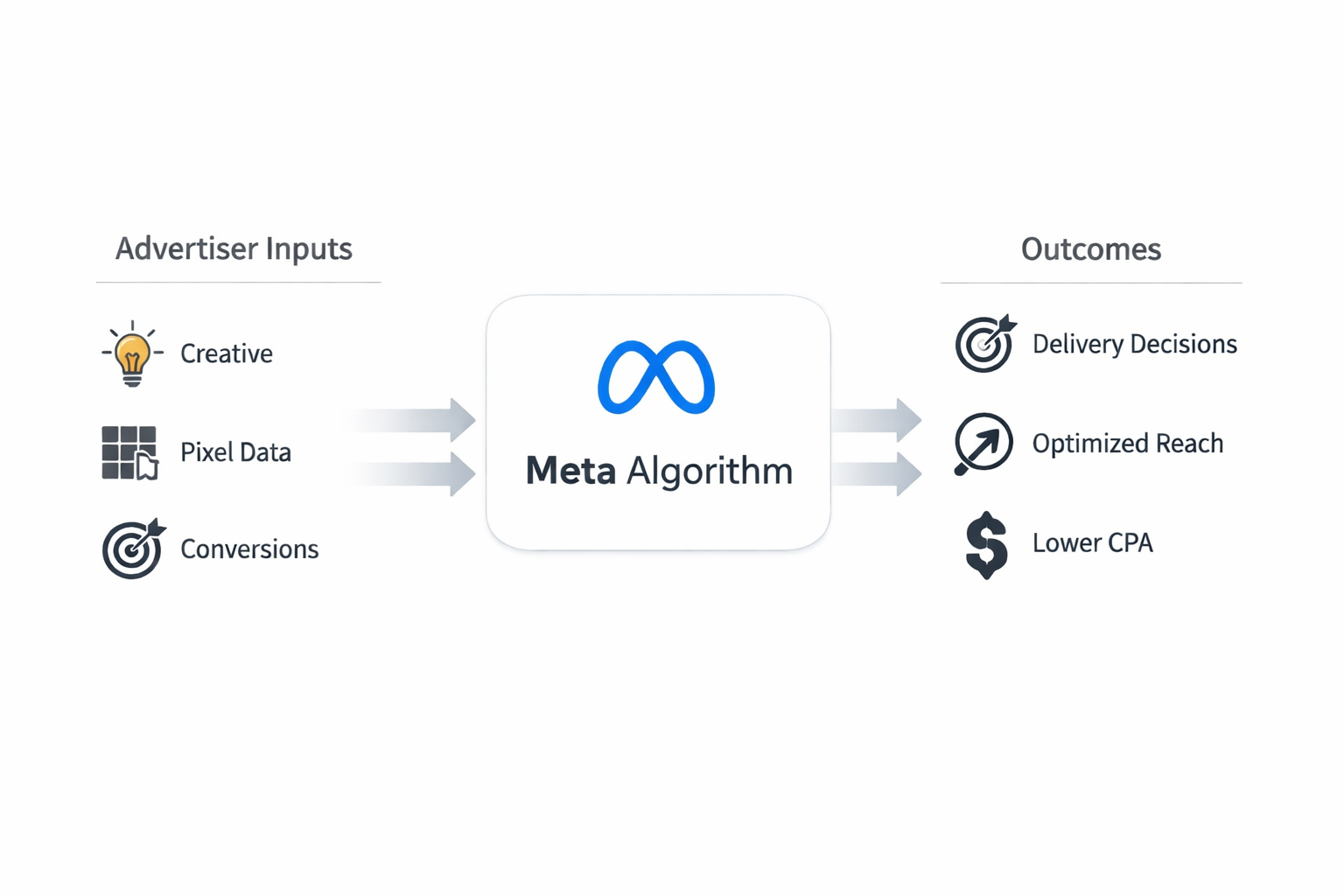
It evaluates:
-
Ad interactions; likes, comments, shares, saves, hides, and reports.
-
Post-click behavior; how long users stay on your site, whether they scroll, and if they bounce quickly.
-
Creative performance patterns; how similar ads perform with similar users across accounts.
This shift explains why advertisers increasingly see ads delivered outside their original audience definitions — and why creative quality now matters more than targeting logic.
A new way to advertise: feed the system good signals
Why your creative matters more
When you can’t tightly define your audience, your creative becomes the primary filter. Ads now need to clearly signal who they are for and why they matter.
Strong creative does this by:
-
Showing value fast; users should understand the benefit within seconds.
-
Using intent-driven messaging; speak directly to problems, such as “Still sending invoices manually?”
-
Improving the post-click experience; fast-loading, mobile-friendly pages with clear CTAs reduce bounce and improve delivery.
Ads that generate clean engagement and strong post-click behavior give the system better data to optimize against.
Don’t target — attract
Instead of narrowing an audience, advertisers now attract the right users through relevance. This works best when:
-
Language matches user intent; “Tired of missing leads?” performs better than abstract product descriptions.
-
Formats match platform behavior; short vertical videos fit Reels, while carousels work better for product education.
-
Creative blends into the feed; ads that look like native or user-generated content often outperform polished brand visuals. A practical guide to this approach is explained in How to Use User-Generated Content in Your Facebook Ads for Authentic Engagement.
When creative resonates, the algorithm finds more people like those who engage — without manual targeting rules.
Audiences still help — just not the same way
Use audiences to help the system learn
Audiences haven’t disappeared, but their role has changed. Instead of acting as strict filters, they now help train the delivery system.
The most useful inputs include:
-
Website visitors; especially users who viewed pricing, product, or checkout pages.
-
Engaged users; people who watched most of a video, saved a post, or clicked through ads.
-
Customer lists; emails from past buyers or subscribers help the system identify similar users and remain a core foundation for performance. This strategy is covered in detail in Why Custom Audiences Should Be the Core of Your Ad Strategy.
These audiences provide context, not boundaries. Meta can still go beyond them if performance improves.
Retarget with better signals
Retargeting still works, but only when it’s built around intent. Showing ads to every visitor no longer performs consistently.
Higher-quality segments include:
-
Checkout abandoners; users who reached the final step but didn’t convert.
-
Long video viewers; people who watched 75–100% of a video.
-
Repeat customers; ideal for upsells and for training lookalike-style delivery.
Cleaner signals lead to lower waste and stronger long-term results.
What results look like without tight targeting
Campaigns may feel less stable at first
Broad and automated delivery can feel unpredictable early on. Performance often fluctuates while the system learns.
To stabilize results:
-
Let learning complete; avoid frequent edits in the first few days.
-
Use realistic budgets; aim for enough volume to generate consistent conversion signals.
-
Track trends, not daily swings; short-term CPA changes matter less than engagement and post-click quality.
Over time, campaigns often settle into more stable delivery as signal quality improves.
Inputs matter more than filters
Without manual targeting, performance depends on how well campaigns are structured.
Key inputs include:
-
Creative variety; different angles, formats, and tones help the system find what works.
-
Fast, focused landing pages; speed and clarity directly affect delivery.
-
Simple campaign structure; fewer ad sets and fewer changes give clearer data.
Advertisers now guide performance indirectly — through inputs — instead of controlling it directly.
How Advantage+ and other smart targeting systems work
Meta’s Advantage+ targeting features
Meta now offers several Advantage+ targeting features that automate audience expansion and delivery decisions. These features treat advertiser inputs as suggestions, then expand beyond them when performance improves.
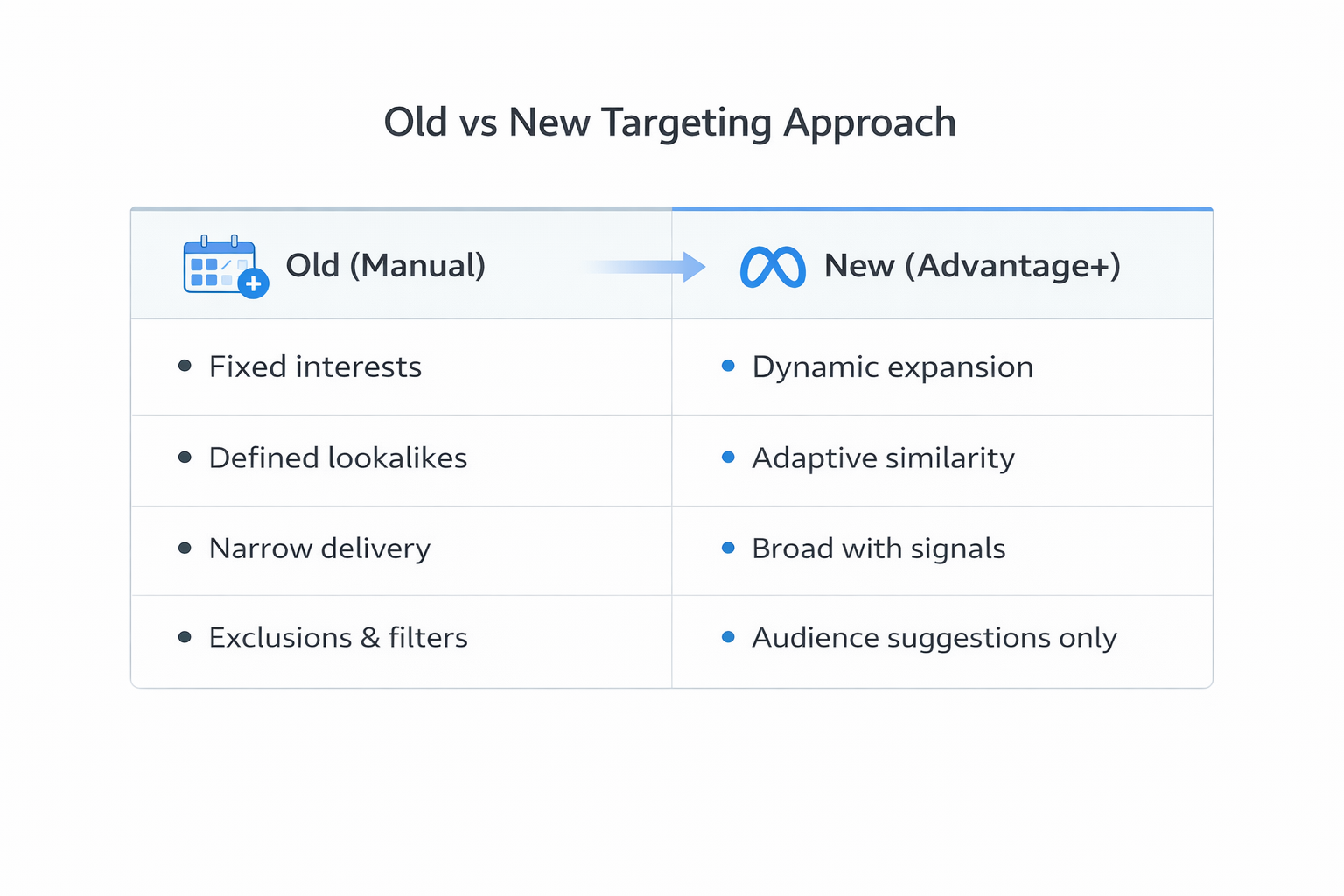
The main components are:
-
Advantage+ Audience; Meta can go beyond your suggested audience using signals like past conversions, pixel data, and ad engagement.
-
Advantage+ Detailed Targeting; exclusions are no longer available, and Meta can expand beyond selected interests if it predicts better results.
-
Advantage+ Lookalike; Meta can go beyond the selected percentage range when performance improves, using the original seed as a reference.
These tools reduce manual setup but increase reliance on signal quality. A deeper explanation of how to work with them is available in How to Improve Campaign Performance with Meta Advantage+.
Similar systems on other platforms
Meta is not alone in this shift. Other platforms now rely on similar automation:
-
Google Performance Max; automated delivery across Search, YouTube, Display, Gmail, and Maps.
-
TikTok Smart Performance Campaigns; delivery based on watch time and engagement.
-
Snapchat Auto-Expand Audiences; automatic audience expansion tied to performance.
Across platforms, targeting is becoming predictive and signal-based rather than rule-based.
How to get ready for a world without targeting
Make better creative, faster
Creative needs to scale faster than ever. Modular systems help:
-
Hooks; problem-focused openers.
-
Value angles; speed, savings, ease of use, or proof.
-
Formats; static, video, carousel, and Reels.
This approach allows rapid testing without rebuilding assets.
Rethink how you group users
Instead of demographics, focus on behavior:
-
Buyers and repeat customers.
-
Visitors to key pages.
-
Highly engaged viewers.
These behaviors signal intent more reliably than interests or age ranges.
Look at signals, not just results
Optimization now means reading indirect feedback:
-
Engagement quality, not just CTR.
-
Post-click behavior in GA4.
-
Patterns across winning creatives.
These signals guide future inputs and creative decisions.
Final thoughts
Targeting is no longer something advertisers control directly. It’s something they influence.
Platforms now reward clean signals, strong creative, and patience. Advertisers who adapt — and stop fighting automation — gain an edge.
In this environment, your message replaces your audience settings. And the system decides the rest.