Meta Ads are no longer an auction you can game with clever targeting or viral creative. In 2026, Facebook and Instagram ads run on a closed-loop machine learning system designed to prioritize session value over simple conversions.
The platforms now reward long-term user impact: content that keeps people engaged after the click, across sessions, and off-platform. Advertisers still chasing CTR or lookalike hacks are getting squeezed by rising CPMs and shrinking delivery.
To succeed now, you must understand what the algorithm wants and how to influence it from the inside.
How delivery really works now: Meta’s invisible scoring system
Surface-level results won’t cut it
Meta Ads delivery is no longer primarily driven by:
-
CTR or thumbstop rate;
-
Broad demographic targeting;
-
1-day click ROAS.
Instead, delivery weight comes from predicted downstream behavior, based on signal density.
That means Meta tracks how users behave after they click, and adjusts ad delivery accordingly.
For more on what Facebook’s algorithm actually sees and rewards, read How to Analyze Facebook Ad Performance Beyond CTR and CPC.
What Meta optimizes for in 2026
Meta uses behavioral proxies to score ad quality. You won’t see these in Ads Manager, but they matter.
Positive delivery signals:
-
Long session duration (2+ minutes post-click);
-
Multi-page navigation or scroll depth;
-
Repeat visits within 7 days;
-
Post shares, DMs, saves, and comments with keywords like “need this,” “bookmark,” or “send me.”
Negative delivery signals:
-
High bounce rate within 3 seconds;
-
Ad hides or report feedback;
-
Post-click form abandonment or slow-loading pages;
-
Passive watch behavior (for video) with no interaction.
If your ads drive cheap clicks but bad sessions, your CPM will quietly rise, and Meta will reduce impressions — even if your ROAS is decent.
Advantage+ campaigns are Meta’s default — use them strategically
Advantage+ isn’t just automation — it’s enforced feedback loops
Advantage+ shopping and Advantage+ app campaigns now control over 70% of spend in most eCommerce accounts. They collapse audience, placement, and creative optimization into a black-box model trained on value-based signals.
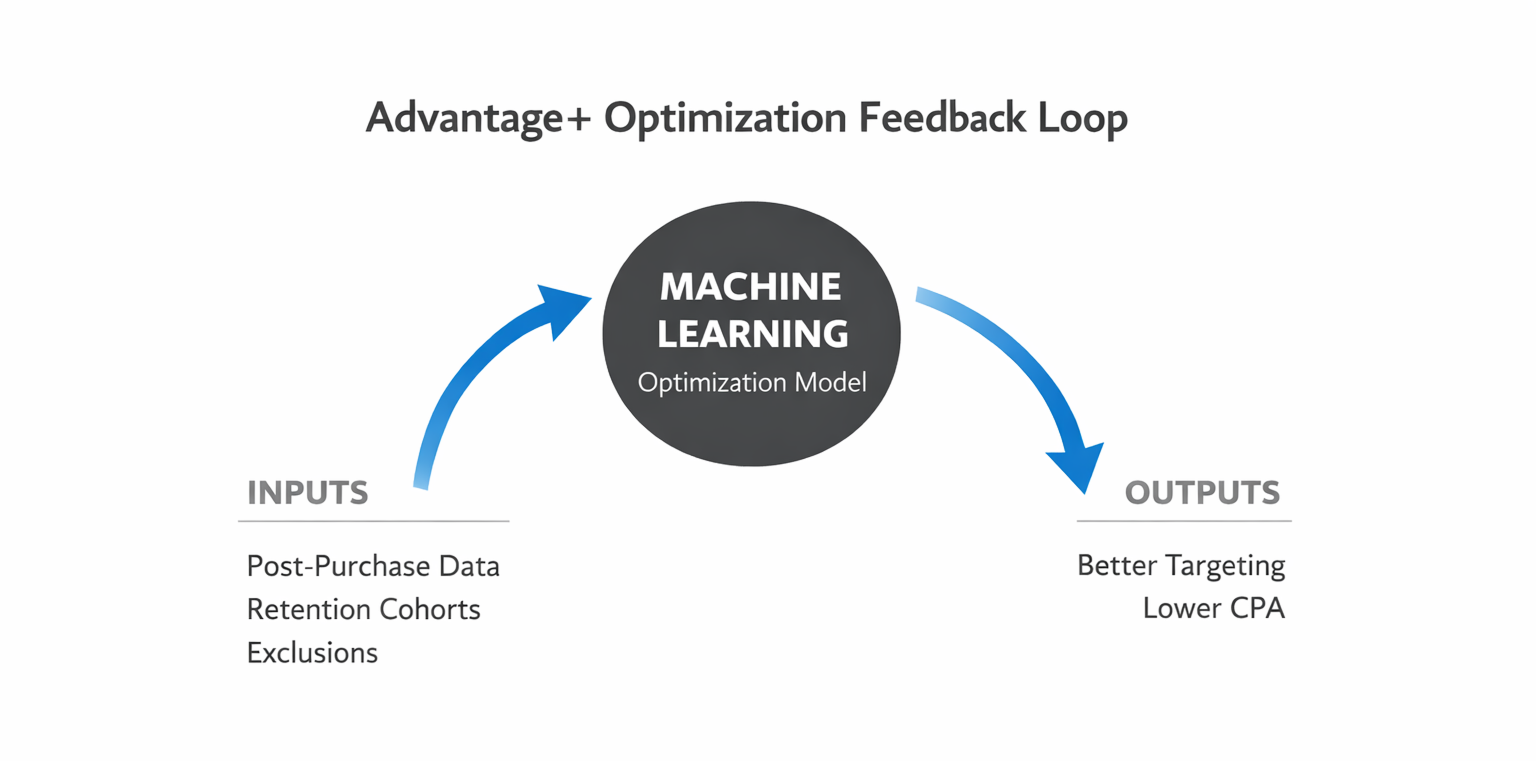
You can't out-optimize the system manually — but you can influence what it learns.
To dig deeper, explore How to Optimize Campaign Performance with Meta Advantage+.
How to make Advantage+ work better for you
1. Seed it with post-purchase signals.
Set up Conversions API to pass:
-
Net profit, not just revenue;
-
Refund and return flags;
-
UTM-tagged buyer source data.
2. Upload retention cohorts as custom audiences.
Use first-party data to label:
-
Repeat purchasers;
-
Subscribers over 90 days;
-
High-LTV customers.
3. Suppress low-value audiences.
Don’t let Meta waste budget on users you know won’t convert again:
-
One-time buyers with returns;
-
Low-margin geos;
-
Test traffic from TikTok or YouTube.
Use suppression lists to sharpen Advantage+ outcomes.
Creative dominance: how modular content beats production scale
Creative quantity doesn’t win — variation does
If you're still launching ads in batches with static headlines and hooks, you’re feeding Meta garbage data.
Instead, treat each ad like a signal probe. Build creative variations around specific behaviors you want to test.
High-leverage creative elements:
-
Opening 1.5 seconds: High-contrast visuals that match user intent (not always flashy);
-
Captions with intent triggers: Keywords like “I switched because…” or “Before this, I wasted…”;
-
CTA timing: Delay CTAs in Reels until after value is delivered — early CTAs now reduce delivery.
Creative testing that actually works in 2026
Run tests inside campaigns — not A/B split tests, which limit learning.
Structure dynamic creatives with distinct variations:
-
Four or more different hooks (e.g., problem, proof, question, contrast);
-
Three value angles (emotional, practical, social proof);
-
Three formats (short-form video, animated image, UGC-style quote static).
Let Meta remix components and surface the strongest combinations. Then rebuild the next rounds from top-performing fragments.
Targeting is still alive — it just looks different now
Most advertisers are too narrow — or too lazy
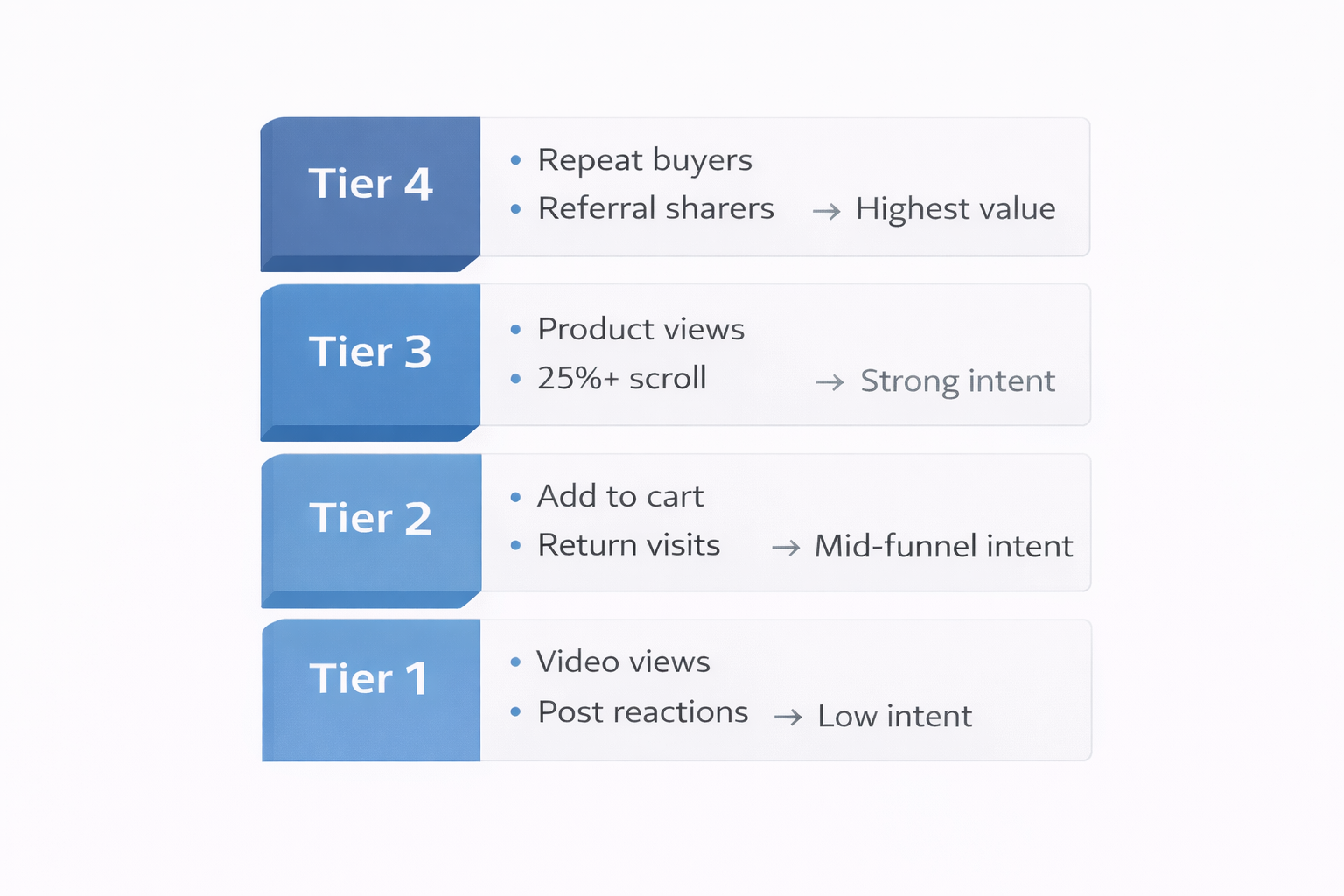
The old model of cold → warm → hot audience stages no longer reflects how Meta maps users. Instead, think in signal strength tiers.
To go deeper into behavioral-based segmentation, explore Behavior-Based Facebook Targeting: The Secret Weapon of Top E-commerce Brands.
The new targeting maturity ladder
Tier 1: General interest or engagement
Examples include video views, post reactions, and profile visits. These users show low purchase intent. This tier works best for reach, awareness, and pixel seasoning.
Tier 2: Mid-funnel activity
Examples include product page views, collection engagement, and 25%+ scroll depth. These audiences help feed Advantage+ learning and provide stronger lookalike seeds.
Tier 3: High-intent action
Examples include add-to-cart events, checkout initiations, and return visits within 48 hours. These users convert efficiently and perform well in retargeting and upsell flows.
Tier 4: Behaviorally verified buyer segments
Examples include repeat buyers, referral sharers, and high-AOV clusters. These audiences support predictive targeting and long-term signal training.
Build campaigns based on audience maturity, not traditional funnel stages.
Measurement: know what Meta sees (and what it ignores)
Attribution models lie — behavioral signals don’t
Your Facebook dashboard attribution might show:
-
7-day click: $38 CPA;
-
1-day click: $96 CPA.
But these metrics don’t tell you:
-
Was the buyer profitable long term?
-
Did they bounce after 3 seconds?
-
Did they ever return?
To understand why Meta’s attribution reporting often misleads, read Meta Ads Attribution: What to Know About Windows, Delays, and Data Accuracy.
Use your first-party data to layer Meta’s modeled conversions with actual business results.
Use blended metrics with behavior overlays
Track these weekly:
-
CPM versus scroll depth;
-
CTR versus time-on-site;
-
Ad saves versus repeat visits;
-
Add-to-cart events versus session quality.
If your high-ROAS ad has low saves and short sessions, it’s not future-proof.
What to do next: tactics for forward-leaning advertisers
1. Build creative to drive retention behaviors.
Likes and comments are vanity. Prioritize:
-
Shares, saves, replies;
-
Rewatch behavior on video;
-
Mid-funnel site behavior from ad clicks.
2. Treat each ad as an input into Meta’s training set.
Every asset teaches Meta who to deliver to. Don’t just optimize for performance — optimize for learning.
3. Rethink media buying as signal architecture.
Structure your campaigns around:
-
Feedback loops (e.g., feed lookalikes from recent buyers);
-
Suppression (exclude past engagers who didn’t convert);
-
Behavioral splits (segment creative by session length outcomes).
4. Align landing pages with Meta’s value system.
Speed, engagement, and depth matter:
-
Mobile load speed under 2.5 seconds;
-
Scrollable, dynamic content — not static product pages;
-
Embedded video or interaction to extend session duration.
Want to improve how you build and refine audiences? Read Custom vs Lookalike Audiences: What Works Best for Facebook Campaigns.
Final thoughts: Meta wants quality, not just conversions
The future of Meta Ads isn’t about winning the auction — it’s about feeding the system the right signals.
Brands that succeed in 2026 will:
-
Master modular creative tied to real behaviors;
-
Structure campaigns to train the algorithm over time;
-
Connect post-click data to platform-side learning.
This isn’t just performance marketing anymore. It’s machine learning strategy — with creative, structure, and data as the inputs.