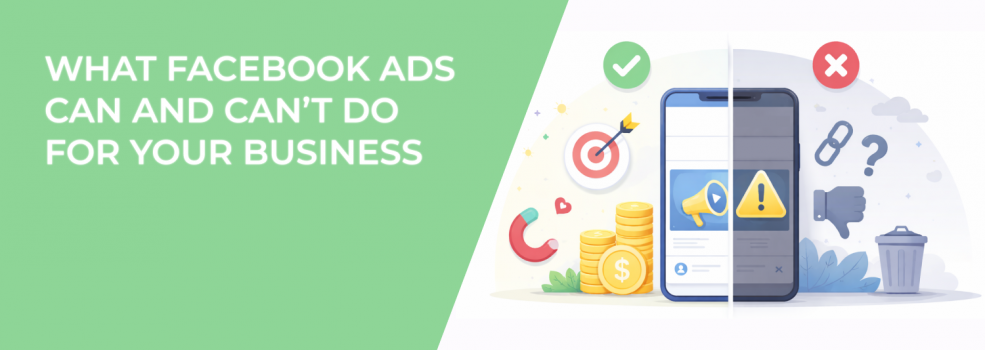
Facebook and Instagram ads are powerful but only if you know what they’re actually built to do.
Many businesses expect them to solve everything from sales to brand awareness to funnel conversion without fixing the real bottlenecks.
This guide shows what Facebook ads can help your business achieve and where they won’t move the needle unless other pieces are already in place.
What Facebook Ads Can Help You Achieve
Done right, Meta’s ad platform offers precision, speed, and scalability. But it works best when layered into a solid strategy — not used in isolation.
1. Distribute High-Performing Offers at Scale
Facebook ads are the fastest way to scale offers that are already converting. They can help you reach new audiences without reinventing your funnel.
For example:
-
A fitness coach selling a $27 downloadable meal plan saw strong email response from organic traffic. With Facebook ads, they reached cold leads and scaled to $1.8K/month in revenue in under 4 weeks.
-
A SaaS brand offering a free 7-day trial retargeted product page viewers and saw a 48% lift in trial sign-ups.
With enough budget and a validated offer, Facebook lets you:
-
Push high-CTR creatives to broad lookalike audiences;
-
Scale winners using rules (e.g., “increase budget 20% if CPA < $40 for 3 days”);
-
Reach consistent daily results across multiple markets.
If an offer struggles at scale, the issue is rarely the ad itself. It’s usually a mismatch between message, audience, and funnel structure — a pattern we break down in more detail in Why Your Facebook Ads Look Great But Still Don’t Sell.
What it can’t do? Force people to buy what they don’t want.
2. Build Audience Layers That Match Buyer Behavior
Most purchases aren’t immediate. Facebook ads let you create a funnel that reflects real user behavior — from attention to decision.
For example:
-
A DTC skincare brand ran video views to cold audiences and retargeted 75% viewers with product reviews. The second ad generated 4x the ROAS compared to cold traffic.
-
A B2B SaaS company created a warm audience from 3-minute explainer video viewers. Their follow-up demo request ad saw a 12% conversion rate.
With Facebook’s tools, you can:
-
Create custom audiences by event (e.g., video watched, page visited, cart started);
-
Segment by intent level — for example, 95% video viewers vs. 3-second viewers;
-
Stack layers: awareness → interest → action → loyalty.
This layered approach is the backbone of sustainable performance, and it’s explored step by step in Facebook Ads Funnel Strategy: From Audience Identification to Conversion.
This lets you meet people where they are — not where your sales target is.
3. Test Offers and Creatives Quickly, Before Scaling
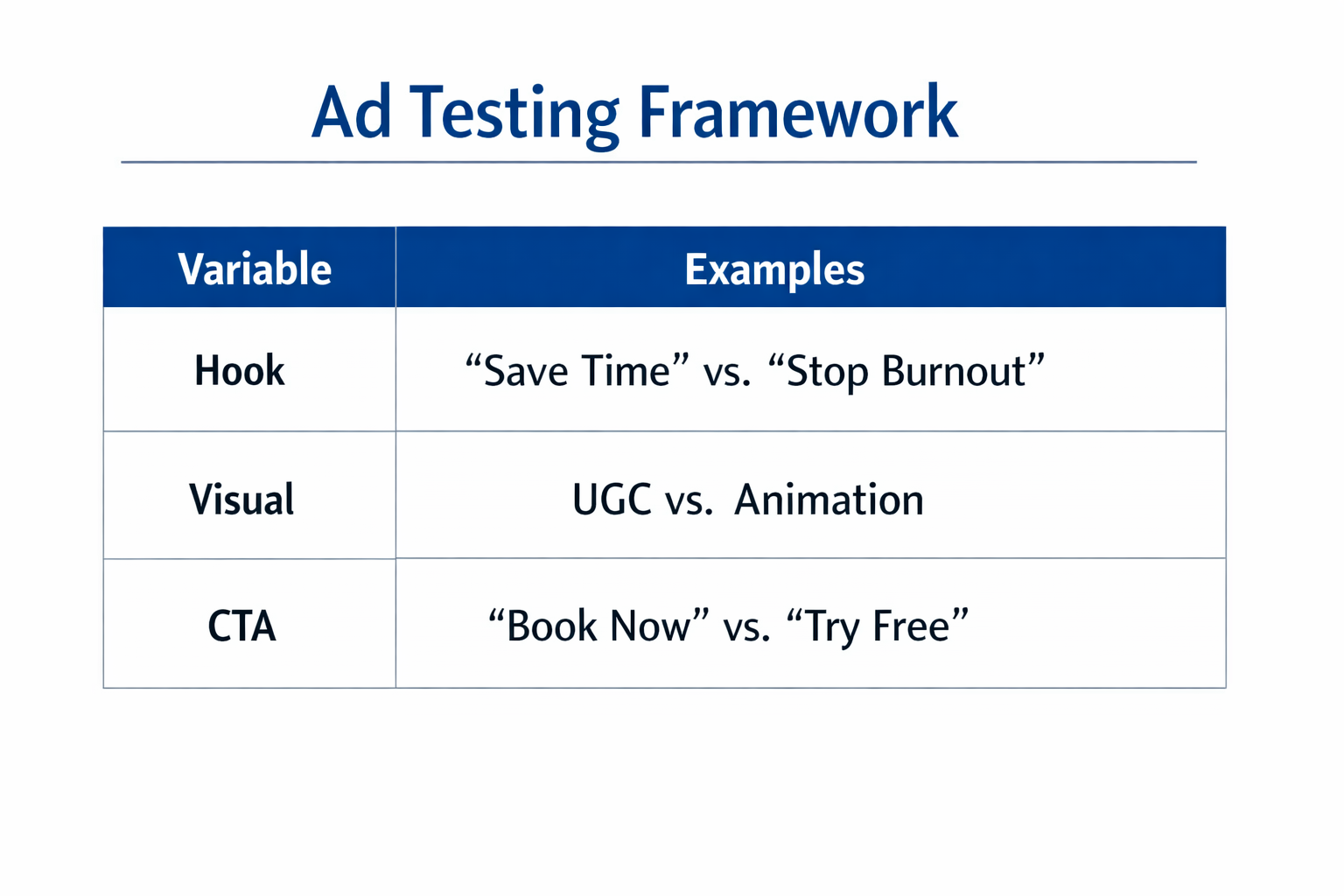
Facebook ads give you fast feedback. Instead of guessing, you can test variations and get clear signals in days — not weeks.
Example:
-
A wellness brand tested two headlines: “Lower Stress Without Medication” vs. “End Stress in 5 Minutes a Day.” The second headline had a 2x higher CTR and cut CPC by 35%.
-
A lead gen agency tested static images vs. UGC-style testimonial videos. The latter produced 60% more leads at a 20% lower cost.
With structured testing, you can validate:
-
Positioning angles — benefit-first vs. urgency-based;
-
Visual formats — branded illustrations vs. raw mobile clips;
-
Offer types — discount vs. free trial vs. bundle.
Random testing wastes budget. A systematic approach — knowing what to test first and why — is outlined in Key Strategies for Facebook Ad Testing: What You Need to Know.
Most campaigns fail not because the product is bad — but because the creative doesn’t match audience psychology.
4. Support Brand and Demand Campaigns at Low Cost
Not every ad needs to sell. Top-of-funnel campaigns help build awareness, positioning, and trust — especially for longer sales cycles.
For instance:
-
A digital product studio ran a founder interview clip to introduce its process to cold audiences. Weeks later, they retargeted 50% viewers with a free consultation offer — resulting in multiple $10K+ clients.
-
A DTC coffee company ran behind-the-scenes videos to showcase sourcing. These built brand affinity, and their retargeted ads later converted at 2.5x ROAS compared to cold traffic.
Use Facebook for brand-building when you want to:
-
Educate before selling — especially in complex or crowded niches;
-
Warm up leads without discounting;
-
Fill your pipeline with future buyers.
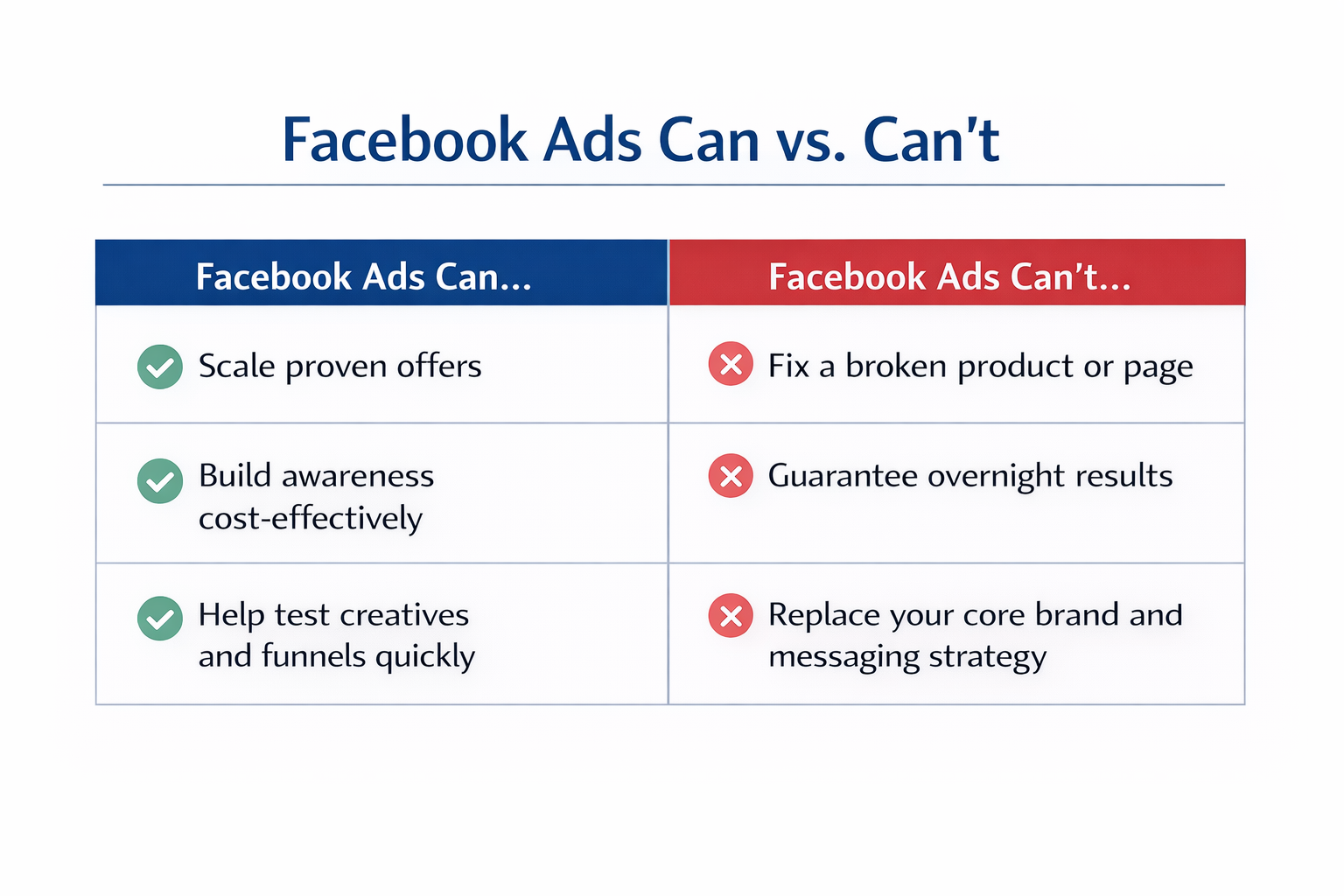
What Facebook Ads Can’t Do — Even With a Big Budget
No matter how much you spend, Facebook can’t fix deeper problems. If your offer doesn’t convert, or your funnel leaks trust — ads will only highlight that faster.
1. Save a Funnel That Doesn’t Convert
Facebook gets you the click. What happens next is on your funnel.
If your landing page is slow, confusing, or mismatched with the ad — you’ll lose people.
Real examples:
-
A finance app spent $4,000 sending users to a generic landing page. Bounce rate: 82%. Solution? A tailored page focused on one key feature — and bounce dropped to 31%.
-
A DTC brand ran a “Buy 1, Get 1 Free” ad that led to a checkout with no mention of the deal. Result: 2.7% cart abandonment spike.
Common mistakes include:
-
Mobile-unfriendly pages with tiny buttons or unreadable fonts;
-
Disconnect between ad promise and landing experience;
-
Complex or slow checkout processes that kill intent.
Before scaling ads, clean your funnel or you’ll burn cash.
2. Deliver Consistent Results Without Data
Facebook’s algorithm learns by observing conversions. If you’re not getting enough data — the system can’t optimize well.
Let’s say you’re running a conversion campaign for ebook downloads. If you get only 3 downloads per day, Meta’s system can’t determine what’s working. That creates:
-
Volatile costs per result;
-
Inconsistent delivery;
-
"Learning Limited" status, which freezes optimization.
For conversion campaigns, you’ll generally need:
-
At least 50 meaningful events per week (e.g., purchases, leads);
-
A budget that supports reaching those goals (often $30–$100/day minimum);
-
A willingness to let campaigns run at least 5–7 days before judging performance.
Understanding which metrics matter at this stage — and which ones mislead — is covered in How to Analyze Facebook Ad Performance Beyond CTR and CPC.
If your volume is low, start with traffic or engagement objectives to build audiences first.
3. Run Without Active Oversight
Auto-campaigns can work — but only if you’ve built them strategically. Most ad sets still require human input.
Even top spenders check daily for:
-
Frequency issues — showing the same ad too often leads to fatigue;
-
Audience overlap — where ads compete with each other and drive up costs;
-
Performance shifts — due to platform changes, seasonality, or competition.
A CPG brand, for example, saw ROAS drop 40% week-over-week. The cause? A single ad creative was live for 3 weeks with 9+ frequency. A fresh creative cut costs in half within 48 hours.
Bottom line: Facebook rewards attention to detail. Lazy setups get punished.
4. Replace Strategy With Media Spend
You can’t buy your way out of unclear positioning or weak messaging. Ads can amplify a story — but they won’t invent one.
Ask yourself:
-
Do you know exactly who you're targeting and what problem they’re solving?
-
Can you explain why your solution is better — without using vague language?
-
Does your creative communicate trust in under 3 seconds?
If not, your best move isn’t more spend — it’s better strategy.
As an example, a coaching offer for “helping women thrive” underperformed for months. Once reframed as “daily systems to reclaim 10 hours a week,” it hit 4.3x ROAS with the same budget.
Final Thoughts — Use Facebook Ads as a Lever, Not a Fix-All
Used correctly, Facebook ads can help you:
-
Scale working offers to new audiences, fast;
-
Build intent-based funnels that mirror real buying journeys;
-
Validate messaging, format, and creative hypotheses with data;
-
Warm up leads long before they’re ready to convert.
But they won’t:
-
Fix bad offers, funnels, or product-market misalignment;
-
Work without enough volume to train the algorithm;
-
Perform well without attention to creative, timing, and user experience.
Want better Facebook performance? Start with clarity. Then use ads to multiply what’s already working.