Many campaigns get clicks. Few drive growth.
Setting up Facebook or Instagram ads is easy. But driving consistent, profitable growth through them takes real strategy.
A lot of campaigns look like they’re working. They get clicks, engagement, or a decent ROAS. But deeper analysis often reveals weak profitability, low customer value, or fragile performance that collapses with scale.
In this article, we’ll break down what actual success looks like on Meta’s ad platforms. You’ll see how to evaluate your campaigns properly, and how advanced advertisers build systems that last.
When “Good Numbers” Can Be Misleading
Let’s be clear — not all positive metrics equal real business growth.
Many advertisers celebrate early signs like reach, CTR, or cheap clicks. But without proper context, these numbers can mask deeper issues.
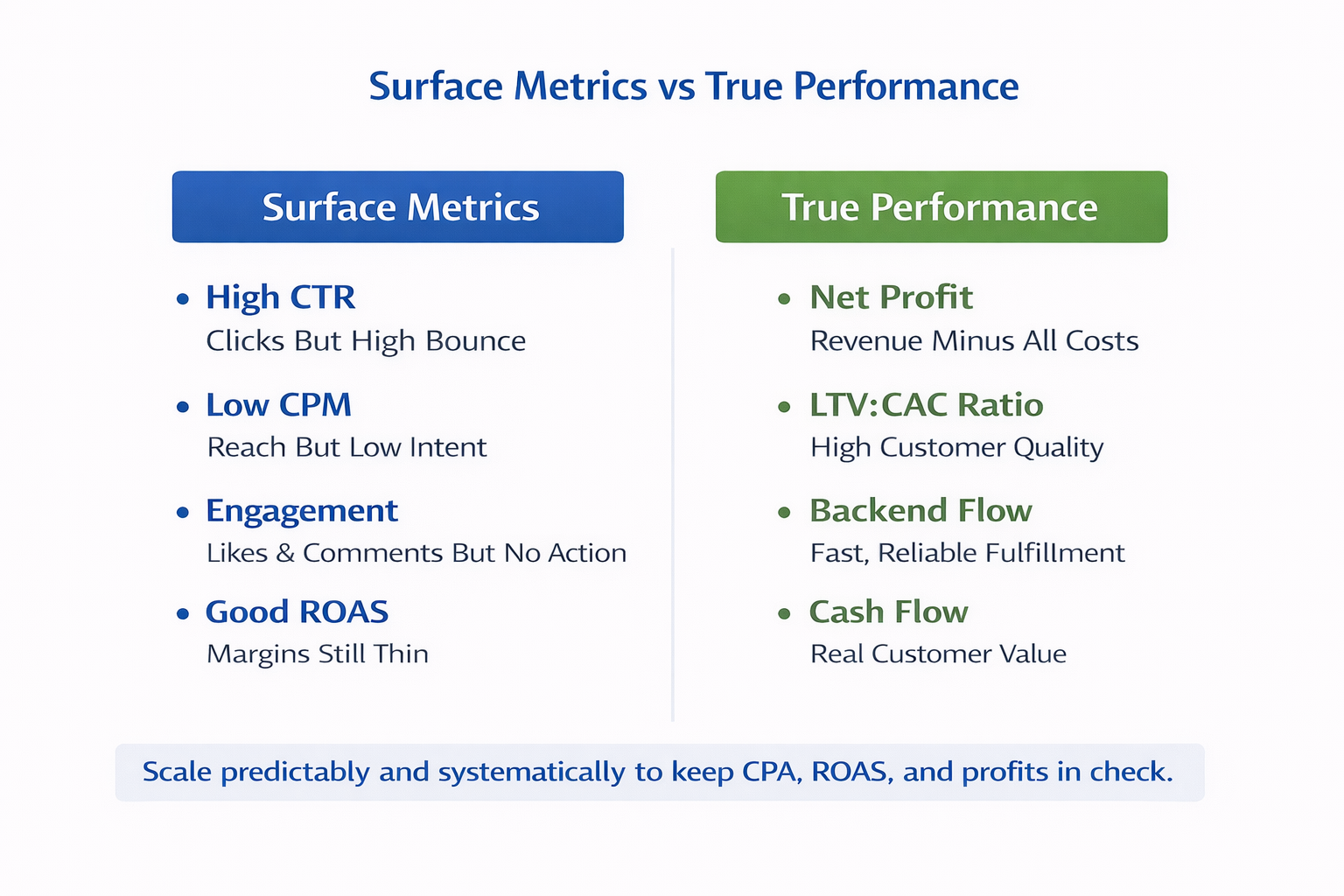 Surface metrics like CTR and CPM are useful signals — but true success comes from tracking profit and customer value.
Signs that performance is fragile, not solid
1. Engagement without follow-through
If people like and comment but don’t visit your site or take action, you’re likely attracting the wrong type of user. This often happens with vague or “viral-style” creative that doesn't qualify the audience.
2. Low CPM, low intent
A low cost per impression might reflect poor traffic quality. Broad, entertainment-based creative can earn cheap views — but they don’t convert.
3. High CTR, high bounce
Clicks are only meaningful if people stay. If you’re seeing bounce rates above 70% from ad traffic, revisit your landing page’s message, speed, and clarity.
Track Time on Page from ad traffic. Pair this with scroll depth to see if users are actually consuming your message.
For a deeper breakdown, read How to Analyze Campaign Performance Beyond ROAS.
What Real Facebook Ads Success Actually Looks Like
Successful campaigns don’t just hit benchmarks — they support your business goals, keep growing, and reduce reliance on lucky wins.
Let’s look at what that really includes.
1. You generate profitable growth, not just impressive ROAS
A 4x ROAS doesn’t matter if your gross margin is 20%. What matters is net profit after all costs — ad spend, fulfillment, tools, team, and returns.
Smart advertisers also track:
-
Blended CAC (across all platforms) to avoid over-optimizing for one channel;
-
Contribution margin from ads, factoring in discounts and variable costs;
-
Cash flow from ad performance, not just theoretical LTV.
Stop reporting ROAS by campaign. Use first-party revenue attribution from tools like Triple Whale, Northbeam, or Elevar to get an accurate read on your actual profit per order.
Also see The ROAS Trap: Why High ROAS Isn’t Always Profitable.
2. You scale predictably and sustainably
Scaling is not just increasing spend. It’s doing so without breaking performance, attribution, or operations.
Indicators of scale-ready campaigns:
-
Stable Cost Per Result as you increase budgets;
-
Performance across multiple ad sets or creative angles, not just one hit;
-
Creative and copy templates that allow for rapid testing and iteration without starting from scratch.
Use time-based budget scaling — increase spend on a set schedule during strong performance windows (e.g., raise by 15% every 72 hours). This avoids resetting Meta’s learning phase and reduces volatility.
Also, split testing bid strategies (e.g., Cost Cap vs. Highest Volume) can help you stay efficient as you grow.
Check out The Science of Scaling Facebook Ads Without Killing Performance for more structured tips.
Full-Funnel Systems Are a Must
Winning campaigns rarely work in isolation. They’re part of a broader journey that builds trust over time.
Strong advertisers build out these layers:
-
Top of funnel: Content-led ads (value posts, UGC, short explainers) to attract interest.
-
Middle of funnel: Social proof, before/after results, FAQs, and comparisons.
-
Bottom of funnel: Offers with urgency, bonuses, or retargeting to warm leads.
Use duration-based audience segmentation in your retargeting. Someone who visited the site 2 days ago needs a different message than someone from 28 days ago. This gives you more control over sequencing.
Also, exclude existing customers from TOF and BOF ads to reduce wasted spend — especially in subscription and repeat-purchase models.
For a complete structure, explore From Awareness to Conversion: Full Facebook Funnel Strategy.
Creative That Converts at Scale
Creative success isn’t about likes — it’s about clarity, testing, and repeatability.
The most effective advertisers treat creative like inventory. They build systems to constantly produce, test, and rotate new angles.
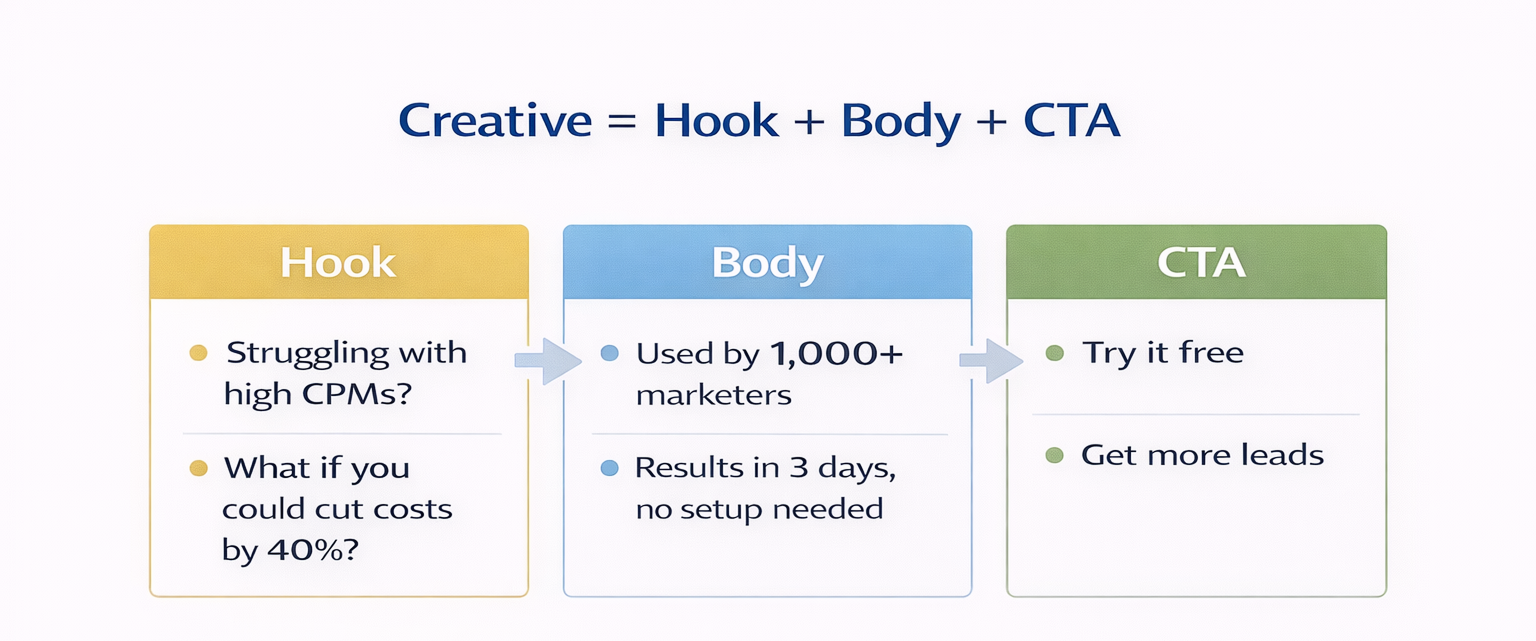
What performance creative actually looks like:
-
Clear first 3 seconds: Visual pattern breaks or “motion hooks” stop scroll;
-
On-screen text: Captures key benefits even with sound off;
-
Fast pacing: For short-form video, trim every second that doesn’t drive clarity;
-
Structure for testing: Same message, different visuals — or vice versa.
Use ad concept mapping — break creative into modular parts (hook, body, CTA). Mix and match proven parts to generate dozens of variants from a few ideas.
Also, track hook-to-hold ratios in video ads. If your 3-second video views are high but drop off by 10 seconds, your body content isn’t delivering.
Want to build a better system? Read Secrets Behind High-Performing Creative Testing Campaigns.
Targeting That Uses Meta’s Strengths — Without Blind Trust
Manual targeting used to be king. Now, Meta’s automation handles a lot — but it needs clean data to perform.
Strong targeting setups include:
-
Broad audiences (with minimal filters) to give Meta room to learn;
-
Lookalikes from high-LTV customers, not just buyers;
-
Pixel data enriched with server-side tracking to feed real conversions back into Meta.
Pair broad targeting with strong in-ad qualifiers — make the ad itself speak to your ideal customer. This filters out unqualified users without needing narrow audience settings.
Also, use dedicated retargeting windows (e.g., 3, 7, 14, 30 days) and exclude overlapping audiences to reduce ad fatigue.
For more help with narrowing or expanding audiences, try Custom vs Lookalike Audiences: What Works Best for Facebook Campaigns?
Backend Systems That Support the Sale
Even the best ads can’t overcome broken back-end flows. Success requires that your site, CRM, and sales processes are tightly aligned.
Here’s what strong systems include:
-
Fast, frictionless landing pages (under 3 seconds load, mobile-optimized);
-
CRM follow-up that starts instantly, especially for lead gen and service-based funnels;
-
Event tracking via CAPI (Conversions API) to preserve attribution with iOS and browser restrictions.
Use hidden fields in your forms to pass UTM and ad ID data into your CRM. This lets you connect specific campaigns to deal quality, close rate, and sales team notes — not just lead count.
Also, split-test landing page versions by traffic temperature. Hot leads need fewer details. Cold traffic needs more education and trust-builders.
Real Success Happens Over Time — With a System
Success doesn’t mean winning fast. It means building a system that improves over time — even when ads fatigue or the market shifts.
What to expect in a mature campaign system:
-
Week 1–4: Rapid creative and audience testing. Don’t expect scale yet — this is for signal discovery.
-
Week 5–8: Push budget to the top 2–3 combinations. Tighten funnel, messaging, and targeting.
-
Month 3+: Add automation (rules, alerts), build new angles, and prepare creative cycles ahead of fatigue.
Build a “fatigue calendar.” Track ad performance over time to spot how long each format lasts (e.g., UGC = 7–10 days, carousels = 2–3 weeks). Plan replacements before things drop off.
Also, rotate in “non-direct” campaigns (e.g., engagement or lead magnets) to support BOF results without always selling.
Final Thoughts: Define Success Around Systems, Not Surges
You don’t need perfect CTRs, viral videos, or flashy dashboards.
Real Facebook Ads success looks like:
-
Profit that holds as you grow spend;
-
Messaging and creative that qualify, not just attract;
-
Funnels that nurture different user types;
-
Backend systems that turn interest into action;
-
Data that tells the full story — not just what Meta reports.
If your business is getting smarter, faster, and more stable every month, your ads are working.
That’s real success.