
CPM (cost per mille) is the price advertisers pay for 1,000 ad impressions. While it’s often treated as a cost problem, CPM is better understood as a market signal. Rising CPMs indicate increased competition, limited inventory, or shifts in how platforms value audiences and placements.
Over the last five years, average CPMs across major paid media channels have steadily increased. Industry benchmarks show that global social media CPMs rose by roughly 35–45% between 2020 and 2024, driven by higher advertiser demand and tighter inventory controls.
Why CPMs Rise
1. Increased Competition
More advertisers bidding for the same audiences automatically push CPMs higher. This effect is especially visible in:
-
B2B niches with limited audience size
-
High-intent segments (decision-makers, buyers, subscribers)
-
Popular placements such as in-feed and short-form video
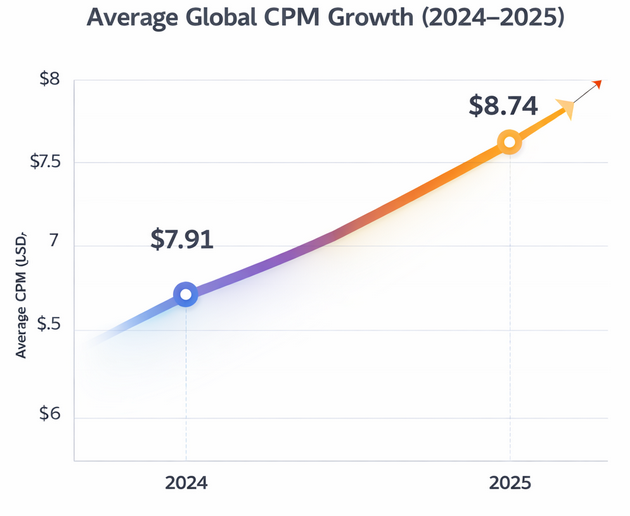
This chart shows the increase in average global CPM from 2024 ($7.91) to 2025 ($8.74), illustrating the trend of rising ad costs
During peak periods like Q4, CPMs can spike by 20–60% compared to annual averages due to seasonal budget surges.
2. Audience Saturation
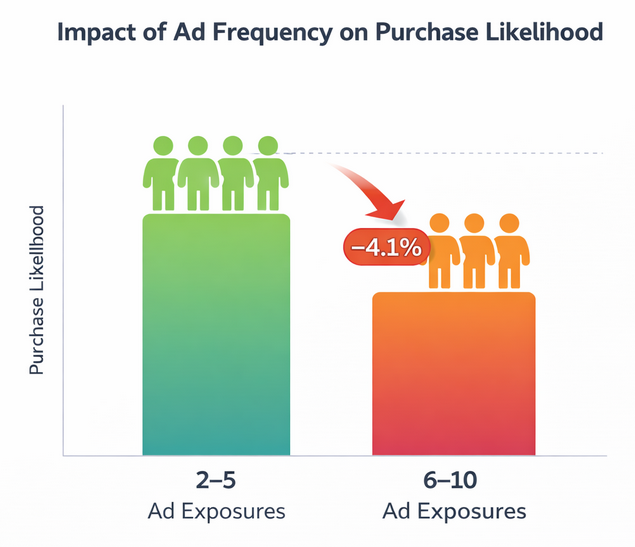
This chart compares purchase likelihood for audiences exposed to ads 2–5 times versus 6–10 times, showing roughly a 4.1% decrease for higher frequency
When the same audience is targeted repeatedly, ad fatigue sets in. Platforms detect declining engagement and respond by raising prices. Studies show that after 3–5 ad exposures, CTR can drop by more than 30%, increasing CPM as delivery efficiency falls.
3. Platform Algorithm Changes
Advertising platforms constantly update auction logic, prioritizing relevance, predicted engagement, and user experience. These changes often reduce available reach for poorly optimized ads, indirectly raising CPMs for advertisers who rely on outdated targeting or creatives.
4. Privacy and Signal Loss
Reduced tracking signals limit platforms’ ability to match ads with high-probability users. As targeting accuracy declines, platforms compensate by pricing impressions higher to manage risk. Since 2021, many advertisers have reported 10–25% CPM inflation tied directly to signal loss.
What You Can Control
While market forces drive CPMs up, advertisers still have levers that meaningfully influence costs.
1. Audience Precision
Broad or loosely defined audiences often lead to wasted impressions. More precise audience construction improves engagement rates, which platforms reward with lower CPMs. Advertisers using refined custom or seed-based audiences often see 15–30% lower CPMs compared to interest-only targeting.
2. Creative Quality and Variety
Creative performance has a direct impact on CPM. Ads with strong early engagement can achieve up to 40% lower CPMs than average-performing creatives. Rotating formats, refreshing messaging, and testing visuals helps avoid fatigue and cost inflation.
3. Placement and Format Mix
Not all impressions are priced equally. In many accounts, expanding beyond default placements reduces CPM by 10–20% while maintaining comparable conversion rates. Video, story, and secondary feed placements often deliver cheaper reach when paired with adapted creatives.
4. Frequency and Budget Control
High frequency accelerates CPM growth. Monitoring frequency caps and pacing budgets prevents oversaturation. Data shows that keeping frequency under 2.5–3.0 per week often stabilizes CPMs and preserves engagement.
CPM Is a Symptom, Not the Root Problem
Rising CPMs are rarely the core issue. They usually reflect deeper problems: overused audiences, weak creatives, or inefficient delivery. Advertisers who focus only on lowering CPM risk missing the bigger picture—profitability depends on what those impressions actually produce.
In many cases, accepting a higher CPM while improving conversion rate leads to lower cost per acquisition overall. The goal isn’t cheap impressions—it’s effective ones.
Related Articles You May Find Useful
Final Takeaway
CPMs will continue to rise as competition intensifies and platforms evolve. What separates efficient advertisers from the rest is not the ability to stop CPM inflation—but the ability to control relevance, engagement, and audience quality in spite of it.