Many Facebook campaigns fail for a reason that is easy to overlook: the ad works exactly as designed — it simply attracts the wrong type of buyer.
Clicks increase, engagement looks healthy, and traffic grows. Yet conversions remain weak and lead quality declines. In these cases, the issue is rarely targeting or budget alone. The real cause often sits inside the message itself.
Ad messaging strongly influences who decides to click, which means it indirectly shapes the audience the algorithm learns from. When the message appeals to the wrong motivations, the system begins optimizing toward users who resemble those early responders.
Over time, the campaign gradually drifts toward a buyer persona that was never the intended customer.
Ad Messaging Determines Who Enters the Funnel
Before Meta’s algorithm starts optimizing delivery, one important step has already happened: a user chose to click the ad.
That decision is heavily influenced by how the ad frames the offer. Two campaigns promoting the same product can attract completely different audiences depending on their messaging.
Consider a simple SaaS example.
- Ad Version A: “Automate your workflow and save hours every week.”
- Ad Version B: “Start using this automation tool for just $9.”
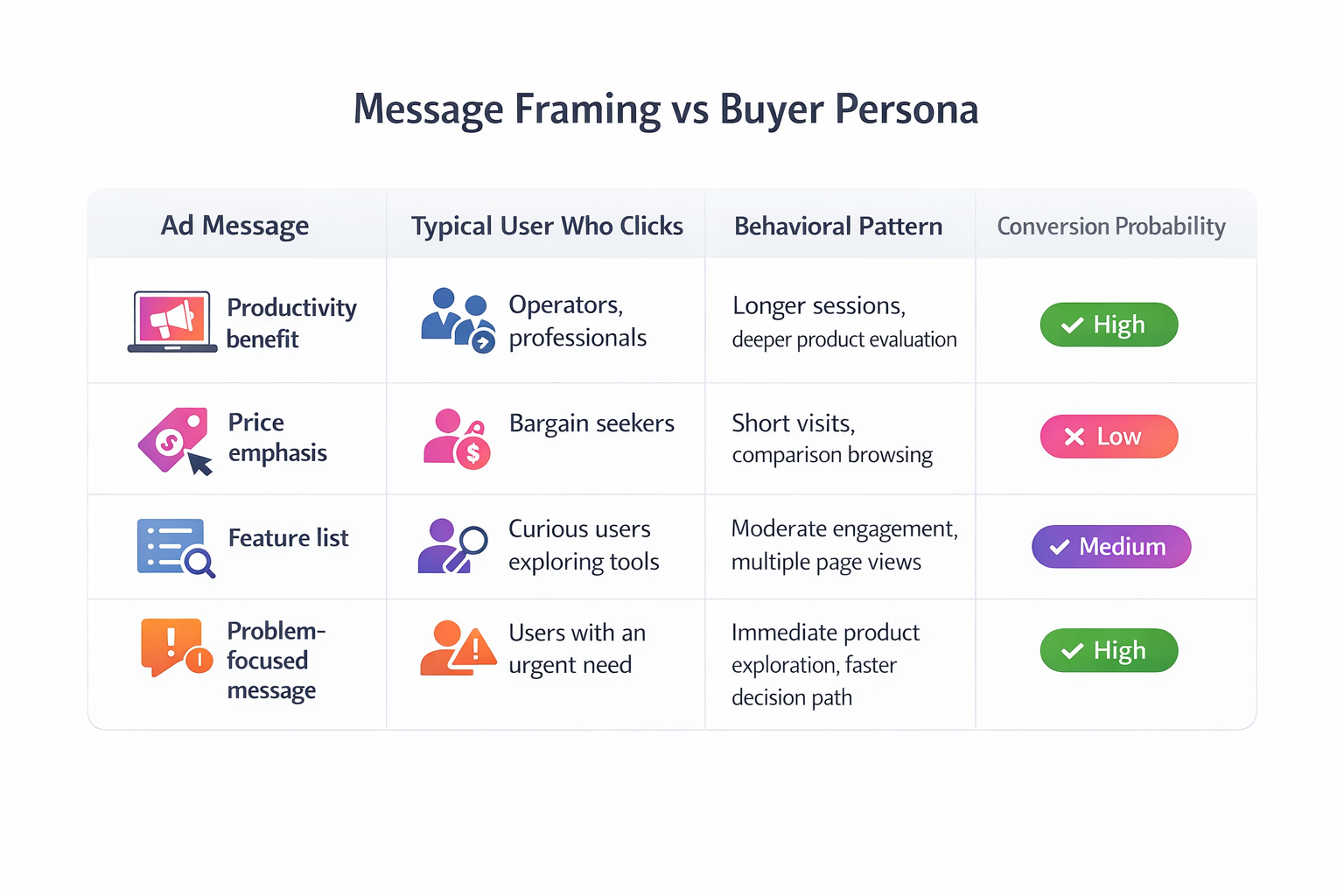
Both ads promote the same product, but they appeal to different motivations.
-
Efficiency-focused messaging attracts professionals.
Users who respond to productivity gains often have a real operational problem and higher purchase intent. -
Price-focused messaging attracts bargain seekers.
Many of these users are exploring tools casually rather than solving an urgent problem. -
Expectation framing changes perceived value.
A productivity message suggests operational improvement, while a price-focused message frames the tool as a cheap utility.
Because of this, the campaign begins collecting very different behavioral signals depending on which message is used.
Audience definition still matters, but messaging acts as an additional filter. If you're building audiences from scratch, the guide How to Define a Target Audience for Marketing: a Step-by-Step Guide explains how targeting inputs influence campaign performance.
Early Engagement Trains the Algorithm
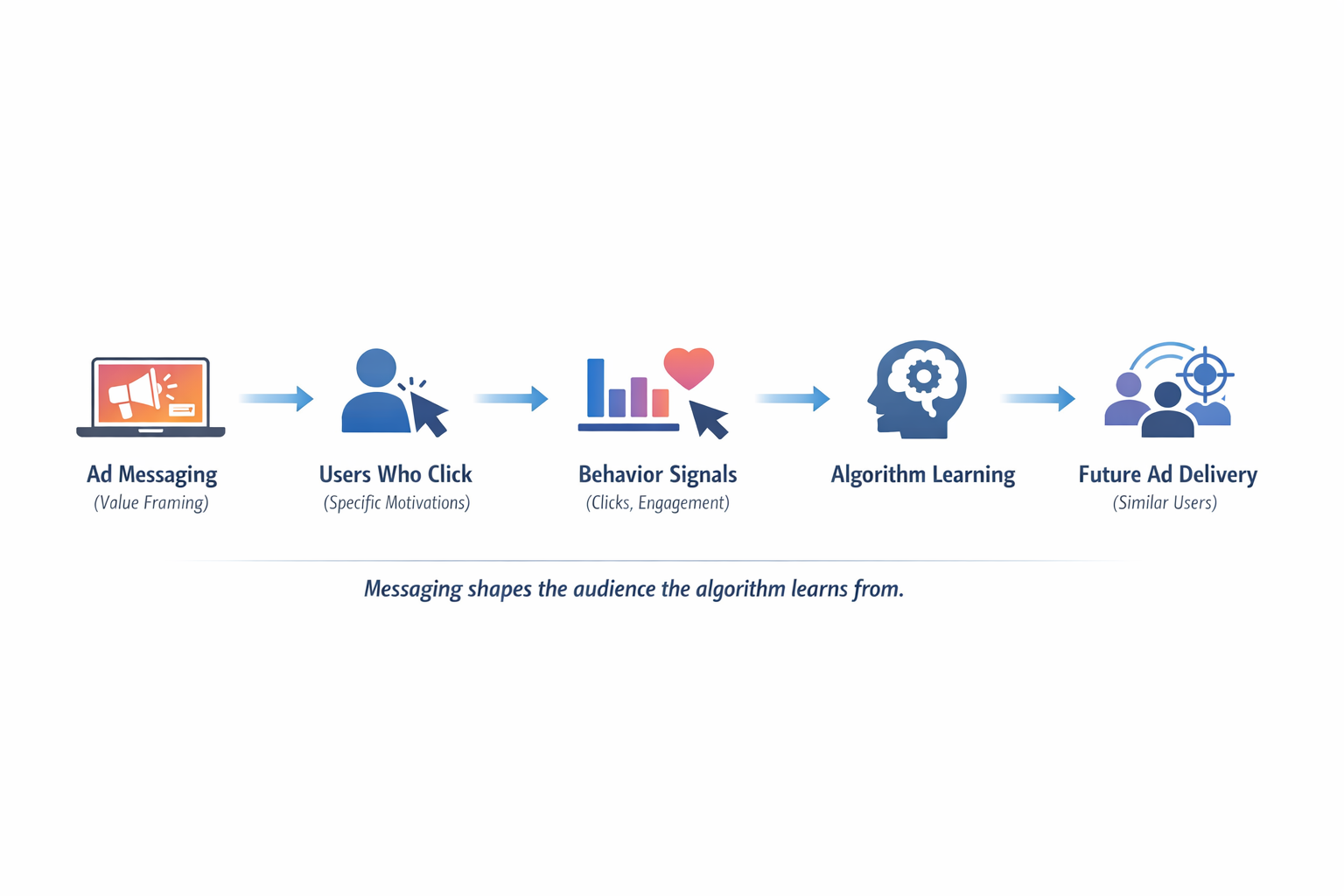
Meta’s delivery system continuously learns from user behavior. The first engagement signals often shape how the campaign evolves.
The learning loop typically looks like this:
-
Users respond to the ad message.
-
Engagement signals are recorded (clicks, visits, events).
-
The algorithm identifies similar behavioral patterns.
-
Delivery expands toward users who resemble early responders.
If the ad initially attracts the wrong persona, the algorithm gradually locks onto that segment.
This often produces a confusing pattern inside Ads Manager:
-
CTR increases.
-
Cost per click decreases.
-
Conversion rate slowly declines.
The campaign appears to perform well at the surface level, but the traffic quality deteriorates. A deeper explanation of this pattern is discussed in Why Your Ads Get Clicks But No Sales: Fixing the Audience Misalignment.
Signals That Messaging Is Attracting the Wrong Audience
The problem usually becomes visible through several campaign signals.
CTR improves while conversions decline
Higher click-through rates may look positive, but they sometimes indicate that the ad appeals broadly rather than precisely.
When CTR rises but conversions fall, the message may be attracting curiosity instead of real purchase intent. Understanding how to interpret these signals correctly is covered in How to Analyze Facebook Ad Performance Beyond CTR and CPC.
Comments reveal unexpected expectations
Audience feedback often exposes the mismatch quickly.
Examples include:
-
users asking whether the product is free;
-
questions about discounts when the product targets enterprise buyers;
-
feature requests irrelevant to the intended use case.
These signals suggest that the ad message is attracting a different type of user than the product was designed for.
Lead quality drops while volume increases
This pattern is common in lead-generation campaigns.
Sales teams may report that:
-
leads lack purchasing authority,
-
prospects come from unrelated industries,
-
trial users abandon the product quickly.
The campaign generates activity, but it fails to attract serious buyers.
Why Messaging Drift Becomes Self-Reinforcing
Once the wrong audience begins interacting with the campaign, the delivery system reinforces that pattern.
Two mechanisms usually drive this drift.
Predictable engagement
The algorithm prefers users who consistently interact with ads. Even if those users rarely buy, predictable engagement signals encourage the system to continue delivering impressions to them.
Auction competition
High-intent buyers usually exist in more competitive auctions. If the campaign starts attracting lower-intent users, the system gradually shifts toward cheaper auctions where those users are more common. This dynamic is closely tied to how Meta selects the winning ad in each impression opportunity, which is explained in Crack the Code: What You Need to Know About the Facebook Ad Auction.
As a result, the campaign becomes structurally aligned with the wrong persona.
Messaging Is a Targeting Mechanism
Advertisers often treat targeting settings as the primary way to control audience quality. In reality, the ad message itself acts as a powerful targeting filter.
The wording, framing, and value proposition determine who feels motivated to click.
When the message attracts the wrong persona, the algorithm simply learns from those signals and continues delivering to similar users. Over time, this creates the impression that the campaign “stopped working,” even though the system is behaving exactly as expected.
Correcting the issue rarely requires rebuilding the campaign.
Often the solution is simpler: adjust the message so the right buyer immediately recognizes the problem being solved — and the wrong audience loses interest before clicking.