AI now plays a major role in how Facebook and Instagram ads perform. It can analyze signals faster than any human, adjust delivery on the fly, and reveal patterns that would be impossible to spot manually. But AI is not a universal solution. It only works when the input, strategy, and environment allow it to work.
This article explains when AI improves performance, when it works against you, and how to combine automation with human judgment for more predictable results.
Why AI Matters in Today’s Meta Ad System
Meta’s ad platforms rely heavily on machine learning to decide who sees your ads and how often. AI organizes user behavior, predicts intent, and manages bidding at a scale humans cannot match. When your account sends strong signals, AI can optimize in ways that would take a full team to replicate.
For a deeper look at how advertisers save time using automation, see How to Use AI to Save Time on Facebook Ad Optimization.
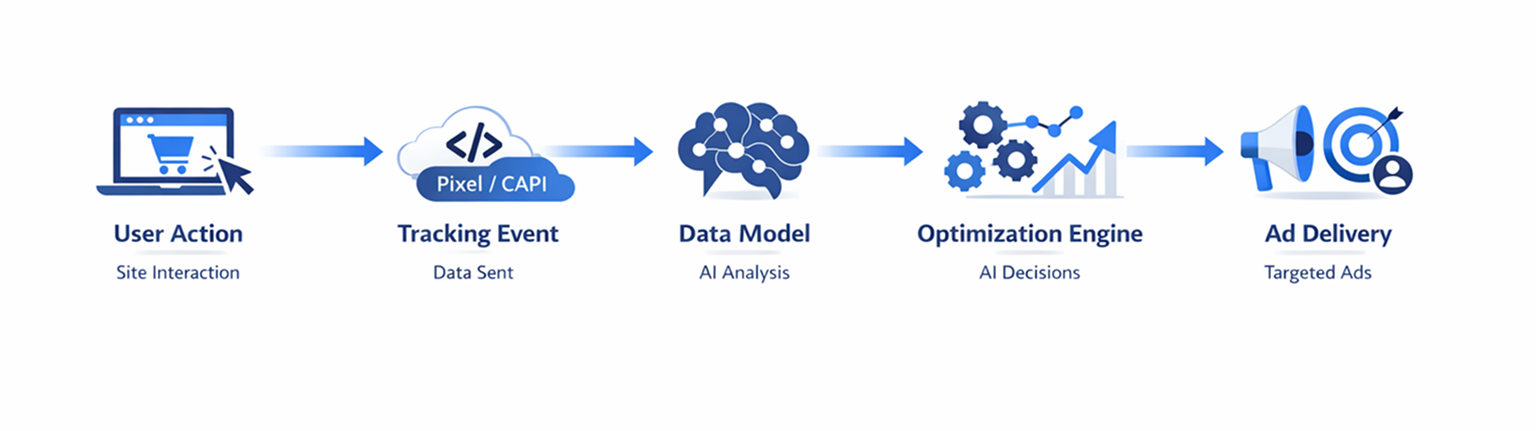
But AI is still limited. It does not understand context. It cannot judge the quality of your offer. And if your tracking or data is inconsistent, AI will learn the wrong patterns.
This is why good input is more important than sophisticated tools.
When AI Works Well
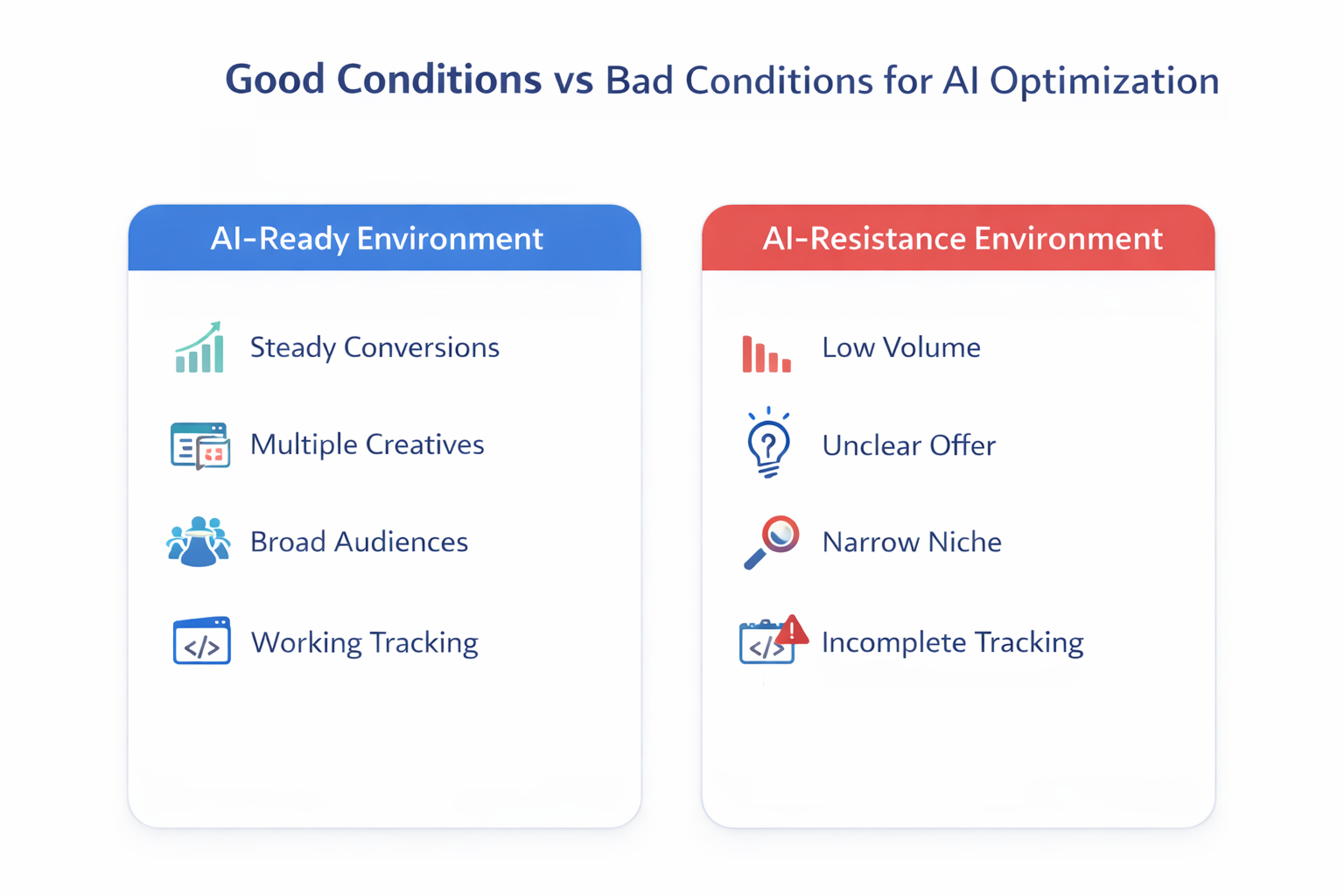
AI is most helpful when the campaign conditions give it enough structure and data to learn from. Below are the most important use cases — each explained in practical, day-to-day terms.
Use Case 1: You Have Steady Conversion Volume
AI needs enough examples of “success” to detect who is most likely to convert next. If your campaign drives 30–50 conversions per week, AI can build a reliable model. With weak data, it guesses.
Why this matters:
If your site fires proper events (ViewContent, AddToCart, Purchase), AI can map user paths and start predicting which users behave like buyers. Without clear signals, the system often wanders into broad, unfocused delivery.
This is exactly why many advertisers begin by fixing tracking before enabling automation.
Use Case 2: You Manage a Large Mix of Creatives
AI is especially strong at rotating multiple variations and finding early indicators of performance.
For example, if you upload several images, videos, and copy styles, AI can:
-
push high-intent creatives automatically;
-
reduce impressions for ads showing early fatigue;
-
discover which content type drives deeper actions, not just clicks.
This saves hours of manual work and produces cleaner test results.
To explore how AI improves targeting precision, see How to Improve Ad Targeting with AI Tools.
Use Case 3: You Run Broad Prospecting Campaigns
Broad targeting is now common on Meta platforms. AI thrives in large audiences because it has room to explore different behaviors and locate “pockets” of high-intent users.
Here is what this looks like in practice:
-
You launch a broad audience with several creatives.
-
AI identifies which creative attracts the cheapest high-quality traffic.
-
It then shifts delivery toward the users most likely to complete your conversion goal.
This approach often outperforms narrow targeting when you are scaling or expanding into new regions.
Use Case 4: You Need Real-Time Bid and Placement Optimization
Auction conditions on Facebook and Instagram change constantly. Competitors enter and leave, CPMs rise or fall, and user behavior shifts throughout the day. AI responds to these micro-changes instantly.
This is useful when:
-
you run campaigns across many placements;
-
your budgets are high enough for frequent bidding updates;
-
you want to avoid manual, hour-by-hour adjustments.
If you want a deeper breakdown of how AI handles optimization tasks, see How to Optimize Facebook Ads With AI Tools.
When AI Struggles
AI tends to underperform when human context matters more than algorithmic pattern detection. Below are key anti-cases explained in detail.
Anti-Case 1: Weak or Incomplete Tracking
If your pixel or API fires incorrect, inconsistent, or missing events, AI builds a faulty model. It may optimize for the wrong behavior (page views instead of purchases, leads instead of quality leads) and push spend into ineffective segments.
This is the most common reason why automated campaigns underperform.
Anti-Case 2: Campaigns With Very Low Data Volume
Small datasets confuse AI. If your campaign generates only a few conversions per week, the system cannot tell whether a trend is meaningful or random.
In low-volume situations, manual controls — such as narrow targeting or fixed bids — often outperform automation because they reduce noise.
Anti-Case 3: Messaging, Offer, or Positioning Still in Development
AI does not understand value.
It cannot tell whether your offer makes sense or whether the message resonates with your buyers.
If the core strategy is still unclear, AI only amplifies whatever is already happening. This often leads to wasted spend.
In these early stages, humans should guide the direction.
Anti-Case 4: Short Campaigns or Flash Promotions
AI needs time to understand who converts. If your campaign runs for only a few days — for example, a 48-hour sale or a local event promo — the system rarely leaves the learning phase. Manual bidding often performs better.
Anti-Case 5: Niche or High-Compliance Verticals
For audiences like:
-
lawyers,
-
medical specialists,
-
high-ticket B2B buyers,
-
regulated industries,
AI tends to over-expand and target irrelevant users because it cannot use sensitive attributes. Human oversight provides better control in these cases.
For a broader view of advantages and disadvantages, you can explore The Pros and Cons of Using AI for Facebook Ads.
Practical Scenarios: Expanded Use Cases and Anti-Cases
Below are real examples advertisers routinely face and how AI behaves in each situation.
Scenario: Large Warm Audiences After a Product Launch
AI excels here. It can segment users by behavior — product viewers, cart abandoners, repeat visitors — and deliver the right messages automatically. It also recognizes which creative works best for each subgroup.
Scenario: A New Store With No Historical Data
AI struggles. With no existing signals, the system does not know what a “good” user looks like. Early optimization must come from humans who understand the brand, the buyers, and the offer.
Scenario: Scaling a Winning Creative Across Regions
AI performs extremely well. You give it a clear target (your conversion event), strong creative, and enough budget. It learns regional differences and adjusts bids in real time.
Scenario: Highly Specialized Local Selling (Dentists, Attorneys, Therapists)
AI often expands too broadly because it cannot legally target these traits directly. Manual filters, narrow geo targeting, and offer-driven messaging usually work better.
How to Combine AI and Human Expertise
The best advertisers use a simple rule: humans set the strategy; AI handles the execution where it makes sense.
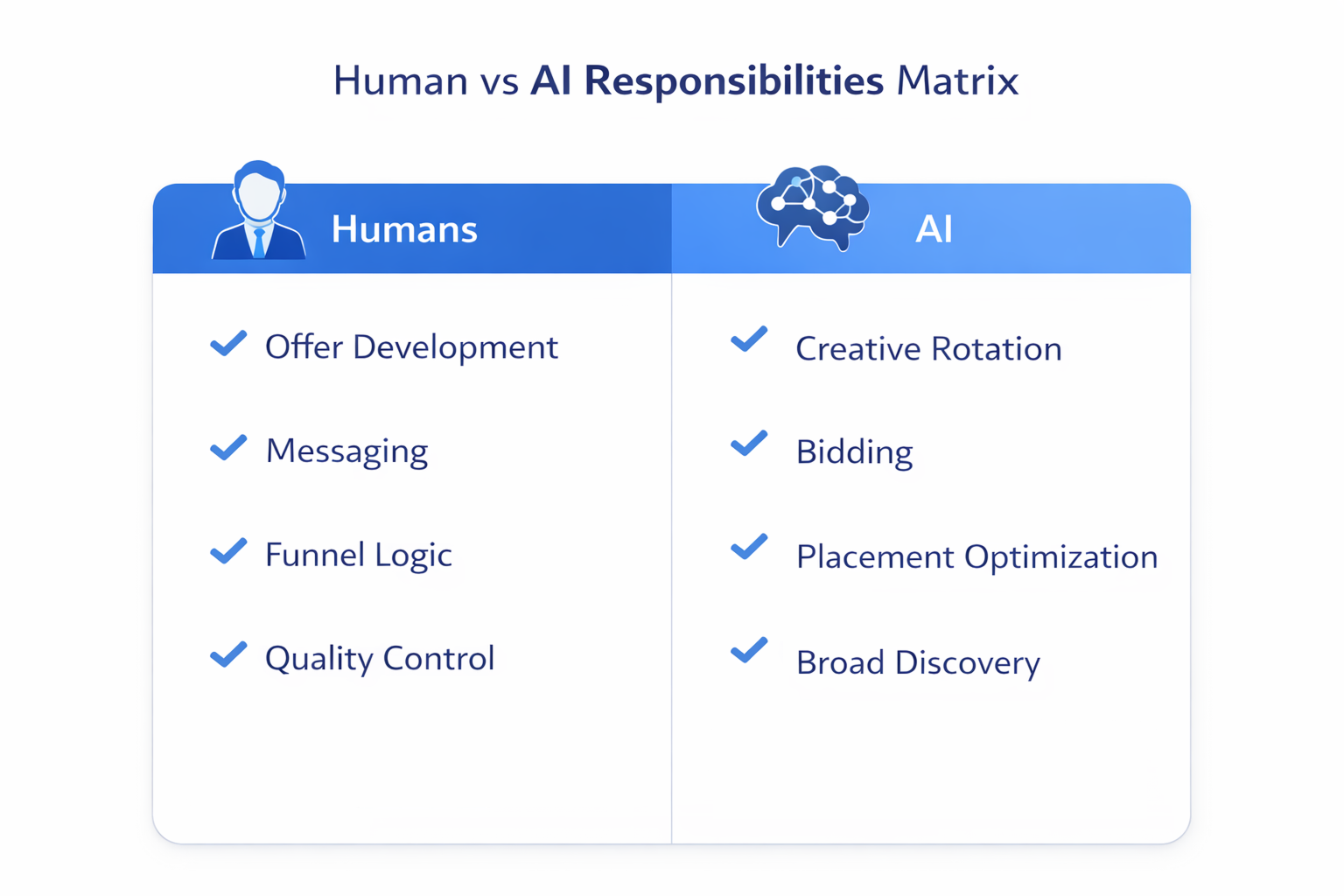
Your role is to define:
-
the offer and angle,
-
the audience logic,
-
the creative direction,
-
the conversion event.
AI’s role is to:
-
deliver ads efficiently,
-
rotate creatives,
-
discover hidden audiences,
-
adjust bids and placements.
This combination protects you from AI’s weaknesses while leveraging its speed and scale.
A Simple Framework: When AI Should and Should Not Be Active
Here is a clean way to evaluate whether AI fits your campaign:
AI Should Be Used When:
-
your tracking is accurate and stable;
-
you have steady conversion volume;
-
your offer is already validated;
-
you want faster creative testing;
-
your audiences are broad and exploratory.
AI Should Not Be Used When:
-
conversions are too low for pattern detection;
-
the offer or messaging is still being shaped;
-
compliance restrictions require strict delivery control;
-
the campaign is too short for learning;
-
your audience is highly niche.
Final Thoughts
AI can be a powerful optimization engine, but it is not a replacement for strategy. It works best when given strong data, clear goals, and enough time to learn. When humans lead the direction and AI handles the repetitive execution, advertisers see more stable, scalable, and predictable results.