Digital advertising is full of advice — some good, some outdated, some dangerous when applied without thought.
Marketers are told to:
-
Use broad targeting,
-
Scale slowly,
-
Test more creative,
-
Trust the algorithm.
These so-called “best practices” are everywhere. But here’s the problem — they’re not strategies. They’re tactics that only work when used in the right context.
What works for one business may tank results for another. Everything depends on your offer, audience, funnel, budget, and platform dynamics.
Let’s unpack some common best practices that quietly hurt performance — and explore better ways to think about your campaigns.
Broad targeting: not always better
The platform logic is simple: give the algorithm space, and it will find the right users.
But that only works when your campaigns send clear, high-quality conversion signals.
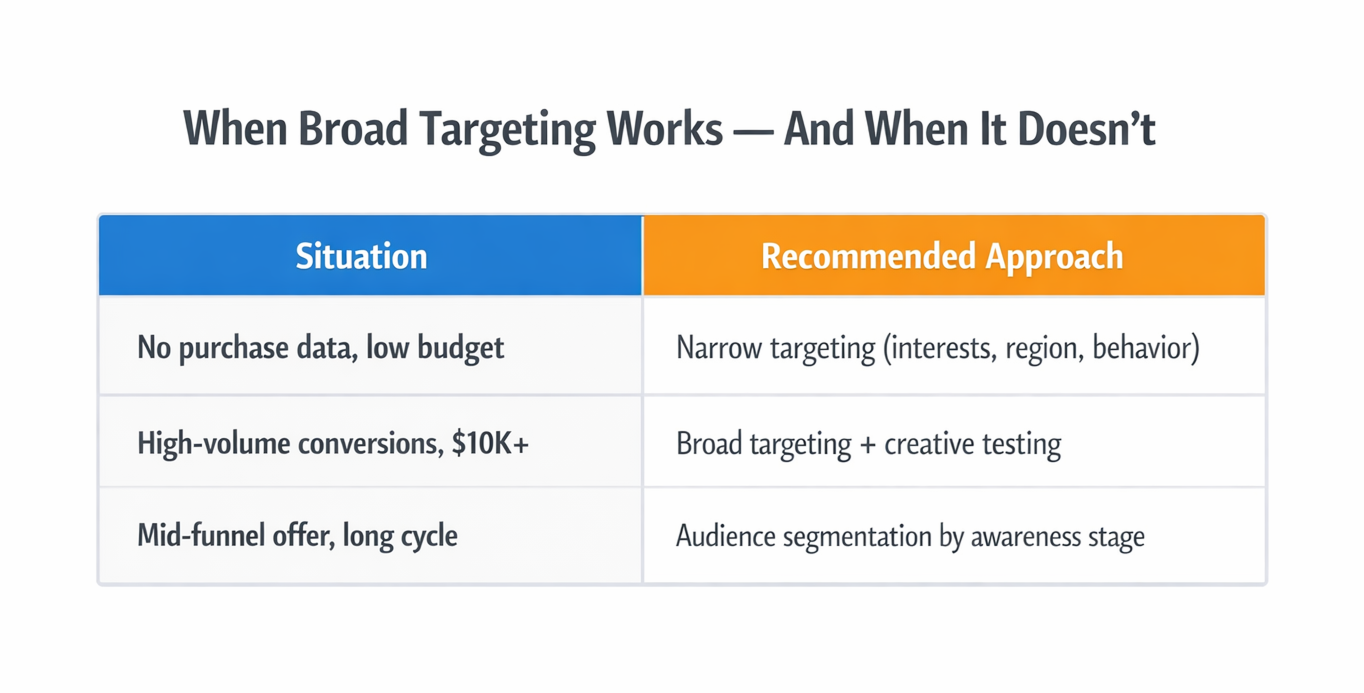
If your business is still building pixel data or launching a new offer, broad targeting can waste budget fast.
Here’s where it usually goes wrong:
-
Your budget is small (e.g., <$100/day), so the algorithm has limited room to test;
-
Your product is niche, requires explanation, or has a long buying cycle;
-
You rely on the platform to do the segmentation work your strategy should be doing.
Instead of defaulting to “broad is best,” start with targeting that reflects buyer intent and platform limitations:
-
Use interest targeting tied to pain points or use cases;
-
Narrow by age, language, or region if applicable;
-
Monitor early signals (CTR, LP views, time on site) before scaling wider.
This isn’t about avoiding broad targeting — it’s about earning it by first feeding the algorithm the right signals.
Need help balancing reach and precision? See: Retargeting vs. Broad Targeting: Which Strategy Drives Better Results?
Creative testing: more doesn’t mean better
Everyone agrees that creative is the biggest driver of ad performance. But most testing advice focuses on quantity — not quality.
| Test Type | Superficial Tweaks | Meaningful Variation |
|---|---|---|
| Hook | "Simplify your work" → "Streamline your work" | "Feeling overwhelmed?" → "Here’s how to save 10 hours/wk" |
| Format | Same static image, different colors | Video vs. carousel vs. UGC-style photo |
| Message angle | Rewording benefits list | Pain point → Feature demo → Social proof |
| Call-to-action (CTA) | “Sign up” → “Learn more” | CTA changes based on message (e.g., “See how” vs. “Start now”) |
The typical scenario:
-
You launch 10 ads with the same structure, only changing a few words or colors;
-
You test without a framework or learning agenda;
-
You judge success on CTR or engagement, not conversion behavior.
The result? Confusing data and no clear direction.
A smarter approach starts with deliberate variation:
-
Test 2–3 different hooks (e.g., “Feeling stuck with spreadsheets?” vs. “Here’s how to reclaim 10 hours a week”);
-
Vary visual formats — talking-head video, carousel, animation, UGC-style;
-
Switch emotional tone — direct challenge vs. curiosity-building vs. soft storytelling.
After each round, write down what you learned:
What made people stop scrolling? What drove clicks or deeper funnel movement?
Instead of chasing volume, pursue insight. For detailed creative frameworks, check: Key Strategies for Facebook Ad Testing.
Attribution defaults: misleading more than useful
Many advertisers rely on default attribution windows like Meta’s 7-day click / 1-day view.
But if your product has a higher price, longer decision cycle, or involves multiple touchpoints — that’s a limited view.
| Default Attribution | Buyer-Centric Attribution | |
|---|---|---|
| Attribution Window | 7-day click / 1-day view (Meta default) | Based on time-to-purchase data |
| What Gets Counted | Immediate actions only | Full customer journey |
| Data Sources | Ad platform reports only | GA4, CRM, CAPI, Multi-source tracking |
| Risk | Over-attributing retargeting | Requires setup, but more accurate |
| Common Mistake | Pausing good campaigns too early | Longer learning, better insight |
| Best For | Low-ticket, impulse products | Higher-ticket, multi-touch journeys |
What often happens:
- Your best campaigns get paused because conversions happen outside the window;
-
You over-attribute results to bottom-funnel view-through retargeting;
-
You misjudge what’s actually influencing purchase behavior.
Instead, use attribution windows that reflect how your buyers behave, not how platforms report data:
-
Review time-to-purchase reports in GA4 or CRM;
-
Compare first-touch and last-touch journeys;
-
Use server-side tracking (Meta’s CAPI, GA4 Enhanced Conversions) to fill in the gaps.
You don’t need perfect tracking — but you do need directionally correct insights. Start here: How to Use the Facebook Attribution Tool.
Budget scaling: cautious doesn’t mean correct
One of the most widely shared scaling tips is to “increase budget by no more than 20% every few days.”
It’s meant to protect performance and avoid learning phase resets.
But following that rule blindly often means missing momentum.
If a campaign is significantly outperforming target ROAS or CPA, slow scaling can choke growth.
When it goes wrong:
-
You undercapitalize on peak-performing creatives or seasonal windows;
-
Platform signals get diluted over time;
-
You hesitate during moments that require bold action.
Instead, think about scaling in proportion to performance signals:
-
Duplicate high-performing ad sets and scale them directly;
-
Use automated rules to adjust budgets dynamically;
-
Scale creative formats, not just spend — stories, reels, carousels.
Scaling should be responsive, not scheduled. Want deeper tactics? See: The Science of Scaling Facebook Ads Without Killing Performance.
Retargeting: not dead, just lazy
Retargeting used to be easy — build a custom audience from your website traffic and show them product ads.
Today, it’s trickier. Privacy changes limit visibility, and lazy tactics lead to overexposure and low ROAS.
Common issues include:
-
Retargeting everyone with the same message, regardless of intent;
-
Overlapping audiences that cause frequency spikes;
-
Ads that repeat instead of reinforce.
The fix isn’t to ditch retargeting — it’s to evolve it:
-
Retarget based on in-platform engagement (video views, comments, post saves);
-
Vary creative and messaging by stage of the buyer journey;
-
Cap frequency to avoid ad fatigue.
Retargeting still drives profit — if you approach it as sequential messaging, not repetition.
Metrics: easy ≠ meaningful
Some metrics are easier to report — but that doesn’t mean they matter.
It’s common to see marketers optimize for CTR, CPM, or post reactions while ignoring downstream behavior.
This leads to:
-
High engagement with little conversion;
-
“Successful” ads that don’t support business outcomes;
-
Confusion when dashboard metrics look good but revenue stalls.
Here’s a better framework:
-
Track stage-specific metrics: engagement rate (TOFU), cost per signup (MOFU), cost per acquisition (BOFU);
-
Monitor user behavior after the click — bounce rate, scroll depth, time on page, conversions;
-
Focus on lifetime value (LTV), not just one-time ROAS.
Your ads don’t exist to generate pretty dashboards. They exist to move users toward outcomes.
Need help going deeper than CTR? Read: How to Analyze Facebook Ad Performance Beyond CTR and CPC.
Final takeaway: best practices aren’t strategies
There’s nothing wrong with using best practices — if you understand what they’re for.
They are starting points, not systems.
The real danger is when you:
-
Treat them as rules instead of options;
-
Ignore platform signals in favor of fixed tactics;
-
Avoid experimentation because the “safe” thing feels more comfortable.
Instead of asking, "What’s the best practice for this situation?" ask:
-
What is our goal right now — awareness, leads, purchases?
-
What do we know about our buyer’s journey?
-
What stage is our campaign in — testing, scaling, optimizing?
-
Are we tracking what matters, or just what’s easy?
When you build campaigns around real context, you’re not chasing best practices — you’re building your own.