A campaign that starts strong and then gradually loses momentum is one of the most common — and most misdiagnosed — patterns in Meta Ads.
Spend drops, CPM rises, or conversions stall without any obvious change. Many advertisers immediately start editing, scaling, or resetting. In most cases, that makes things worse.
Delivery slowdown is usually not a bug. It’s a signal that something inside the auction system or your campaign inputs has shifted.
The First Signal: Spend Distribution Starts Compressing
You’ll often see the issue before it shows up in CPA.
Check hourly breakdowns. A healthy campaign spends relatively evenly across the day. A slowing one starts behaving differently:
-
Spend clusters into narrow time windows.
Instead of steady pacing, most of the budget is spent in a few hours. -
Early-day delivery weakens.
The campaign “waits” before spending, instead of competing consistently. -
Late-day spikes become aggressive.
The system rushes to spend remaining budget.
This pattern means one thing: your ads are no longer competitive across the full auction landscape.
They still work — but only in specific pockets where signals are strong.
Auction Pressure Changes Faster Than You Think
Mid-campaign slowdowns often come from outside your account.
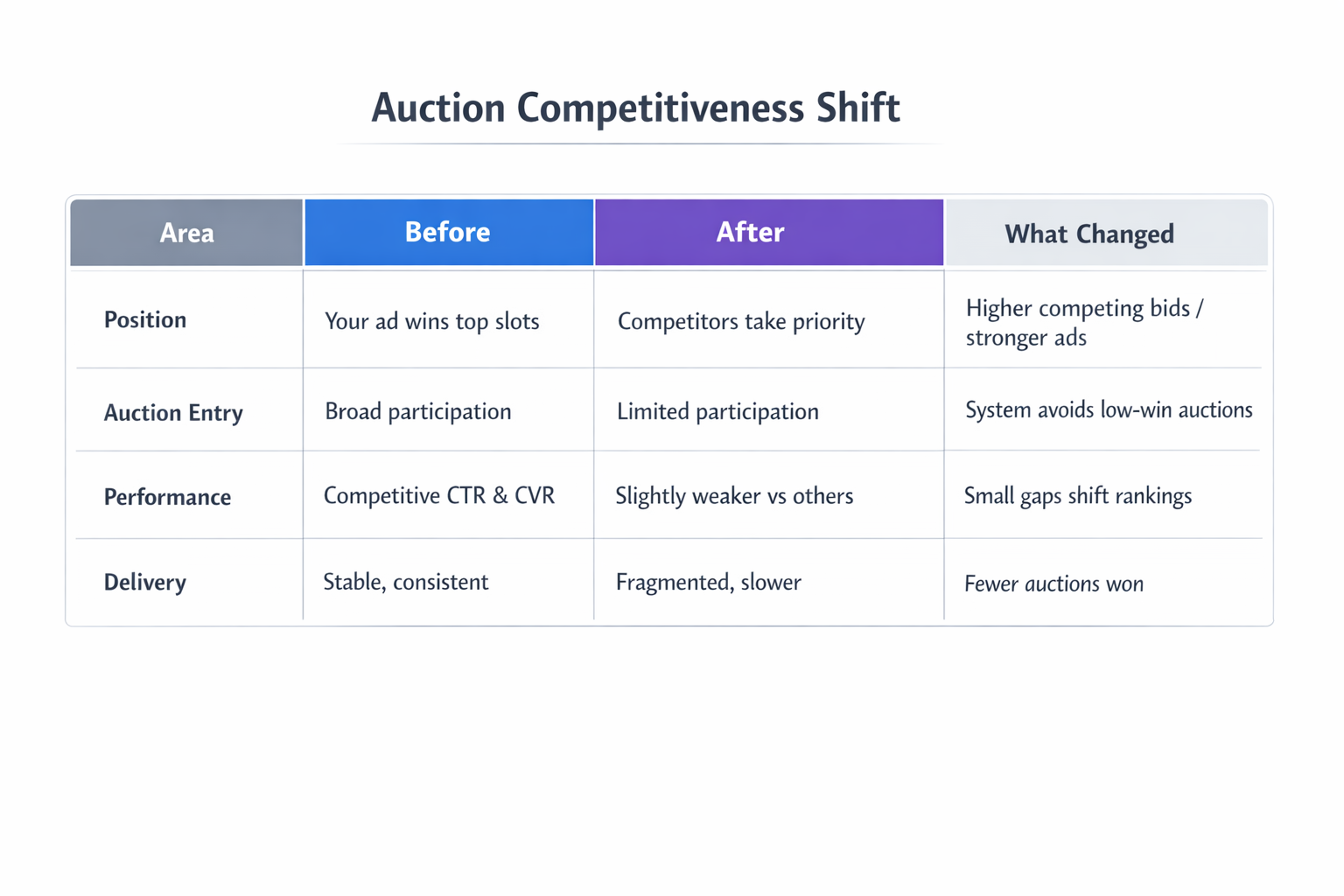
Even if you didn’t change anything:
-
New advertisers enter the same auctions and push CPM up.
-
Competitors refresh creatives and outperform yours.
-
Demand shifts due to seasonality or weekly cycles.
You’ll see this in Ads Manager as:
-
Gradual CPM increases over several days.
-
Slight CTR decline without a full drop.
-
Stable impressions but weaker scaling.
If this sounds familiar, it’s worth revisiting how factors that influence the cost of Facebook ads actually play out mid-campaign — because cost pressure rarely comes from just one variable.
The key point: delivery slows because you’re losing more auctions than before, not because the system stopped delivering.
Signal Quality Weakens Before Results Collapse
Most advertisers react too late — when conversions already dropped.
The earlier signal is inconsistency.
Watch for:
-
Conversion volatility between days.
One day performs well, the next doesn’t — with similar spend. -
Fewer clustered conversions.
Results stop coming from similar user profiles. -
Longer conversion lag.
Users take more time to convert after clicking.
This is where algorithm confidence drops.
Meta’s system scales when it sees patterns. When those patterns break, it reduces:
-
bid aggressiveness
-
auction participation
-
impression expansion
This is also why campaigns that look “fine” at surface level suddenly slow down — a dynamic explained in why Facebook ads performance declines over time (and how to prevent it).
Frequency Rises While Performance Becomes Unstable
Frequency alone isn’t a problem. But frequency + instability is.
You’ll typically see:
-
Frequency increasing from ~1.8 → 2.5+
-
CTR soft decline
-
Conversion rate becoming unpredictable
This means:
-
The system is leaning on the same users more often
-
It struggles to find equally strong new users
-
Expansion is becoming inefficient
At this stage, delivery tightens because the algorithm prioritizes certainty over scale.
Budget Stops Translating Into Delivery
Another clear signal: budget becomes harder to spend.
You increase budget — but:
-
Spend doesn’t scale proportionally
-
CPA worsens quickly
-
Learning phase resets happen more often
What’s happening:
-
The system cannot find enough high-probability users at your cost level
-
It reduces exploration to avoid inefficiency
-
Your budget becomes “excess” relative to signal quality
This is where many advertisers panic and force changes — instead of recognizing that the system is deliberately holding back.
Creative Fatigue Is Relative, Not Absolute
Your creative doesn’t need to “fail” to lose delivery.
It only needs to become weaker compared to alternatives in the auction.
Typical signs:
-
CTR slowly declines (not crashes)
-
CPM increases even with stable targeting
-
Impression share drops
If you’ve seen this before, it’s the same mechanism behind ad fatigue on Facebook: how to spot it early and fix it fast —
except here it shows up as delivery slowdown, not just performance decline.
The system simply chooses other ads more often.
Audience Saturation Narrows Delivery Scope
Even in large audiences, saturation happens in layers.
What you’ll see mid-campaign:
-
Strong early results from high-intent segments
-
Gradual expansion into weaker segments
-
Then a contraction back into smaller, high-confidence groups
That contraction is where delivery slows.
The system is effectively saying:
“I can still get results — but only from a smaller pool.”
This reduces scale even if your audience size hasn’t changed.
How to Diagnose the Real Cause
Before making changes, isolate the driver.
| Diagnostic Check | What You Observe in Ads Manager | What It Actually Means | Action |
|---|---|---|---|
| CPM trend (5–7 days) | CPM rising steadily or spiking | More advertisers entering the same auctions → you’re being outbid | Do not change structure; test competitiveness (creative or bid) |
| Conversion clustering | Conversions spread across time / inconsistent batches | Weak or fragmented signal → algorithm can’t identify patterns | Improve signal density (optimize event, reduce noise) |
| Hourly spend distribution | Spend concentrated in few hours (late spikes) | Limited auction access → system only enters when probability is high | Increase competitiveness (creative, CTR, engagement signals) |
| Frequency vs CVR | Frequency rising while CVR fluctuates or drops | Audience saturation → repeated exposure without incremental intent | Refresh creative selectively or expand audience slightly |
| Creative test response | New variation restores delivery | Previous creative lost auction rank (not fatigue—relative competitiveness) | Iterate creatives, keep structure stable |
| Creative test fails | No delivery improvement | Constraint is structural or auction-driven (not creative) | Re-evaluate budget, targeting, or external pressure |
Use this workflow:
-
Check CPM trend (last 5–7 days).
Rising CPM = auction pressure, not campaign failure. -
Compare conversion clustering.
If conversions are now scattered, signal quality dropped. -
Review hourly spend distribution.
Compressed delivery = reduced competitiveness. -
Track frequency vs conversion rate.
Rising frequency + unstable CVR = saturation. -
Introduce one controlled creative variation.
If delivery improves, the issue was competitiveness — not structure.
This approach prevents overcorrection and keeps your signal intact.
What Not to Do
When delivery slows, most mistakes come from reacting too aggressively.
Avoid:
-
Large budget changes.
These reset learning and remove stability. -
Full creative resets.
You lose accumulated performance data. -
Multiple simultaneous edits.
You can’t isolate cause and effect. -
Over-segmentation.
Smaller datasets weaken signal strength further.
These actions often turn a slowdown into a full performance drop.
A More Effective Response
Instead of “fixing” the campaign, focus on restoring system confidence.
A practical approach:
-
Introduce incremental creative variations (not replacements)
-
Allow the system to rebuild conversion clustering
-
Keep budget stable while testing inputs
-
Monitor delivery patterns, not just top-line KPIs
In many cases, delivery recovers once the system regains enough signal density.
Final Takeaway
Mid-campaign delivery slowdowns are rarely caused by one issue.
They usually come from a combination of:
-
declining relative creative strength
-
weaker conversion patterns
-
rising auction competition
-
shrinking high-confidence audience segments
If you treat this as a KPI issue, you’ll keep chasing symptoms.
If you treat it as a shift in signal quality and auction position, your decisions become much more precise — and much less destructive.