Automated campaign optimization has become a cornerstone of digital marketing strategy. By leveraging algorithms, machine learning, and real-time data processing, marketers can streamline campaign management and improve outcomes across channels. However, like any technology-driven solution, it comes with both benefits and trade-offs that must be carefully evaluated.
What Is Automated Campaign Optimization?
Automated campaign optimization refers to the use of software and algorithms to manage, adjust, and improve marketing campaigns without continuous manual intervention. This includes bid adjustments, audience targeting, creative rotation, budget allocation, and performance analysis.
According to recent industry research, over 80% of digital marketers use some form of automation in their campaigns, and organizations that adopt automation report up to a 20% increase in marketing ROI.
Pros of Automated Campaign Optimization
1. Increased Efficiency
Automation significantly reduces the time spent on repetitive tasks such as bid management and reporting. Marketing teams can reallocate their efforts toward strategy and creative development.
A study by McKinsey found that automation can reduce marketing operational costs by up to 30%.
2. Real-Time Optimization
Unlike manual processes, automated systems can analyze performance data in real time and make immediate adjustments. This allows campaigns to respond quickly to changes in user behavior and market conditions.
For example, automated bidding strategies can adjust thousands of bids per second—something impossible for human operators.
3. Improved Targeting Accuracy
Machine learning algorithms can process vast datasets to identify high-performing audience segments. This leads to more precise targeting and higher conversion rates.
Research shows that companies using advanced personalization and targeting see revenue increases of 10–15%.
4. Scalability
Automation enables marketers to manage large-scale campaigns across multiple platforms without proportional increases in workload. This is particularly valuable for organizations running global or multi-channel campaigns.
5. Data-Driven Decision Making
Automated systems rely on data rather than intuition. This reduces bias and helps ensure decisions are based on measurable performance metrics.
Cons of Automated Campaign Optimization
1. Lack of Transparency
Many automation platforms operate as “black boxes,” making it difficult to understand how decisions are made. This can limit a marketer’s ability to diagnose issues or refine strategies.
2. Over-Reliance on Algorithms
Excessive dependence on automation can lead to complacency. Without human oversight, campaigns may drift away from strategic goals or fail to capture nuanced market insights.
3. Data Dependency
Automation systems are only as effective as the data they receive. Poor data quality or insufficient data volume can lead to suboptimal results.
4. Limited Creativity
While automation excels at optimization, it cannot replace human creativity. Campaign messaging, branding, and emotional resonance still require human input.
5. Initial Setup Complexity
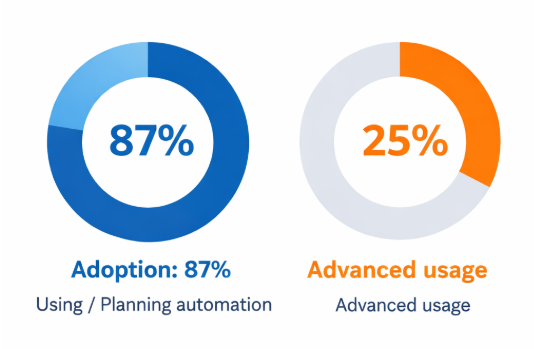
While most marketing teams adopt automation, only a small portion fully leverage its advanced capabilities
Implementing automated optimization requires careful configuration, including defining goals, setting parameters, and integrating data sources. Poor setup can negate potential benefits.
Best Practices for Using Automated Optimization
To maximize the benefits while mitigating risks, consider the following strategies:
1. Combine Automation with Human Oversight
Use automation for execution but maintain human control over strategy and creative direction.
2. Ensure High-Quality Data
Invest in data hygiene and integration to provide accurate and comprehensive inputs for automated systems.
3. Continuously Monitor Performance
Even with automation, regular performance reviews are essential to identify anomalies and opportunities for improvement.
4. Start Small and Scale Gradually
Test automation on smaller campaigns before rolling it out across larger initiatives.
5. Align Automation with Business Goals
Clearly define KPIs and ensure automation settings are aligned with overall marketing objectives.
Suggested Articles for Further Reading
Conclusion
Automated campaign optimization offers significant advantages in efficiency, scalability, and data-driven performance. However, it is not a fully autonomous solution. Success depends on a balanced approach that combines technological capabilities with human expertise.
By understanding both the strengths and limitations of automation, marketers can make informed decisions and build more effective, resilient campaigns.