The ad is live. CTR is where you want it. CPMs look reasonable. Even CPCs are trending lower than expected.
On the surface, everything seems to be performing. But revenue? Leads? Sales? Still flat.
If this sounds familiar, you’re not dealing with an underperforming ad — you’re dealing with misleading signals. In this article, we’ll break down why some ads can “look fine” while quietly missing the mark, and how to identify the real friction points in your ad-to-sale journey.
Looking at Ad Metrics in Isolation Creates False Confidence
Ad platforms are designed to optimize for their own success — not yours. They reward engagement and cheap traffic, which often has little to do with business results.
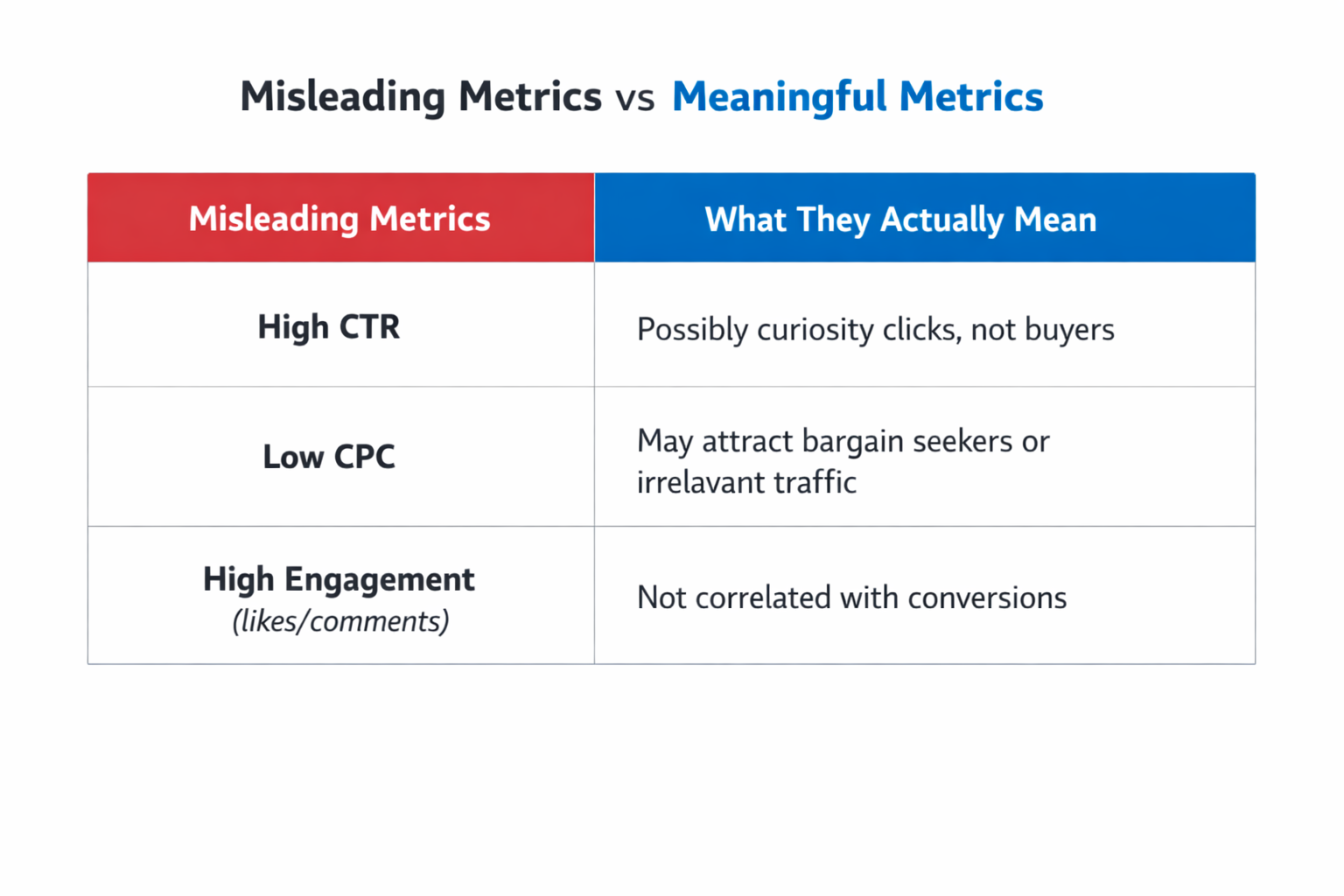
If you only track:
-
Click-through rate (CTR), you’ll optimize for curiosity instead of intent.
-
Cost-per-click (CPC), you’ll chase volume instead of value.
-
Engagement, you’ll attract people who respond, not necessarily those who convert.
Instead, combine platform metrics with off-platform behavior:
-
Track click-to-lead conversion rates using server-side analytics.
-
Monitor lead quality over time, not just quantity.
-
Attribute outcomes across multiple touches — ad → page → CRM → sale.
For help interpreting your ad data with more clarity, read How to Analyze Facebook Ad Performance Beyond CTR and CPC.
By measuring the complete flow, you’ll avoid optimizing for vanity metrics.
What Happens After the Click Often Breaks the Sale
Even high-quality traffic won’t convert if the experience that follows is confusing, misaligned, or simply unpersuasive. Most advertisers over-focus on front-end metrics and ignore conversion architecture.
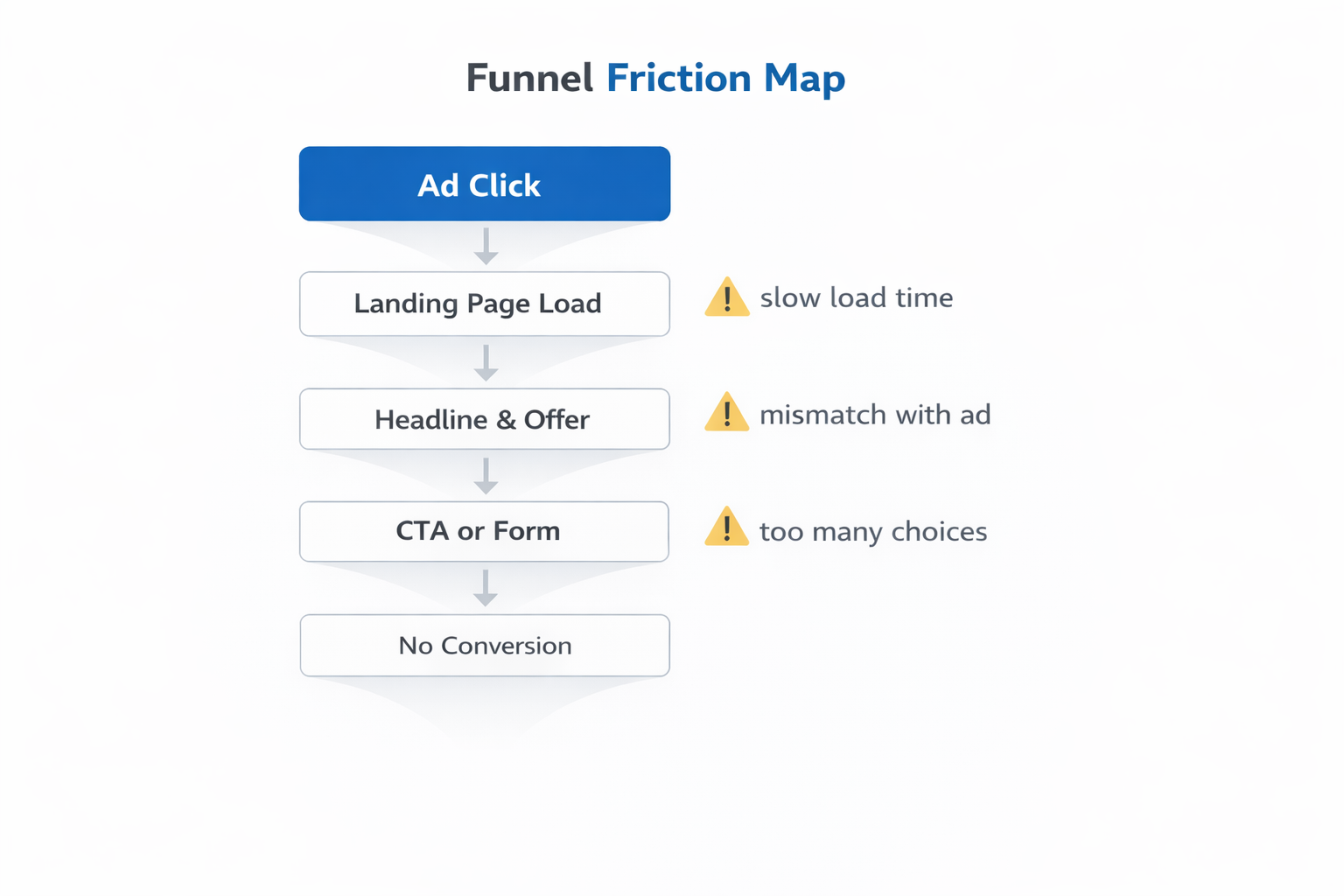
Instead of just looking at bounce rates, try investigating:
-
Unclear information hierarchy — Are the key benefits instantly visible above the fold?
-
Non-priority CTAs — Are there too many options competing for attention?
-
Lack of urgency or frictionless paths — Does the user feel any reason to act now?
-
Generic social proof — Are testimonials vague or irrelevant to the current visitor?
Use tools like heatmaps or session recordings to identify friction. For a deeper guide, explore Optimizing for Post-Click Experience: What Happens After.
Ad Success Often Hides Targeting Drift
Even “good” ads deteriorate over time. This isn’t just fatigue — it’s often subtle drift in who the platform shows your ad to. Over time, Meta may favor segments that click but don’t buy, simply because the algorithm sees that behavior as “positive.”
Watch for:
-
Increasing volume from lower-intent geographies or devices.
-
Rising frequency in ad sets with stable budgets.
-
Sudden jumps in CTR with no corresponding increase in leads or purchases.
To correct this, reintroduce friction. Examples include:
-
Adding qualifying language like, “For business owners only.”
-
Using longer copy to slow the scroll and increase self-selection.
-
Excluding site visitors who bounced within 10 seconds — they’re likely not aligned with your offer.
Also see Why Your Ads Get Clicks But No Sales: Fixing the Audience Misalignment.
Most Brands Use Creative Testing the Wrong Way
Testing is more than swapping thumbnails or changing a headline. It’s about isolating variables that directly affect outcomes — not just testing random ideas.
Avoid “testing noise” by:
-
Mapping creative variables to the stage of awareness you’re targeting.
-
Testing headlines only when the rest of the structure is proven to convert.
-
Avoiding format changes (e.g., video vs. static) unless the messaging is consistent.
For more insight, read Key Strategies for Facebook Ad Testing: What You Need to Know.
Over-Optimization Limits Learning
Advertisers often over-refine their campaigns too early, before there’s enough data to reach meaningful conclusions. This creates a fragile setup that looks efficient but breaks under pressure.
Here are signs you may be over-optimizing:
-
Ad sets get reset frequently, losing historical learnings.
-
Budgets are adjusted daily, confusing the delivery algorithm.
-
Too many exclusions limit discovery of new high-intent segments.
A better approach:
-
Set learning periods of at least 5–7 days per creative or audience test.
-
Avoid segmenting by minor demographics unless your offer requires it.
-
Use broad targeting with layered exclusions only after clear patterns emerge.
Need help exiting the learning phase faster? Read How to Finish the Facebook Learning Phase Quickly.
Attribution Misreads Are More Common Than You Think
If you’re judging ad success based only on what Facebook reports, you’re missing part of the picture. Many advertisers misdiagnose campaign performance because attribution isn’t set up to reflect the full customer journey.
Here’s what to check:
-
Are your attribution windows too short? Consider 7-day click and 1-day view as a baseline.
-
Are you comparing Meta data with Google Analytics or CRM records regularly?
-
Are you capturing post-view conversions (where no click occurs but a visit follows)?
To uncover the full impact of a campaign:
-
Use attribution modeling tools that show contribution across multiple touches.
-
Conduct lift tests — split your audience and measure actual incremental results.
-
Ask high-value customers what influenced their decision to buy. Manual feedback can surface what attribution misses.
You can also explore Meta Ads Attribution: What to Know About Windows, Delays, and Data Accuracy.
Final Takeaway: Don’t Trust “Fine”
When ads look fine but don’t drive results, the root cause is usually hidden beneath the surface.
You might be optimizing for metrics that don’t move your business forward. Or interpreting performance signals out of context.
Real ad performance is holistic. It connects targeting, creative, post-click experience, and back-end outcomes.
So next time a campaign seems “fine” — ask yourself whether the traffic is converting, whether the funnel is aligned, and whether your measurement tells the full story.