You launch a campaign that looks correct on paper. Targeting is broad enough. Budget is reasonable. Creative follows patterns you’ve seen working elsewhere.
A competitor in the same space is clearly scaling — you see their ads frequently, sometimes multiple variations, running for weeks.
Your campaign either stalls after a few days or never reaches stable performance. This gap is rarely explained by “better ads.”
It’s almost always explained by how the system reads your account versus theirs.
The Gap Usually Shows Up in CPM First
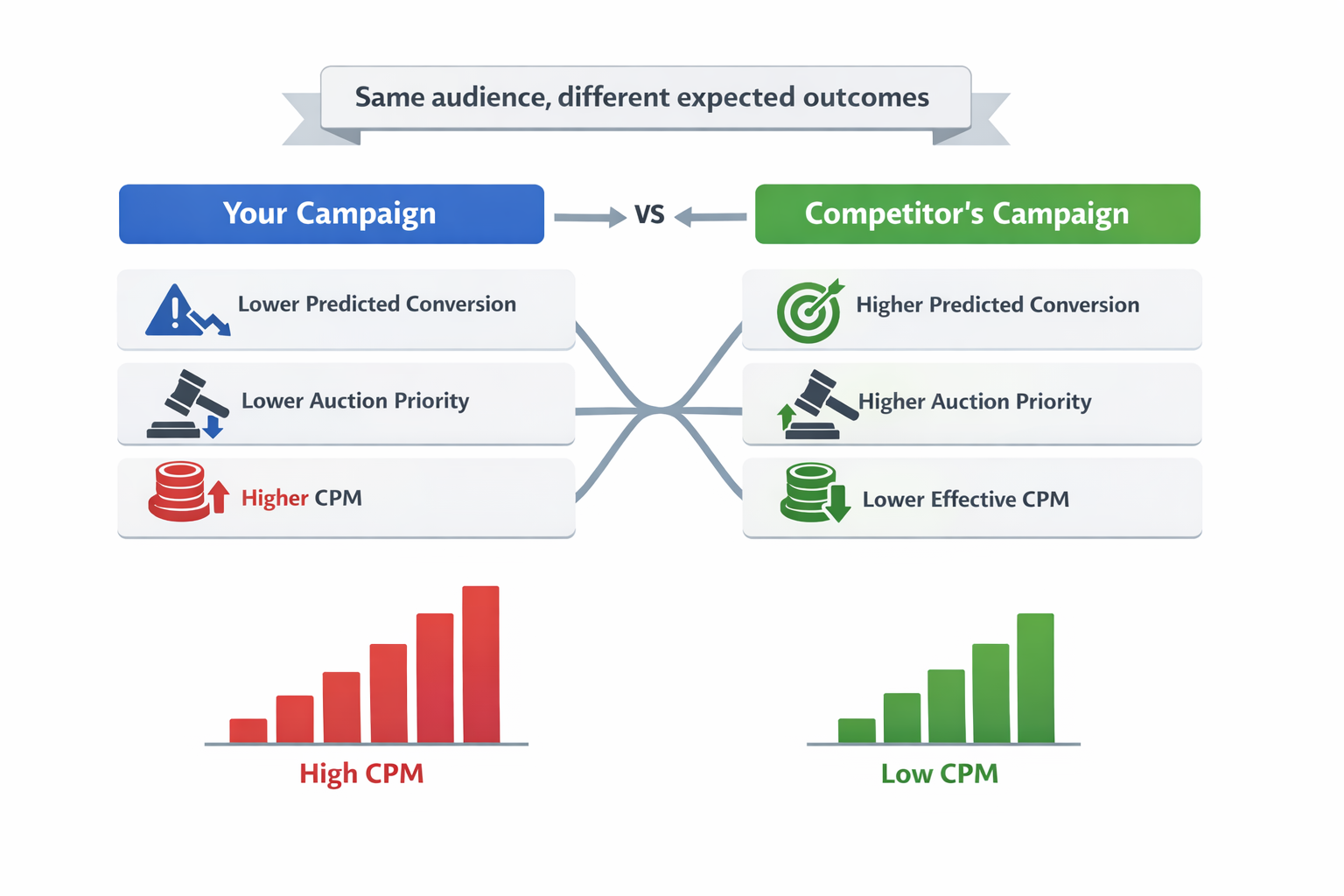
Before conversion rate drops or CPL increases, CPM is usually the first signal that something is off.
You might notice that:
-
your CPM climbs after the first couple of days,
-
spend starts slowing down despite available budget,
-
or delivery never ramps properly in the first place.
Meanwhile, competitors maintain stable delivery.
This happens because Meta constantly estimates how likely a user is to convert after seeing your ad.
If your account produces:
-
inconsistent conversion patterns,
-
delayed signals,
-
or mixed post-click behavior,
the system reduces how aggressively it bids.
If you’ve ever looked into Factors That Influence the Cost of Facebook Ads, you’ve seen that CPM is not just about competition — it’s tied to expected performance.
Your competitor isn’t getting cheaper traffic. They’re getting better auction priority.
Early Conversions Shape More Than Most Teams Expect
The first conversions don’t just “start learning.”
They define what the system considers a good outcome.
If early conversions include:
-
low-intent leads,
-
accidental submissions,
-
or users who never engage further,
the algorithm builds around those patterns.
From that point, it keeps finding similar users.
That’s where divergence begins.
This is the same root issue described in Why Your Facebook Ads Aren’t Generating Leads and How to Fix It — the system optimizes exactly what you feed it, not what you intend.
You don’t scale what you want. You scale what you validate early.
The Funnel Can Undermine Delivery Without Obvious Failures
Most teams look at CTR and CPL and assume the funnel is fine.
Meta doesn’t.
It looks at behavior consistency after the click.
You might have:
-
decent CTR,
-
acceptable CPL,
-
steady traffic.
But if users:
-
hesitate on the page,
-
drop off inconsistently,
-
or convert at irregular intervals,
the system struggles to connect cause and effect.
This is where Optimizing for Post-Click Experience: What Happens After becomes critical — not just for UX, but for algorithm clarity.
Inside Ads Manager, this often appears as:
-
strong first-day performance that fades,
-
rising CPC without changes,
-
uneven daily results.
The system doesn’t scale confusion.
Scaling Doesn’t Break Campaigns — It Reveals Them
Scaling doesn’t create problems.
It exposes them.
When you increase budget, Meta:
-
enters more competitive auctions,
-
reaches less obvious users,
-
relies more on learned patterns.
If those patterns are weak, performance drops quickly.
A typical sequence:
-
early results look strong,
-
budget increases,
-
CPL rises,
-
delivery becomes unstable.
This is exactly what happens in What to Do When Your Facebook Ads Suddenly Stop Converting — the system runs out of reliable signals.
Scaling amplifies whatever is already there — good or bad.
Same Targeting Still Leads to Different Audiences
Two advertisers can use identical targeting and still reach completely different users.
Because targeting is only the starting point.
Actual delivery depends on:
-
who converts,
-
how they behave,
-
how predictable that behavior is.
If your leads hesitate or drop off, the system learns slowly.
If a competitor’s users behave consistently, the system sharpens faster.
You’re not competing on targeting inputs. You’re competing on signal quality.
Creative Performance Depends on Account Context
This is where many teams misdiagnose performance.
They copy competitor creatives and expect similar results.
Instead, performance drops.
The assumption becomes: “the creative isn’t good enough.”
But creative is evaluated inside account history.
If your account has:
-
weaker engagement patterns,
-
inconsistent conversion signals,
-
broader behavioral clusters,
Meta distributes impressions more cautiously.
So the same creative gets:
-
slower learning,
-
weaker early feedback,
-
less stable delivery.
The ad didn’t change. The system interpreting it did.
What to Check Before Changing Anything
Before touching creatives or rebuilding campaigns, look at how delivery behaves over time — not just totals.
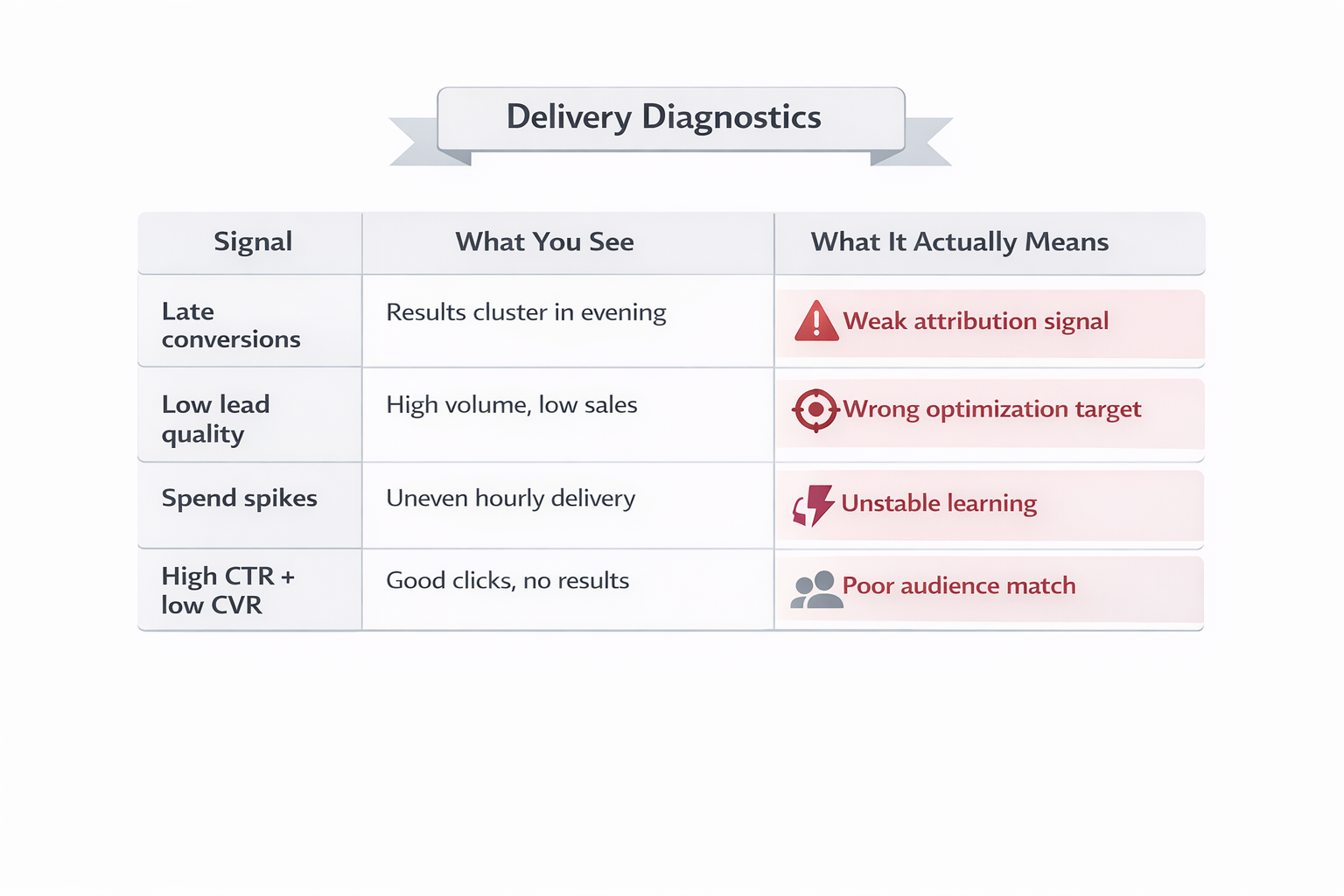
Start with conversion timing.
If conversions appear late or cluster unpredictably, the system struggles to connect impressions to outcomes. You’ll often see slow spend early in the day and uneven pacing.
Then check lead quality directly.
Pull a batch of leads and review them. If a large share is unqualified or low intent, that’s what Meta is optimizing for — even if CPL looks fine.
Next, look at spend distribution.
Stable campaigns spend relatively evenly. Weak ones spike for a few hours, then stall.
Then observe post-click signals:
-
high CTR with weak conversion rate,
-
rising CPC,
-
inconsistent daily results.
That pattern usually means the system can’t find repeatable user profiles.
Finally, compare CPL with what happens after the lead. If cost improves but quality drops, targeting is drifting.
At that point, optimization is happening — just in the wrong direction.
What Actually Changes Performance
Performance improves when signals become clearer and more consistent.
One of the biggest shifts is adjusting what counts as a conversion.
Not by narrowing targeting — but by improving signal quality.
Another lever is reducing behavioral friction. If users hesitate, reload, or abandon mid-process, the system reads that as uncertainty. Fixing small UX issues can stabilize performance faster than changing ads.
Scaling should only happen when daily results stop fluctuating.
If results swing without a pattern, increasing budget spreads that instability.
There’s also the issue of resets.
Frequent edits or duplications interrupt learning. Accounts that scale well keep structures stable long enough for patterns to compound.
And then there’s alignment. If the ad promise and landing experience don’t fully match, users pause. That hesitation lowers conversion probability at scale.
Final Take
When Facebook ads work for competitors but not for you, the difference isn’t creative or budget.
It’s signal quality.
Competitors aren’t outsmarting the system.
They’re feeding it better data.
Once your account produces:
-
consistent conversions,
-
predictable behavior,
-
clean feedback loops,
delivery stabilizes.
And when delivery stabilizes, performance follows.