Scaling digital advertising campaigns is a necessary step for growth, but it often comes with a critical challenge: disrupting the learning phase. Most ad platforms rely on machine learning algorithms that require a stable flow of data to optimize performance. When significant changes are introduced, campaigns can re-enter the learning phase, leading to unstable results, higher costs, and reduced conversion rates.
According to industry benchmarks, campaigns that exit the learning phase successfully can achieve up to 20–30% lower cost per acquisition compared to those that frequently reset. This makes it essential to scale strategically rather than aggressively.
Understanding the Learning Phase
The learning phase is a period during which an advertising platform’s algorithm gathers data to optimize delivery. During this time, performance may fluctuate as the system tests different audience segments, placements, and bidding strategies.
Most platforms recommend achieving at least 50 optimization events within a 7-day window to stabilize performance. If major changes are made—such as large budget increases, targeting shifts, or creative overhauls—the algorithm may reset and begin learning again.
Why Scaling Often Causes Resets
Scaling introduces new variables into the system. When these variables exceed certain thresholds, the algorithm treats the campaign as fundamentally different.
Common triggers include:
-
Budget increases above 20–30% in a short period
-
Significant audience changes
-
Switching bid strategies
-
Replacing a large portion of creatives
Research shows that abrupt scaling can increase CPA volatility by over 35% during the first few days after changes.
Strategies to Scale Without Resetting
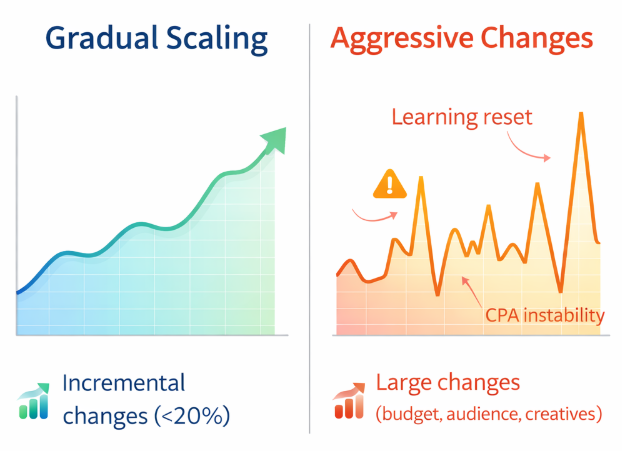
Abrupt campaign changes can reset the learning phase, leading to unstable performance and higher cost volatility
1. Gradual Budget Increases
Instead of doubling budgets overnight, increase them incrementally. A widely accepted approach is to raise budgets by no more than 10–20% every 48–72 hours.
This allows the algorithm to adapt without treating the campaign as new. Campaigns scaled gradually have been shown to maintain up to 90% of their pre-scaling efficiency.
2. Horizontal Scaling
Rather than pushing more budget into a single campaign, duplicate successful campaigns and distribute spend across them.
This approach preserves the learning state of the original campaign while expanding reach. Horizontal scaling can improve overall stability and reduce risk.
3. Audience Expansion in Layers
Avoid broad targeting changes all at once. Instead, expand audiences step by step:
-
Start with lookalike audiences close to your core segment
-
Gradually widen targeting criteria
-
Test broader segments in separate campaigns
Layered expansion helps maintain consistent performance signals.
4. Creative Rotation Instead of Replacement
Replacing all creatives at once can reset performance signals. Instead:
-
Introduce new creatives alongside existing ones
-
Phase out underperforming assets gradually
Campaigns that rotate creatives incrementally often experience up to 25% higher engagement stability.
5. Use Campaign Duplication Strategically
When scaling aggressively is necessary, duplicating a campaign can be safer than modifying the original. This keeps the original campaign stable while allowing experimentation.
However, duplicated campaigns should be monitored closely to avoid audience overlap and increased competition.
6. Optimize Before You Scale
Ensure campaigns are fully optimized before increasing spend. This includes:
-
Stable CPA over several days
-
Consistent conversion volume
-
High-performing creatives and audiences
Scaling an unstable campaign amplifies inefficiencies, often leading to wasted budget.
Monitoring During Scaling
Scaling does not end with budget adjustments. Continuous monitoring is essential to detect early signs of instability.
Key metrics to track include:
-
Cost per acquisition (CPA)
-
Conversion rate
-
Frequency
-
Return on ad spend (ROAS)
If performance drops significantly—typically more than 15–20%—pause scaling and allow the campaign to stabilize.
Common Mistakes to Avoid
-
Scaling too quickly without sufficient data
-
Making multiple major changes simultaneously
-
Ignoring early warning signs of performance decline
-
Overlapping audiences across duplicated campaigns
Avoiding these pitfalls can significantly improve scaling outcomes and maintain algorithm efficiency.
Conclusion
Scaling without resetting the learning phase requires a balance between growth and stability. By increasing budgets gradually, expanding audiences strategically, and maintaining consistent optimization signals, it is possible to grow campaigns while preserving performance.
Marketers who follow structured scaling strategies can reduce volatility, improve efficiency, and achieve more predictable results over time.
Further Reading