High engagement feels good inside Ads Manager. You see more likes, more comments, and more shares. Click-through rate climbs and CPM drops. But your cost per lead increases and sales slow down at the same time.
This creates confusion for advertisers and business owners. The ad looks successful on the surface, yet pipeline metrics tell a different story. Many teams assume engagement equals demand, but that assumption breaks campaigns. Engagement measures attention, while conversions measure intent and commitment.
When those two signals move in opposite directions, performance suffers. This gap is explained in detail in CTR vs Conversions: Why High CTR Doesn’t Always Mean More Sales, where attention and buying intent are clearly separated.
Why high engagement can hide real problems
Engagement is immediate and visible, which makes it emotionally rewarding. Revenue data is slower, less visible, and often tracked in another system. That difference pushes teams to optimize what they can see instead of what truly matters.
An ad can generate strong reactions and long comment threads. It can also attract people who were never serious buyers. When that happens, you scale the wrong signal.
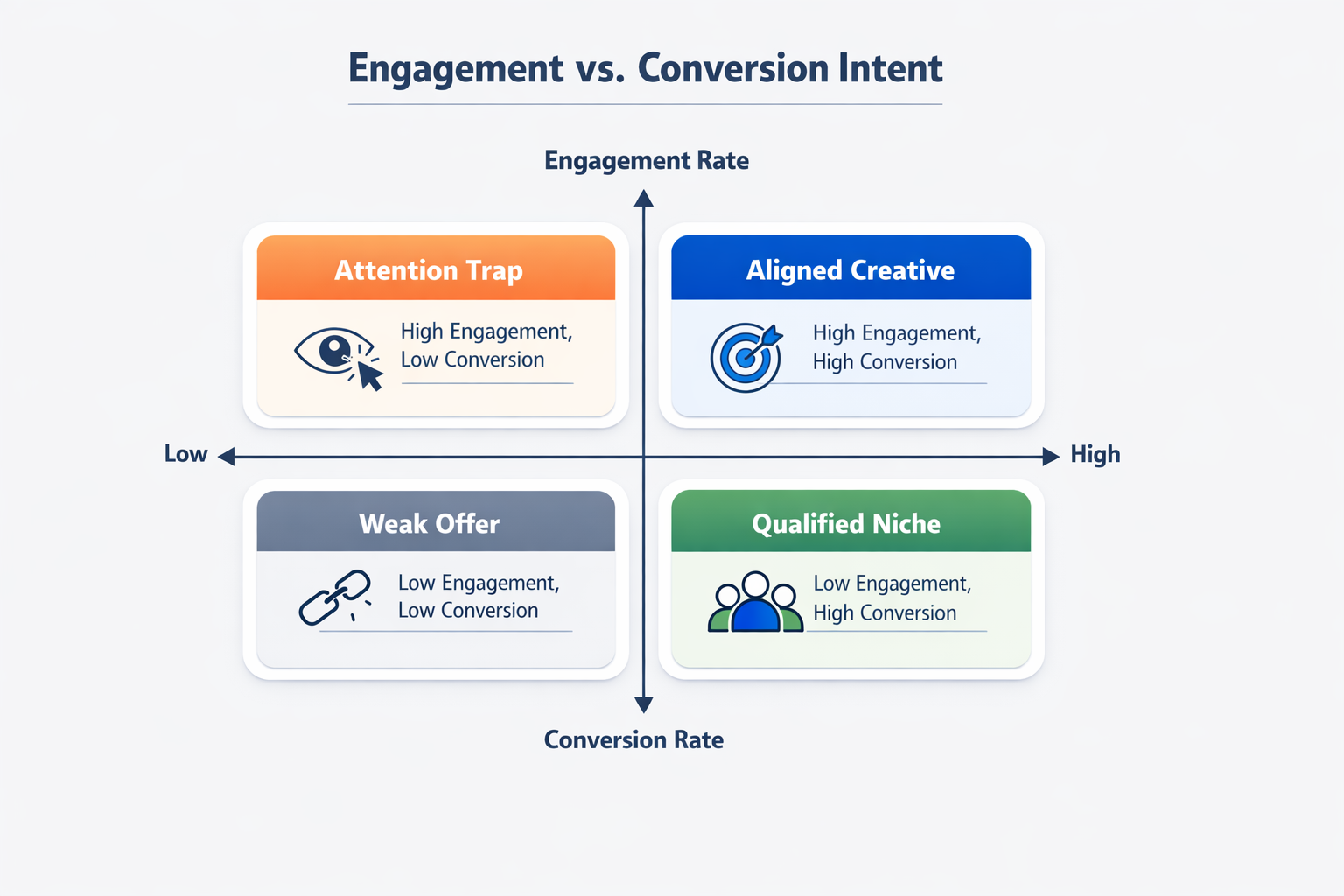
Engagement is optimized for interaction, not buying
Meta’s delivery system favors ads that generate quick reactions. When users like, comment, or click, the algorithm increases delivery because it detects activity. CPM often drops because the ad appears relevant in the feed.
However, feed relevance is not the same as commercial alignment. A funny, dramatic, or emotional creative can attract wide attention without filtering intent. If the message appeals to everyone, it qualifies no one.
Many advertisers focus only on CTR and CPC, which creates blind spots. A deeper breakdown of this issue appears in How to Analyze Facebook Ad Performance Beyond CTR and CPC, where surface metrics are separated from revenue signals.
Broad messaging brings broad traffic
High engagement creatives often use wide hooks. They address common frustrations or make bold claims that resonate with large audiences. That approach increases reach quickly but weakens buyer precision.
For example:
-
A dramatic revenue promise without context; this attracts curious users rather than qualified prospects.
-
A highly relatable meme about marketing struggles; this drives comments but not purchase intent.
-
A general problem statement without clear criteria; this pulls in people outside your target segment.
Traffic increases and clicks increase, yet lead quality declines. The algorithm learns from engagement patterns, so it expands delivery toward similar low-intent users. Over time, conversion rate drops even if engagement remains strong.
How creative structure affects conversion rate
Creative structure shapes audience composition. Small messaging changes determine who feels invited to click and who feels excluded. Performance campaigns need clarity more than excitement.
Hooks that create curiosity without commitment
Strong hooks improve stop rate and early interaction. They often boost CTR in the first days of a campaign. The problem appears when the hook creates curiosity without commercial alignment.
Common examples include:
-
Large income numbers without qualification; these attract aspirational traffic with low buying readiness.
-
Emotional storytelling without clear offer framing; this builds empathy but not urgency.
-
Open-ended curiosity questions; these increase clicks without increasing commitment.
These creatives win the scroll but lose at the conversion step. High CTR combined with low conversion rate is a clear signal that attention is misaligned with intent. This dynamic is also explored in Ad Metrics That Lie: When Good Numbers Hide Bad Performance, where strong platform metrics mask weak business outcomes.
Adding small friction improves quality
High-converting creatives often feel less flashy and more specific. They reduce unnecessary reach by qualifying the viewer early. This lowers engagement slightly but strengthens downstream performance.
Examples of useful friction include:
-
Mentioning a starting price range; this filters out users with unrealistic expectations.
-
Naming the exact audience type; this excludes people who do not identify with the profile.
-
Describing required effort or timeline; this discourages casual browsers.
When fewer but better users click, conversion rate improves. Cost per acquisition stabilizes because the algorithm receives clearer signals. This connects directly to the principle discussed in Audience Quality vs Quantity: What Drives Better Long-Term Results?, where long-term efficiency depends on quality, not volume.
The hidden algorithm feedback loop
Creative does more than generate clicks. It trains the delivery system by shaping early engagement signals. Those early signals influence future audience expansion.
If initial engagement comes from low-intent users, the system scales toward similar profiles. Even if engagement stays high, buyer quality declines gradually. This creates a hidden negative feedback loop that weakens conversion efficiency over time.
Engagement-heavy traffic lowers signal density
Meta optimizes best when it receives consistent conversion events. When many users click but few convert, signal density drops. The system lacks strong indicators of who actually buys.
Conversion data becomes thin and unstable. Learning slows and CPA fluctuates more aggressively. High engagement traffic can inflate sessions without improving meaningful events, which weakens optimization across ad sets.
Social proof can distort perception
Ads with large comment threads look powerful and credible. They create the illusion of momentum and validation. However, comment volume does not equal purchase intent.
Long discussions often attract casual interaction from users outside your core market. As engagement grows, similar users enter the auction and reinforce the wrong signal. Conversion rate erodes quietly while the ad appears popular.
How to detect when engagement is hurting performance
Engagement itself is not the enemy. Misalignment between engagement and revenue is the problem. You need to compare platform data with CRM and sales metrics.
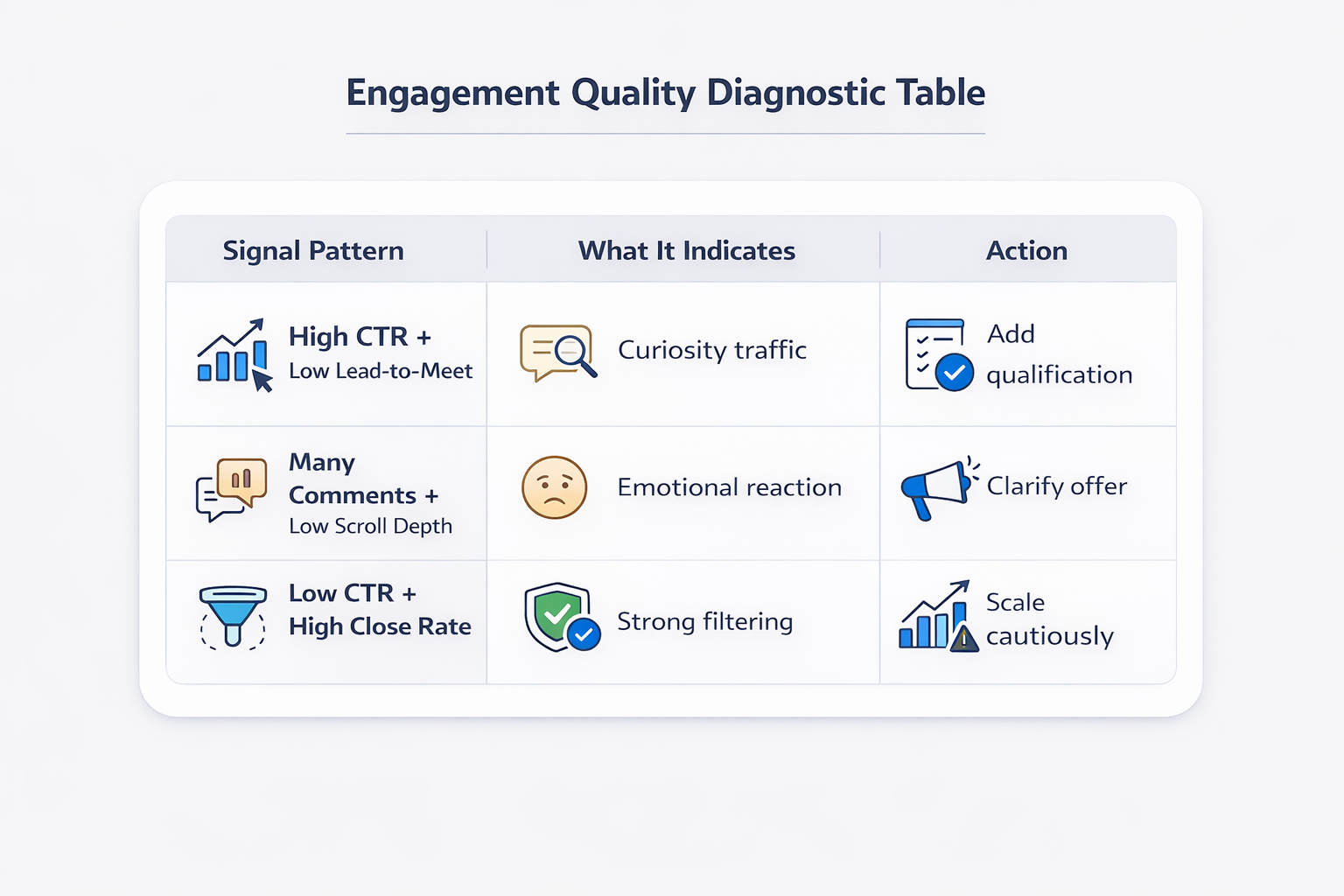
Compare CTR with downstream quality
Do not stop at cost per lead. Track what happens after the form submission and inside your sales pipeline. Strong creative should improve both CTR and lead progression.
Review metrics such as:
-
Lead-to-meeting rate; this reveals early qualification strength.
-
Meeting-to-close rate; this shows alignment between messaging and reality.
-
Average deal value by campaign; this highlights profitability differences.
If CTR rises while these metrics decline, your creative is attracting attention without attracting buyers.
Check audience expansion patterns
Break down performance by age groups, placements, and interest clusters. Engagement-driven creatives often expand into adjacent segments that look promising at the top level.
If new segments show strong CTR but weak conversion, your message is too broad. Tightening positioning or adding qualification language can restore quality and stabilize results.
Review on-site behavior
Engaged clicks do not guarantee serious evaluation. Use analytics tools to study what happens after the click.
Watch for patterns such as:
-
High bounce rates after strong hooks; this signals curiosity without intent.
-
Short time on page; this shows mismatch between ad promise and offer.
-
Form starts without completion; this reflects low commitment users.
These behaviors appear before revenue drops significantly, which gives you time to adjust creative direction.
Designing creatives that balance attention and intent
The goal is not low engagement. The goal is aligned engagement that supports buying behavior. Creative should attract the right users and repel the wrong ones at the same time.
Match the hook to the real offer
Your opening message should reflect the true nature of the product. Avoid exaggerated framing that expands reach beyond your actual target. Specificity reduces unnecessary clicks and improves alignment.
When the hook mirrors the real value proposition, fewer unqualified users enter the funnel. This strengthens signal quality for the algorithm and improves conversion consistency.
Qualify early in the ad
State clearly who the offer is for and under what conditions it works best. Mention context such as company size, budget level, or required commitment when relevant. This reduces engagement slightly but increases buyer alignment.
Qualified traffic produces cleaner learning signals. Over time, conversion rate stabilizes and CPA becomes more predictable.
Optimize around revenue metrics
Shift your reporting focus toward economic outcomes rather than vanity signals. CTR and engagement rate are secondary to cost per opportunity and revenue per campaign.
Run weekly reviews that connect ad data with CRM outcomes. Monitor opportunity volume, deal value, and closed revenue alongside platform metrics. When creative decisions are tied to revenue impact, engagement becomes a supporting signal rather than the primary goal.
When lower engagement is a good sign
High-converting ads often look quiet compared to viral creatives. They may have fewer comments and average CTR, yet they consistently produce qualified leads and sales. That contrast can feel uncomfortable if you are used to measuring success by reactions.
Serious buyers rarely behave like casual scrollers. They click with intent, evaluate the offer carefully, and move forward without public interaction. Performance marketing rewards clarity, alignment, and relevance more than visible excitement.
If engagement drops slightly but revenue improves and lead quality strengthens, that is a positive signal. In that scenario, your creative is filtering better, your traffic is cleaner, and your campaign is aligned with real demand rather than surface-level attention.