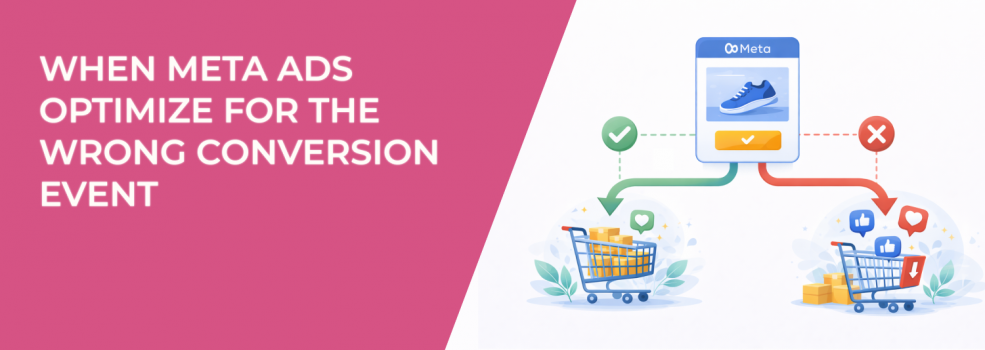
Meta campaigns often underperform for a structural reason. They optimize for the wrong conversion event.
The platform executes exactly what you configure. If the selected signal is misaligned with revenue, delivery drifts away from profitability.
Many advertisers prioritize higher-volume events to stabilize learning. That decision improves short-term metrics but weakens revenue efficiency over time.
What Conversion Optimization Actually Means
When you choose a conversion event, you define the system’s success metric. The algorithm then searches for users most likely to trigger that specific action.
Meta does not understand your margins or sales process. It understands event probability and behavioral patterns derived from historical data.
If you optimize for Add to Cart, the system finds habitual cart users. If you optimize for Leads, it finds habitual form submitters, not necessarily buyers.
The Probability Model Behind Delivery
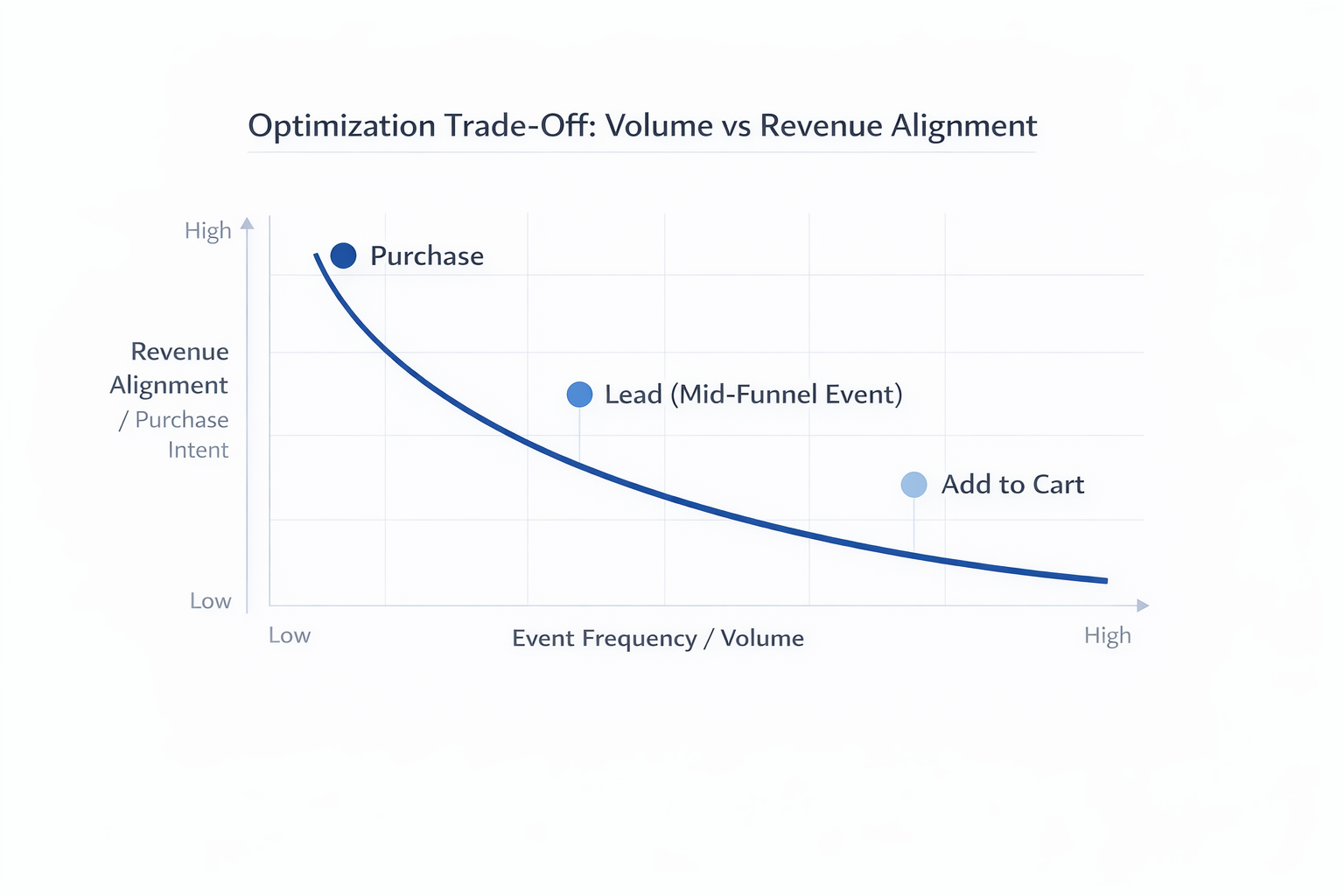
Meta predicts which users are most likely to complete the selected event. Higher event frequency improves learning stability and reduces volatility inside each ad set.
Lower-frequency events increase variance during the learning phase. This is why many accounts struggle with the learning status explained in What Does “Learning Limited” Mean in Facebook Ads?
This creates a structural tension between data volume and intent quality:
-
High-volume events; faster learning, weaker purchase intent.
-
Mid-funnel events; moderate stability, inconsistent revenue correlation.
-
Purchase events; slower ramp-up, strongest revenue alignment.
Choosing speed over intent reshapes the audience pool over time.
Common Conversion Events That Distort Results
Many campaigns optimize for events that appear close to revenue but behave differently in practice. The gap between surface intent and actual buying behavior compounds gradually.
Small misalignments influence audience composition. Over several weeks, that influence becomes structural and harder to reverse.
Lead Instead of Qualified Lead
Optimizing for generic lead submissions prioritizes form completion behavior. It does not prioritize downstream qualification outcomes or closed revenue.
The algorithm identifies users who frequently submit forms. Some are comparison shoppers, freebie seekers, or low-intent researchers.
Typical signals include:
-
High lead volume; declining meeting rate.
-
Stable CPL; falling close rate.
-
Increasing sales rejection percentage.
If you want a deeper breakdown of how objectives influence outcomes, review How Facebook Ad Objectives Impact Lead Quality.
Add to Cart Instead of Purchase
Add to Cart events occur more frequently than purchases. That improves data density but shifts optimization toward browsing intent rather than transaction commitment.
Cart behavior signals interest. Purchase behavior signals financial commitment and payment completion.
When optimizing for Add to Cart:
-
CPA decreases; revenue per user declines.
-
Cart volume increases; checkout rate remains flat.
-
Retargeting pools expand without proportional sales growth.
This issue often overlaps with broader targeting errors described in Why Facebook Ads Fail: 7 Targeting Issues You Didn’t Know About.
Landing Page Views Instead of Conversions
Some advertisers select Landing Page Views to stabilize early delivery. This is common in new accounts with limited purchase data.
Traffic metrics improve quickly. Revenue metrics remain unchanged because the algorithm optimizes for page loads, not outcomes.
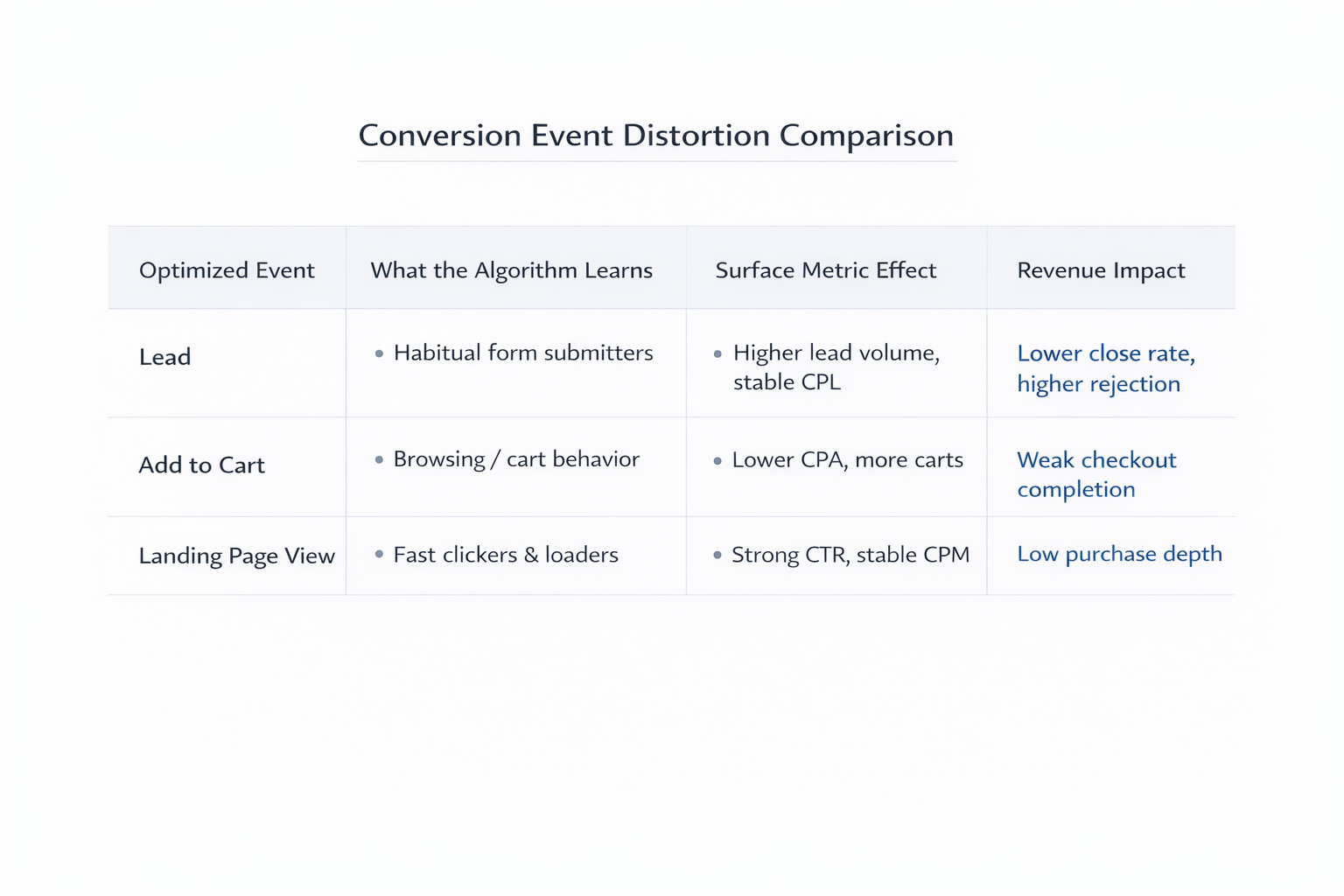
The system finds fast clickers who wait for the page to load. It does not differentiate between casual readers and serious buyers.
This pattern usually shows:
-
Strong CTR; weak conversion rate.
-
Stable CPM; declining return on ad spend.
-
High session volume; low transaction depth.
Understanding the difference between surface metrics and business metrics is critical. See Which Facebook Ad Metrics Predict Profitability Best? for a deeper framework.
Why Advertisers Downgrade Conversion Events
Meta recommends stable event volume per ad set for consistent learning. Many accounts struggle to reach sufficient purchase events weekly, especially with fragmented structures.
Advertisers respond by selecting higher-funnel signals. That decision reduces volatility but alters audience quality and long-term intent modeling.
Higher-funnel optimization shifts user composition. Over time, the pixel learns predominantly from lower-intent behavior, which compounds into structural bias.
The Compounding Feedback Effect
When lower-quality conversions dominate, lookalike seeds degrade. Broad targeting absorbs weaker behavioral patterns and amplifies them.
Budget then scales into audiences trained on soft intent. Even after switching back to Purchase optimization, the learning base contains bias that takes time to correct.
Recovery requires consolidation, clean purchase data, and disciplined optimization.
How to Detect Event Misalignment
Platform metrics alone cannot diagnose this issue. You need cross-funnel outcome visibility that connects ad performance to real revenue.
Start by comparing campaign-level performance against CRM or sales data. Look for divergence between platform efficiency and actual profitability.
Key comparisons include:
-
Lead-to-meeting rate; does quality decline as lead volume increases.
-
Meeting-to-close rate; does performance vary by campaign objective.
-
Revenue per conversion; does it justify the optimized event.
If platform metrics improve while revenue stagnates, the event is likely misaligned.
Map Campaign Objectives to Sales Outcomes
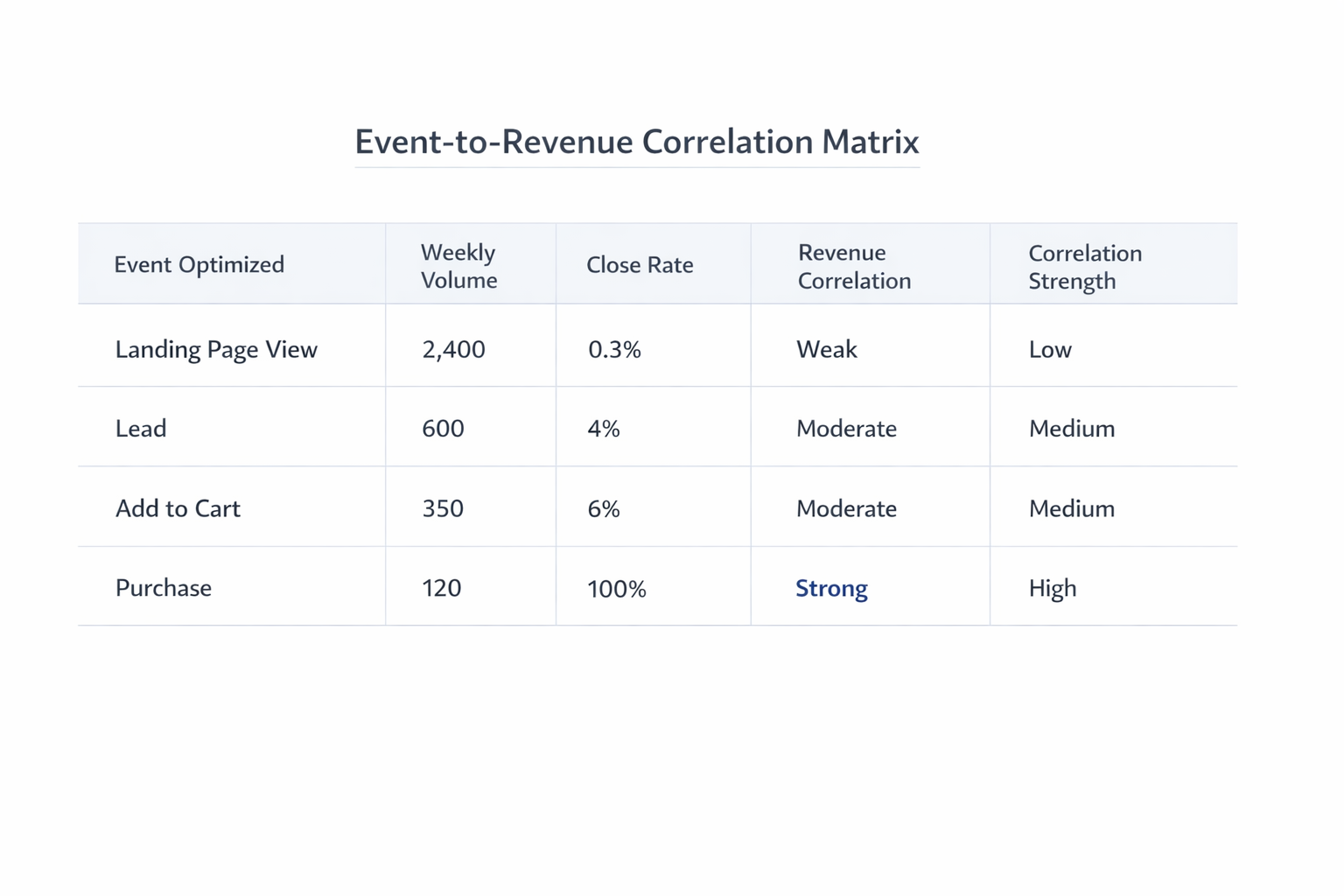
Export CRM results and align them with campaign objectives. Evaluate whether optimized events correlate with closed revenue instead of intermediate actions.
Look for structural contrasts:
-
Campaigns optimizing for Leads; high volume, weak close rate.
-
Campaigns optimizing for Purchase; lower volume, stronger margins.
-
Campaigns optimizing for Add to Cart; heavy retargeting reliance.
Patterns usually become visible within several weeks of consistent tracking.
When Higher-Funnel Optimization Makes Sense
There are legitimate cases for mid-funnel optimization. The decision must rely on validated revenue correlation rather than delivery stability alone.
Use higher-funnel events when purchase volume is structurally insufficient. Long sales cycles may also require early predictive signals that reliably forecast revenue.
Before committing, confirm predictive strength through cohort analysis. Do not assume early intent guarantees downstream profitability.
Validate Event Predictiveness Rigorously
Run cohort analysis across several weeks. Compare downstream revenue from users who triggered the selected event against those who did not.
Evaluate:
-
Do these users close at consistent rates.
-
Does cost per selected event correlate with cost per acquisition.
-
Does scaling this event increase total revenue, not just event volume.
If correlation is weak, the event should not guide optimization.
Structural Fixes Before Event Downgrades
Many accounts lack purchase volume because structure is fragmented. Budgets are split across too many ad sets with overlapping audiences.
Each ad set then receives insufficient conversion data. Learning instability follows, which tempts advertisers to lower the event threshold.
Instead of downgrading:
-
Merge overlapping audiences; increase signal density per ad set.
-
Reduce unnecessary exclusions; simplify targeting logic.
-
Consolidate budget; concentrate purchase data into fewer learning systems.
Structural discipline often restores Purchase optimization without sacrificing intent.
Improve Data Integrity
Optimization quality depends on tracking accuracy. Missing or delayed purchase signals distort the learning system and misguide delivery.
Verify:
-
Pixel fires correctly on purchase confirmation pages.
-
Server-side events deduplicate properly with browser events.
-
Offline conversions upload consistently if sales close outside the website.
For a broader breakdown of diagnostic thinking, review How to Tell If Facebook Ads Are Optimizing for the Wrong Goal.
The Long-Term Cost of Wrong Optimization
Optimizing for the wrong event rarely causes immediate collapse. It produces gradual revenue decay masked by stable platform metrics.
Audience quality erodes while acquisition volume appears healthy. Scaling becomes increasingly dependent on retargeting pools and short-term fixes.
Teams often adjust creatives or budgets instead of correcting the core signal. The structural misalignment persists and compounds across months.
Conversion optimization defines who the algorithm searches for and learns from over time. If revenue is the objective, optimize for revenue-aligned events whenever volume allows. When volume is insufficient, fix structure and tracking before lowering intent thresholds.