Most advertisers run Facebook and Instagram ads together and assume performance differences are just noise. In reality, one platform often drives the majority of results while the other struggles to convert.
This split is not random. It comes from how users behave on each platform, how creatives are consumed, and how the algorithm interprets engagement signals.
If you understand these differences, you can stop forcing budget into underperforming placements and scale what actually works.
Why Performance Diverges Between Instagram and Facebook
You’ll often see a campaign where Instagram delivers lower CPA even with higher CPM. At the same time, Facebook may generate cheaper impressions but weaker conversion rates.
This happens because the system optimizes for outcomes, not costs.
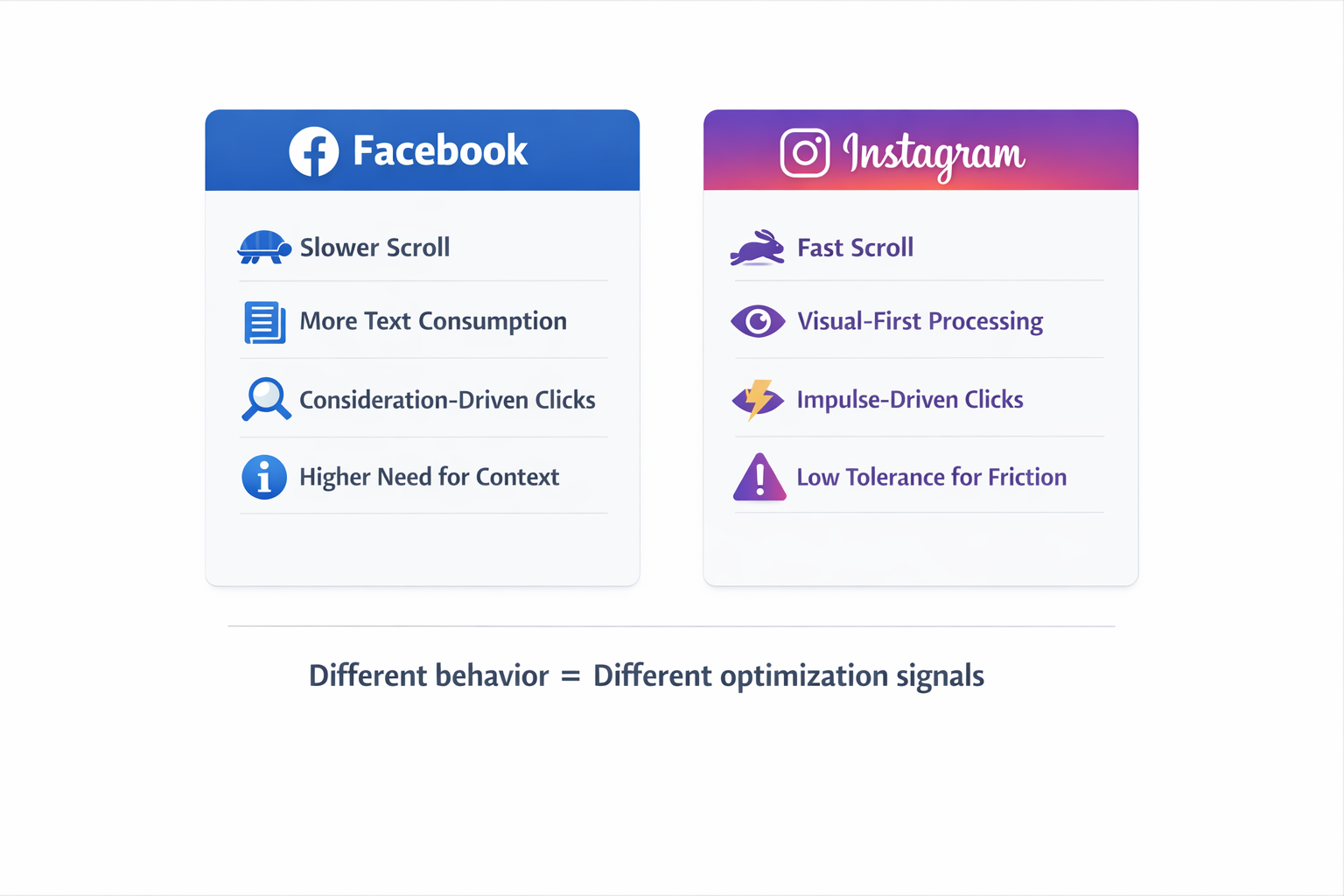
When Instagram users engage faster — clicking, watching, or converting — the algorithm increases delivery there. Over time, spend shifts naturally toward Instagram placements.
You can confirm this inside Ads Manager:
-
Spend gradually reallocates toward Instagram.
-
CTR is higher on Instagram placements.
-
Conversion events stabilize faster during the learning phase.
If these patterns appear early, it’s not a temporary fluctuation. It’s a structural signal.
When Visual Products Drive Immediate Decisions
Instagram outperforms when the product communicates value instantly without explanation.
This typically applies to:
-
Aesthetic-driven products
Fashion, beauty, fitness, and interior products rely on visual appeal. Users decide based on what they see, not what they read. -
Transformation-based offers
Before-and-after results, physical changes, or design improvements translate well into short visual sequences. -
Lifestyle positioning
Products tied to identity or aspiration perform better in a feed built around curated content.
This behavior is especially visible in visually-driven campaigns like those discussed in Instagram Ads for E-Commerce: How to Drive Sales Through Visual Storytelling.
In contrast, Facebook users often require more context. They pause, read, and evaluate. If your offer depends on explanation, Instagram loses its advantage.
When Creative Does Most of the Selling
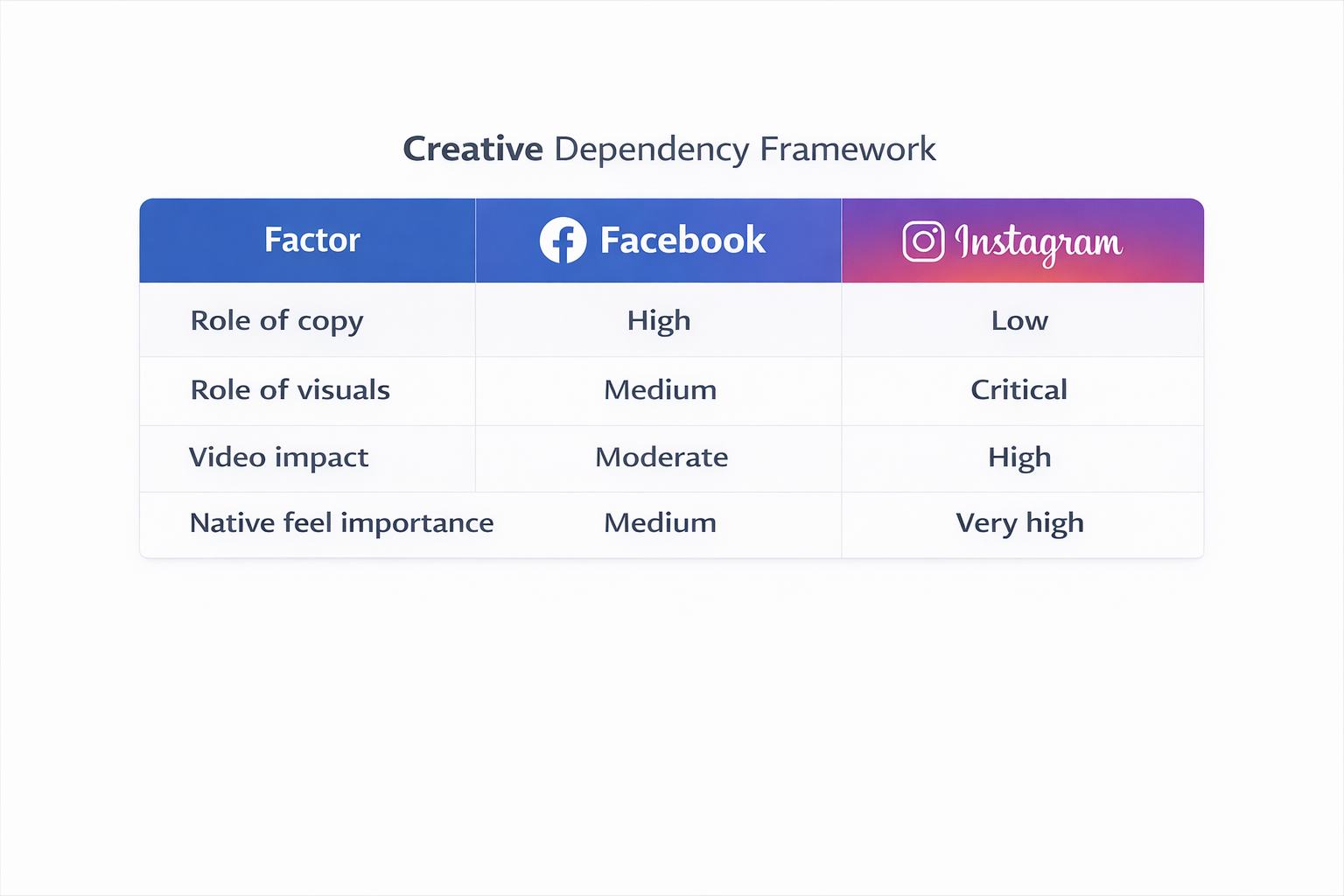
Instagram is a creative-driven environment. If the ad itself carries the conversion, performance improves significantly.
You’ll notice Instagram outperform when:
-
Short-form video generates early engagement signals
Reels-style creatives often produce strong interaction within the first 24–48 hours. -
The value proposition is clear without relying on copy
If users understand the offer within a few seconds, friction drops. -
Content looks native to the platform
Ads that resemble organic posts consistently outperform polished brand creatives.
This is why formats like Reels and Stories have become central, as explained in How to Use Instagram Reels in Your Marketing Strategy and How to Use Instagram Stories for Audience Engagement and Conversions.
If your best-performing ads rely on motion and visual storytelling, Instagram will typically take over delivery.
When Users Are in Discovery Mode
Instagram users are more open to discovering new products without prior intent. This changes how cold traffic behaves.
Instagram tends to win when:
-
Users are browsing, not searching
They are open to inspiration and new ideas. -
Emotional triggers drive action
Visual appeal and perceived lifestyle fit matter more than rational evaluation. -
Cold audiences convert without heavy nurturing
If your funnel is simple, Instagram reduces friction.
You’ll typically see:
-
Faster conversions after the first click.
-
Higher first-touch conversion rates.
-
Strong performance from broad audiences.
This aligns with broader Instagram behavior patterns covered in How to Use Instagram Ads for Small Business Growth in 2025.
When Mobile Experience Is Fully Optimized
Instagram is almost entirely mobile-native. If your funnel matches that environment, performance improves quickly.
Instagram outperforms when:
-
Landing pages load instantly and focus on one action
-
Forms are short and easy to complete
-
The user journey feels continuous from ad to conversion
If your mobile experience is weak, Instagram traffic drops off quickly — even if the ad performs well.
When Frequency Reinforces the Decision
Instagram users often tolerate repeated exposure better than Facebook users.
Instagram performs better when:
-
Multiple exposures strengthen recognition
-
Creative variation prevents fatigue
-
Retargeting relies on visual recall
You’ll typically observe:
-
Higher frequency without immediate CPA spikes.
-
Stable CTR despite repeated impressions.
-
Faster retargeting conversions.
Managing this properly becomes critical at scale, especially in visual-heavy campaigns like those discussed in Scaling Instagram Ads While Maintaining ROI: What You Need to Know.
When Facebook Still Performs Better
Instagram is not universally better. Facebook outperforms when context and explanation matter.
Facebook tends to win when:
-
The offer requires detailed explanation or trust-building.
-
The sales cycle is longer.
-
The audience engages with long-form content.
-
The demographic is less Instagram-active.
How to Decide Where to Scale
Instead of relying on assumptions, evaluate performance structurally:
-
Compare conversion efficiency, not CPM.
-
Analyze placement performance early.
-
Look at post-click behavior.
-
Match creatives to platform behavior.
Avoid fixed splits. Let performance data guide allocation.
Practical Takeaway
Instagram outperforms Facebook when the experience is fast, visual, and frictionless.
If your product can be understood instantly, your creative feels native, and your funnel is optimized for mobile behavior, Instagram often becomes the primary growth driver.
If your offer requires explanation and trust-building, Facebook will likely perform better.
Treat them as different behavioral environments, not interchangeable placements.