Traditional targeting models rely heavily on firmographics and static buyer personas. While industry, company size, and job title remain useful segmentation variables, they are insufficient in isolation. Modern demand generation requires dynamic, behavior-driven targeting frameworks.
Engagement signals—observable interactions between prospects and digital assets—offer real-time insight into buyer intent, content resonance, and stage progression. When properly structured, scored, and activated, these signals transform targeting from assumption-based to evidence-based.
Organizations that adopt data-driven targeting strategies report 5–8x higher ROI compared to non-data-driven approaches (McKinsey). Meanwhile, companies leveraging behavioral segmentation see up to a 760% increase in revenue from segmented campaigns (Campaign Monitor). The competitive advantage is clear: engagement-informed targeting materially improves performance.
What Are Engagement Signals?
Engagement signals are measurable behavioral indicators that demonstrate a prospect’s interaction with content, platforms, or outreach efforts. They typically fall into several categories:
1. Content Engagement Signals
-
Blog article views
-
Time on page
-
Scroll depth
-
Whitepaper downloads
-
Webinar registrations and attendance
2. Email Engagement Signals
-
Open rates
-
Click-through rates (CTR)
-
Reply behavior
-
Forwarding activity
3. Website Behavioral Signals
-
Repeat visits
-
High-intent page visits (pricing, product pages, case studies)
-
Session frequency and recency
4. Social and Community Signals
-
Post interactions
-
Profile visits
-
Event participation
-
Direct messaging engagement
Research from HubSpot indicates that companies using behavioral targeting generate 2–3x more conversions than those relying solely on demographic segmentation. The underlying principle is straightforward: behavior predicts buying readiness more accurately than static attributes.
Why Engagement Signals Improve Targeting Precision
Real-Time Intent Identification
Firmographic filters identify who a company is. Engagement signals identify what they are doing now. A prospect visiting a pricing page three times in a week represents a fundamentally different opportunity than a cold contact in the same industry.
Progressive Qualification
Instead of qualifying leads at a single moment, engagement signals allow continuous recalibration of lead scores. This reduces false positives and improves alignment between marketing and sales.
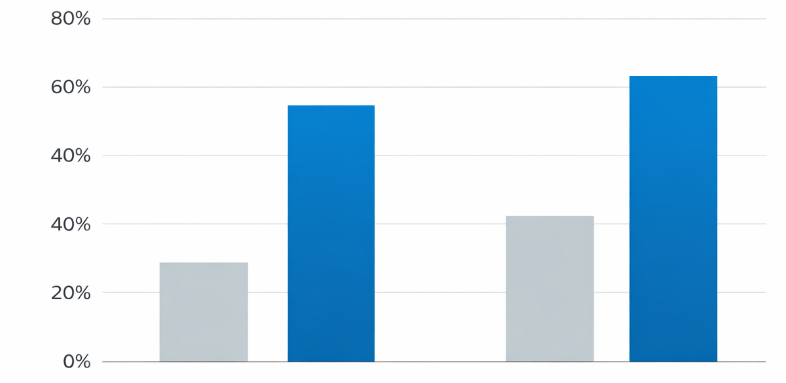
Behavioral targeting consistently drives up to 2–3× higher conversion rates and improves lead qualification accuracy by 40–60% compared to traditional targeting models
According to Gartner, B2B buyers spend only 17% of their purchase journey meeting with potential suppliers. The remaining time is spent independently researching. Engagement tracking enables teams to capture that invisible 83% of the journey.
Campaign Optimization Feedback Loops
Engagement data provides measurable feedback on messaging resonance. If a segment consistently engages with technical documentation but ignores executive-level thought leadership, targeting logic can be adjusted accordingly.
Building an Engagement-Driven Targeting Framework
Implementing engagement-based targeting requires structured execution. The following framework outlines a scalable approach.
Step 1: Define Signal Hierarchies
Not all engagement signals carry equal weight. A pricing page visit should not be treated the same as a homepage bounce. Develop a tiered scoring system:
-
Tier 1: High-intent actions (demo requests, pricing visits)
-
Tier 2: Mid-intent actions (case study downloads, webinar attendance)
-
Tier 3: Awareness actions (blog reads, social interactions)
Weight signals according to their historical correlation with closed-won outcomes.
Step 2: Map Signals to Funnel Stages
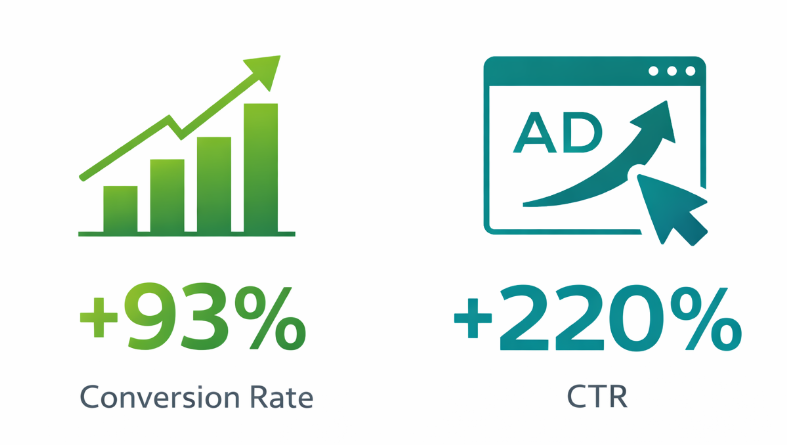
B2B teams using intent and engagement signals report up to 93% increases in conversion rates and 220% higher CTRs over traditional targeting methods
Associate engagement types with awareness, consideration, and decision phases. This enables stage-based segmentation and tailored messaging.
For example:
-
Awareness: Educational blog engagement
-
Consideration: Solution comparison page visits
-
Decision: Direct outreach replies and repeated product page sessions
Step 3: Integrate Multi-Channel Data
Siloed data reduces signal reliability. Website analytics, CRM records, email platforms, and social engagement data must be unified to create a comprehensive behavioral profile.
Aberdeen research shows that organizations with strong sales and marketing alignment achieve 36% higher customer retention and 38% higher sales win rates. Engagement signal integration is a core enabler of this alignment.
Step 4: Automate Trigger-Based Actions
Engagement-based targeting should not remain passive. Trigger automated actions such as:
-
Sales alerts when high-intent thresholds are crossed
-
Dynamic audience inclusion in remarketing campaigns
-
Personalized outreach sequences based on content consumption patterns
Automation ensures responsiveness while maintaining scale.
Advanced Use Cases for Engagement Signals
Account-Based Marketing (ABM)
Engagement clustering at the account level provides stronger buying signals than individual interactions. Multiple stakeholders engaging with late-stage assets indicates organizational momentum.
Predictive Segmentation
Machine learning models can identify patterns across engagement sequences to forecast conversion probability. Companies using predictive analytics in marketing are 2.9x more likely to achieve above-average revenue growth (Forrester).
Churn Prevention
Engagement decline among existing customers can signal dissatisfaction or competitive evaluation. Monitoring post-sale behavioral changes enables proactive retention strategies.
Common Mistakes to Avoid
-
Overvaluing vanity metrics such as impressions without behavioral depth.
-
Ignoring recency weighting. A signal from six months ago should not carry the same value as one from yesterday.
-
Failing to connect engagement signals to revenue outcomes, resulting in activity-based rather than outcome-based optimization.
Precision targeting requires continuous model validation against closed-loop reporting.
Measuring the Impact of Engagement-Driven Targeting
Key performance indicators should include:
-
Conversion rate improvement by segment
-
Sales cycle duration reduction
-
Cost per qualified lead (CPL) decrease
-
Pipeline velocity acceleration
-
Revenue per account growth
According to Salesforce, high-performing marketing teams are 1.5x more likely to use data analytics extensively in decision-making. Engagement signal utilization is a defining characteristic of that maturity.
Conclusion: Behavioral Data as a Competitive Advantage
Engagement signals represent more than tactical metrics—they are strategic intelligence. By operationalizing behavioral insights, organizations can refine targeting continuously, prioritize high-intent accounts, and deploy resources with greater efficiency.
In a B2B environment where buyer journeys are increasingly self-directed and multi-threaded, behavioral precision is not optional. It is foundational to sustainable pipeline growth.
Recommended Reading
To further deepen your targeting strategy, consider exploring:
These articles expand on behavioral intelligence, segmentation optimization, and data-driven demand generation methodologies.