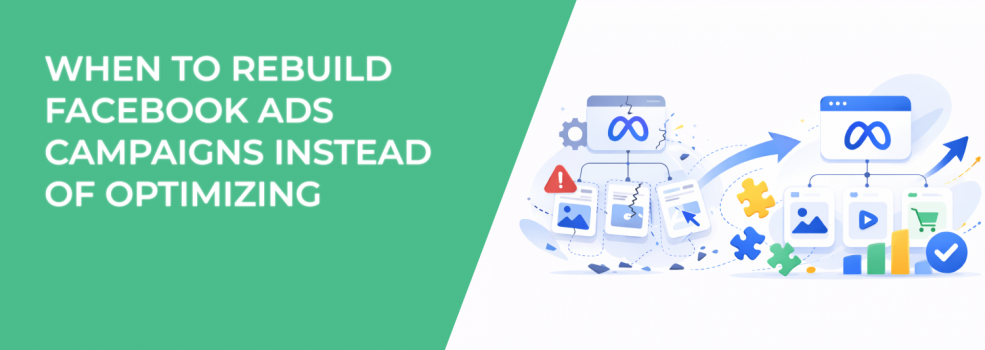
Most advertisers default to optimization when performance declines. They adjust bids, rotate creatives, or refine targeting. Those actions improve variables inside the existing system, but they do not question whether the system itself still supports growth.
Optimization works when the architecture is sound and signals flow clearly. Rebuilding becomes necessary when structure limits learning, distorts reporting, or fragments data across campaigns.
Understanding that distinction prevents months of incremental fixes that never resolve the core constraint.
The difference between optimization and structural repair
Optimization modifies inputs within a stable framework. It assumes campaign logic, objectives, and signal flow align with revenue.
Structural repair addresses foundational misalignment. It changes how campaigns are organized, how events are prioritized, and how budgets distribute learning across audiences.
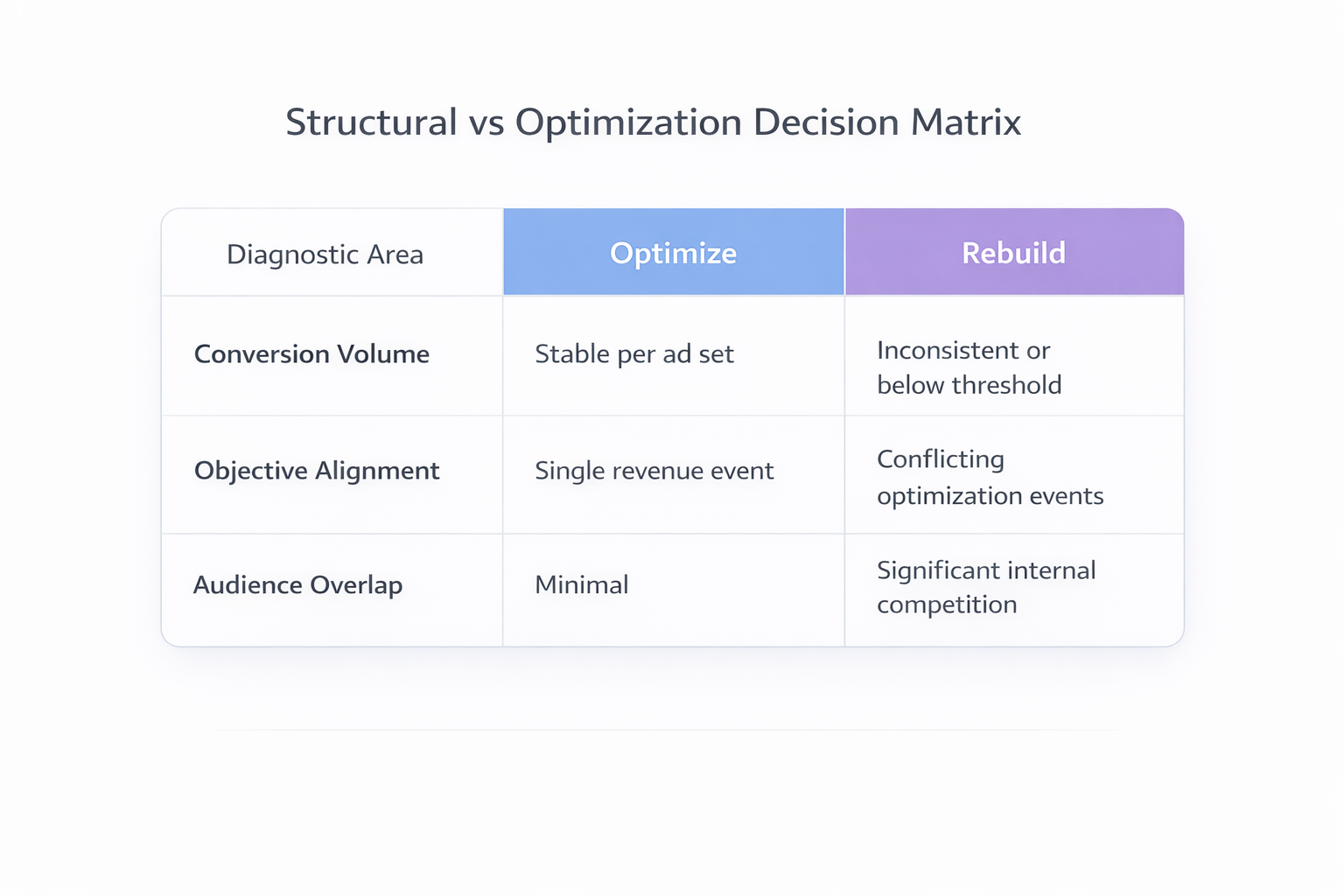
If the algorithm receives inconsistent or diluted signals, no bid adjustment will restore stability. In that situation, rebuilding corrects the system rather than polishing its surface.
Audience architecture often sits at the center of structural issues. If segmentation logic is unclear, performance volatility follows, regardless of creative quality.
Clear signs you need a rebuild
Structural weakness leaves patterns that repeat across accounts. Recognizing these patterns early reduces wasted spend.
Learning phases never stabilize
When ad sets repeatedly return to learning, the account likely suffers from signal fragmentation. Excessive segmentation prevents sufficient weekly conversion volume per ad set.
Common structural causes include:
-
Narrow interest stacks with small audience pools; each ad set generates too few optimization events.
-
Budget distributed across many micro-segments; none reach consistent event density.
-
Separate campaigns built for slight audience variations; learning resets frequently.
This often stems from over-applying segmentation tactics described in the Facebook Custom Audiences Guide: Everything You Need to Know without consolidating for scale.
Increasing budget inside this fragmented structure usually amplifies volatility. Consolidation into fewer, broader ad sets restores signal concentration.
Performance swings without clear external cause
Weekly fluctuations are normal. Severe instability across campaigns usually signals internal competition or conflicting objectives.
Look for these patterns:
-
Prospecting campaigns optimized for leads; retargeting campaigns optimized for purchases; reporting becomes inconsistent.
-
Overlapping custom audiences; campaigns compete in the same auctions.
-
Mixed attribution settings; comparisons across campaigns lose reliability.
Many of these issues arise from layered audience strategies similar to those outlined in The Complete Guide to Warm, Cold, and Custom Audiences in Meta Ads, but executed without structural discipline.
Rebuilding around a unified optimization event aligns signal flow and simplifies performance analysis.
Cost per result increases while engagement remains stable
If click-through rate remains steady but cost per result rises, the issue likely sits beyond creative appeal. Attention remains intact, yet conversion efficiency deteriorates.
Structural contributors often include:
-
Optimization set to low-quality events; volume increases while downstream conversion rate declines.
-
Event prioritization misconfigured; purchase events are delayed or underreported.
-
Multiple audience sources layered without hierarchy; signal strength weakens.
This commonly appears when advertisers scale lookalikes aggressively without revisiting seed quality or structural alignment, as discussed in The Ultimate Guide to Facebook Lookalike Audiences.
Creative refresh alone will not correct these distortions. A rebuild that realigns event hierarchy and audience strategy addresses the root constraint.
Situations where optimization is sufficient
Not every performance dip indicates architectural failure. Some accounts remain structurally sound but face tactical friction.
Optimization is appropriate when:
-
Ad sets consistently exceed 50 weekly optimization events; learning remains stable.
-
Performance decline follows recent budget expansion; recalibration time is required.
-
Seasonality or promotional cycles explain short-term volatility; structure remains coherent.
In these cases, controlled creative testing and measured budget adjustments are more appropriate than a reset.
Structural weaknesses that develop quietly
Certain problems accumulate gradually and rarely trigger obvious warnings. Over time, they erode efficiency and limit scale.
Segmentation that creates auction pressure
Advertisers often divide audiences into multiple clusters that appear distinct but overlap behaviorally. Audience sizes differ, yet auction competition remains high.
Consequences include:
-
Increased CPM driven by internal bidding pressure.
-
Limited scalability as campaigns constrain each other.
-
Rising frequency among similar user pools.
This pattern frequently appears when detailed targeting is layered excessively, as described in How to Layer Detailed Targeting for Hyper-Specific Facebook Audiences, but without evaluating overlap impact.
Rebuilding with broader audiences and differentiated messaging at the ad level reduces overlap while preserving strategic clarity.
Campaign objectives that drift apart
Accounts evolve as new initiatives launch. Over time, objectives diverge and campaigns pursue inconsistent definitions of success.
Examples include:
-
Lead generation campaigns feeding CRM systems while purchase campaigns pursue immediate revenue.
-
Traffic campaigns targeting the same audiences as conversion campaigns.
-
Retargeting structured by funnel stage but optimized for different events.
These inconsistencies fragment data and obscure which signals the algorithm should prioritize. A rebuild aligns all campaigns under one primary revenue objective.
Legacy experiments that never disappeared
Historical testing often leaves residual structures active. Duplicate campaigns and narrow ad sets continue running with minimal budget and unclear purpose.
Indicators of this issue include:
-
Multiple campaigns targeting identical geographies and demographics.
-
Separate ad sets created for minor creative variations.
-
Complex exclusion layers that remove audience segments without measurable impact.
Over time, complexity replaces clarity. Consolidation restores efficiency and improves learning depth.
A decision framework for rebuilding
Rebuilding should follow diagnosis rather than frustration. A structured evaluation clarifies whether the foundation remains viable.
Ask these questions:
-
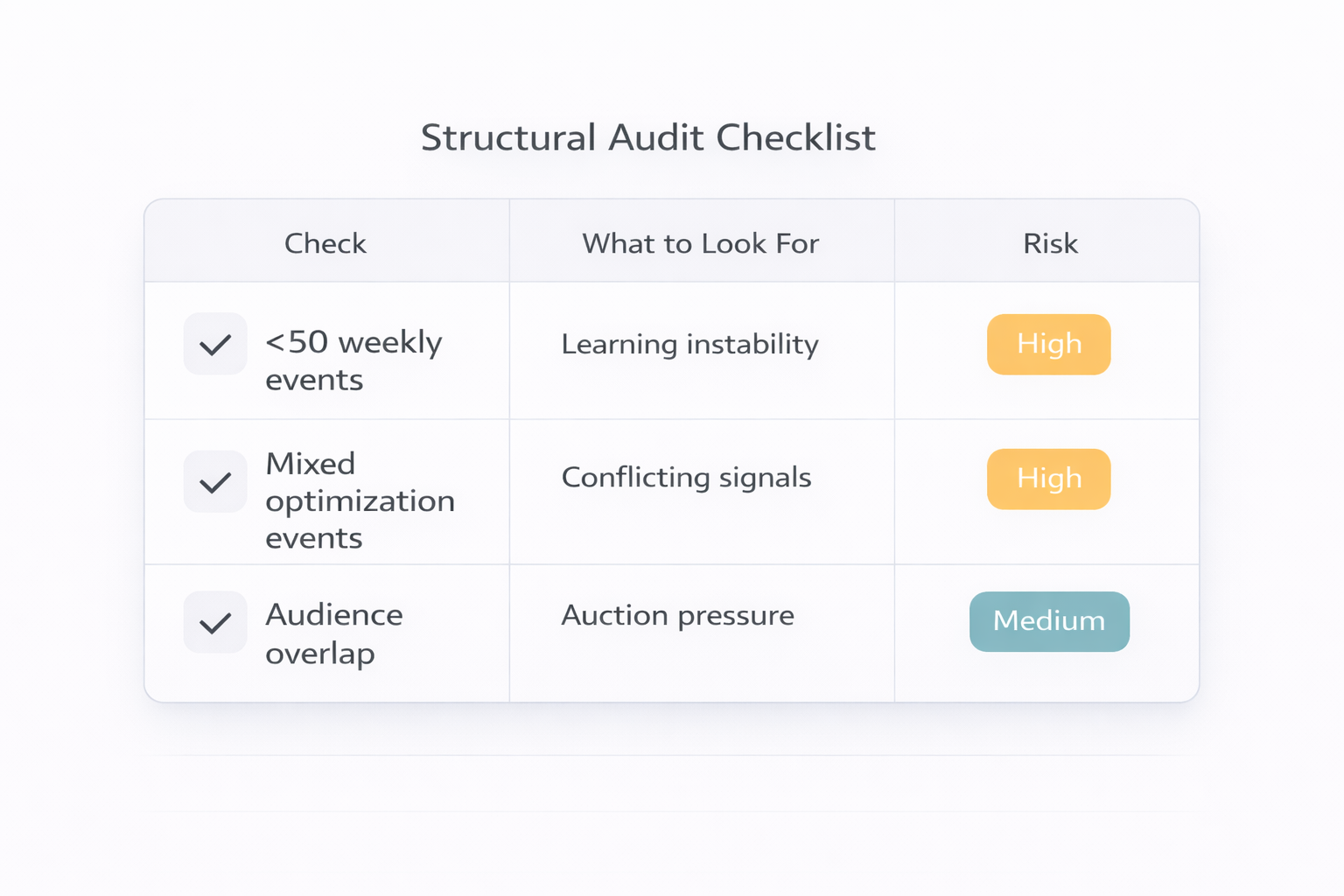
Does each active ad set consistently exceed 50 optimization events per week? If not, signal density is insufficient.
-
Do all campaigns optimize toward a single revenue-aligned event? If not, objectives conflict.
-
Are audience definitions mutually exclusive and strategically distinct? If not, internal auction pressure exists.
-
Has the account accumulated duplicate or legacy campaigns over several months? If yes, complexity may outweigh insight.
If multiple weaknesses appear, structural repair is justified. If the framework remains coherent, optimization is the correct response.
How to execute a controlled rebuild
Rebuilding should be deliberate and phased. Abrupt deletion of campaigns discards valuable historical data.
A structured transition includes:
-
Mapping the revenue path from impression to sale; defining one primary optimization event tied directly to business outcomes.
-
Consolidating audiences into broader segments; shifting differentiation into messaging rather than structural segmentation.
-
Aligning prospecting and retargeting under the same success definition; removing conflicting event priorities.
-
Launching the new structure in parallel; gradually reallocating budget as stability emerges.
This approach preserves continuity while correcting architectural flaws.
The long-term impact of structural alignment
Accounts with weak foundations rarely collapse overnight. Efficiency erodes gradually as incremental fixes layer over unresolved structural problems.
Advertisers often attribute stagnation to creative fatigue or market conditions, while audience architecture remains misaligned with revenue objectives.
When campaign structure aligns with event hierarchy, audience logic, and signal density, optimization becomes predictable. Tactical adjustments then enhance performance instead of compensating for systemic weaknesses.