Meta’s algorithm optimizes for the event you choose, not for your company’s financial reality. That difference creates friction when platform efficiency improves but business performance declines. Many advertisers miss this gap because Ads Manager shows strong metrics. Revenue reports tell a different story.
Optimization is mechanical. Business growth is structural. When those two logics diverge, you get scale without profit.
Why Platform Optimization Is Not Business Optimization
Meta optimizes toward a defined event inside the auction system. It does not understand your margins, fulfillment constraints, or sales team capacity. The system maximizes the probability of generating the selected outcome at the lowest predicted cost.
That logic works well when the selected event equals true business value. It breaks when the event is only a proxy.
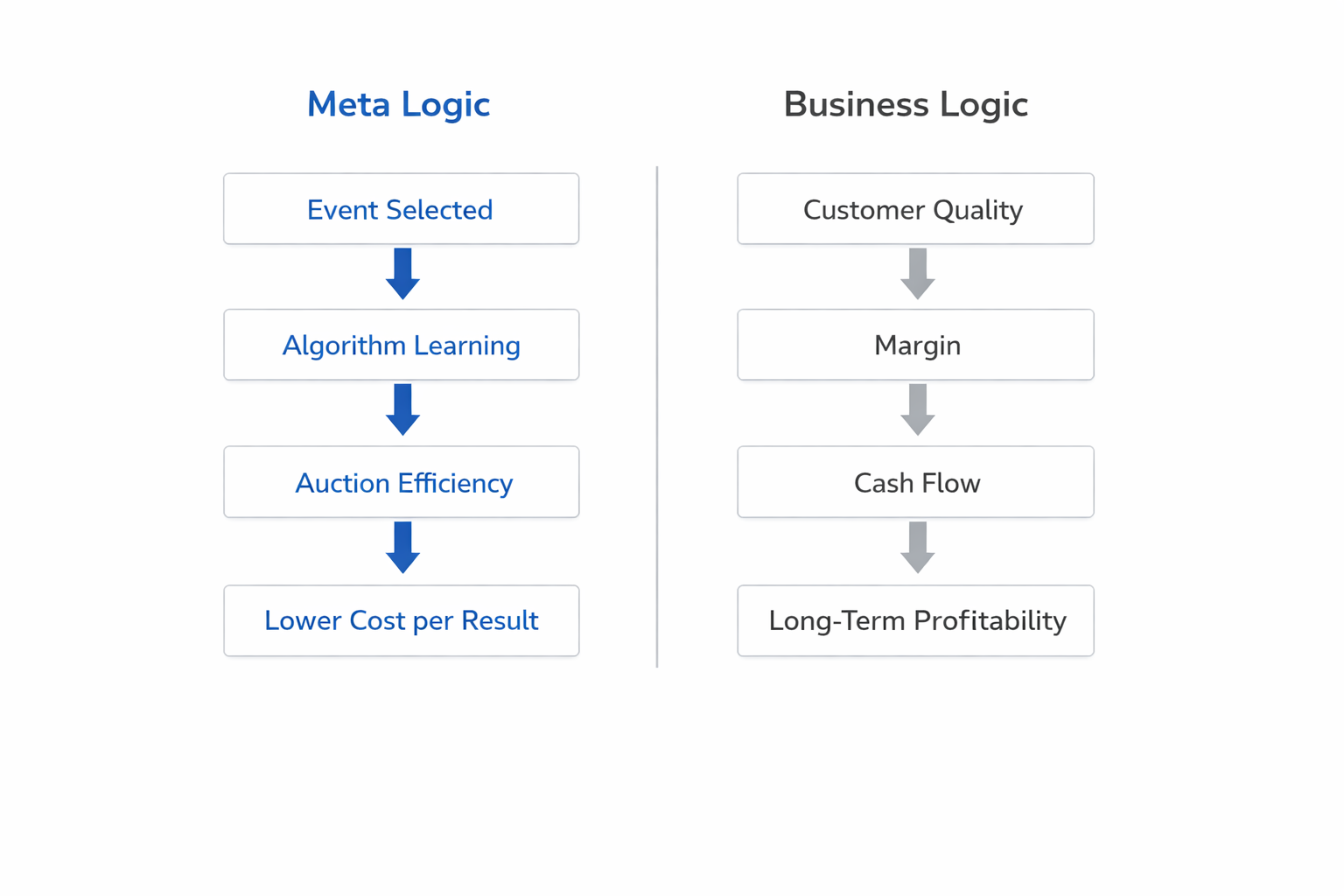
Common examples include:
-
Optimizing for leads instead of qualified opportunities; the algorithm finds cheap form submissions, not sales-ready prospects, which inflates CRM rejection rates.
-
Optimizing for purchases without margin filters; the system drives volume for low-margin SKUs that look efficient but weaken contribution profit.
-
Optimizing for landing page views in early testing; traffic quality improves inside the platform while downstream revenue remains flat.
The algorithm performs correctly. The objective is misaligned.
Where Conflicts Usually Appear
Misalignment rarely shows up as a sudden collapse. It emerges gradually as structural drift inside the account.
Volume growth without revenue growth
Lead volume increases month over month. Cost per lead decreases. Sales close rates decline at the same time.
This pattern often signals optimization toward cheap intent rather than strong intent. The algorithm finds users who complete forms quickly but lack purchase urgency. If your audience setup relies heavily on broad segments without qualification layers, as explained in The Complete Guide to Warm, Cold, and Custom Audiences in Meta Ads, the system often prioritizes scale over intent depth.
Improved ROAS with shrinking cash flow
Return on ad spend rises. Average order value falls. Repeat purchase rates weaken.
Meta favors users who convert easily. Those users often purchase discounted or low-ticket items. When segmentation does not reflect economic tiers, a problem frequently discussed in Maximizing ROI through Facebook Audience Segmentation, the algorithm shifts budget toward what converts fastest, not what contributes most.
Stable CPL but declining pipeline velocity
Cost per lead remains stable across campaigns. Time to qualified opportunity increases. Sales teams report longer follow-up cycles.
The algorithm keeps producing similar leads. Their buying readiness shifts subtly over time, which does not register in platform metrics.
The Core Structural Causes
Conflicts between optimization and business goals usually come from structural decisions, not creative fatigue.
Event selection compresses intent
When you optimize for early-funnel events, you compress different intent levels into one signal. Meta cannot distinguish between research behavior and purchase readiness if both trigger the same event.
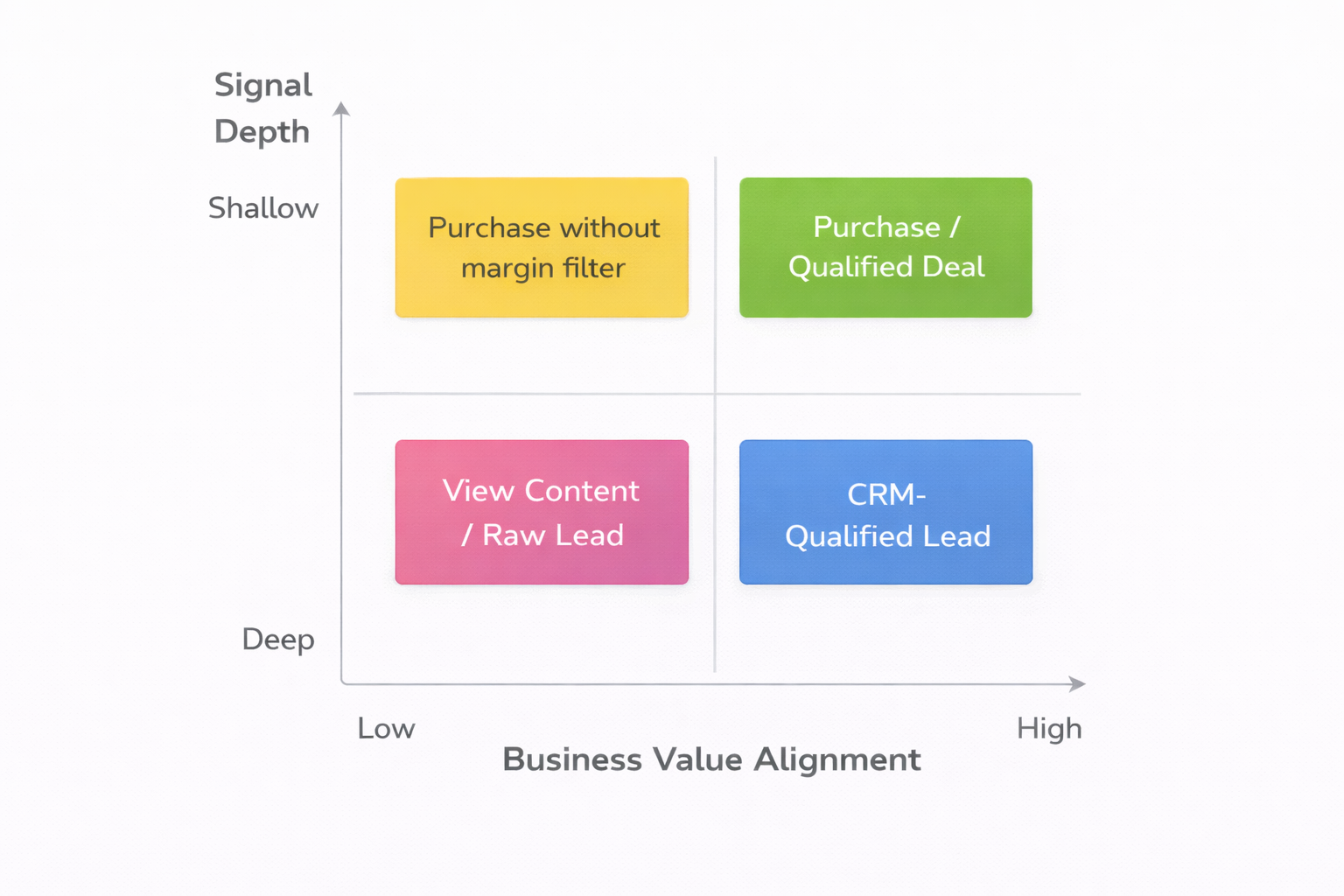
For example:
-
Whitepaper downloads may include students, competitors, and buyers; the algorithm treats them as identical signals.
-
Add-to-cart events mix price checkers with committed buyers; both reinforce the same optimization loop.
-
View content events capture curiosity, not transaction probability.
Each of these broad signals dilutes commercial precision. Stronger custom audience logic, such as layering engagement depth and recency described in Facebook Custom Audiences Guide: Everything You Need to Know, helps prevent this compression.
Attribution windows distort feedback loops
Meta optimization depends on conversion feedback speed. Short attribution windows prioritize users who convert quickly, not necessarily users with higher lifetime value.
If your business has a long consideration cycle, rapid converters often represent smaller deals. Larger contracts convert later and receive less algorithmic reinforcement. Over time, the system biases toward short-cycle buyers.
Margin blindness inside optimization
Meta does not evaluate profit contribution. It optimizes revenue or event count.
If product margins vary widely, the system shifts budget toward items with higher conversion probability. These items may carry lower gross margin or higher fulfillment cost. Revenue grows while net profit weakens.
Diagnosing Optimization Conflict
Before restructuring campaigns, validate whether misalignment truly exists. Do not rely on intuition. Use comparative metrics across systems.
Cross-platform comparison framework
Evaluate these pairs side by side:
-
Cost per lead vs. cost per qualified opportunity; track the percentage that advances beyond initial screening.
-
ROAS vs. contribution margin; adjust revenue for product cost, discounts, and refunds.
-
Conversion rate vs. customer lifetime value; monitor repeat purchase patterns by acquisition source.
When platform efficiency improves while business efficiency declines, optimization conflict is present.
Segment-level revenue analysis
Break down performance by acquisition campaign, not just by overall account totals. Many accounts contain one highly efficient campaign that quietly lowers overall deal quality.
Look for patterns such as:
-
A single broad campaign producing most leads but a minority of closed revenue.
-
Retargeting campaigns inflating short-term ROAS while prospecting quality erodes.
-
High-frequency segments converting well initially but generating elevated refund rates.
These patterns signal structural imbalance. Expanding seed quality for lookalikes, as discussed in The Ultimate Guide to Facebook Lookalike Audiences, often reveals whether scale is built on strong or diluted signals.
Aligning Meta Optimization With Business Outcomes
Once misalignment is confirmed, structural adjustments must follow. Cosmetic tweaks to budgets or creatives will not solve the issue.
Re-evaluate the primary optimization event
Choose the deepest event that still generates at least 50 conversions per week per ad set. That threshold maintains stable learning without sacrificing commercial intent.
If purchase volume is too low, consider:
-
Optimizing for qualified lead events pushed from your CRM; this filters low-intent users before they reinforce the algorithm.
-
Using value-based optimization tied to predicted deal size; this teaches the system to prefer higher-revenue prospects.
-
Consolidating ad sets to increase signal density for deeper events.
Signal depth and signal volume must remain balanced.
Integrate offline and CRM feedback
If you run lead generation campaigns, push qualified and disqualified statuses back to Meta using offline conversion tracking. This closes the optimization loop with real sales data.
When only raw leads feed the algorithm, it learns speed. When sales outcomes feed the algorithm, it learns quality.
Segment by economic value, not demographics
Many advertisers segment audiences by interests or age. Business alignment requires segmentation by revenue behavior.
For example:
-
Separate campaigns for high-margin products and low-margin products; allocate budget according to contribution margin.
-
Distinct messaging for enterprise buyers versus small accounts; optimize each toward its true revenue objective.
-
Dedicated retargeting for repeat purchasers with higher lifetime value; reinforce profitable cohorts.
This approach shifts optimization from platform efficiency to economic efficiency.
When to Rebuild Instead of Adjust
Some accounts accumulate structural compromises over time. In these cases, incremental adjustments prolong misalignment.
Rebuild the campaign structure when:
-
The current optimization event no longer reflects the core revenue driver.
-
Signal fragmentation across multiple pixels or domains reduces learning stability.
-
Budget allocation heavily favors low-margin or low-quality segments.
Rebuilding allows clean signal architecture and consolidated data flow. It also resets budget distribution according to economic logic rather than historical inertia.
The Strategic Principle
Meta’s algorithm executes defined objectives with precision. It does not evaluate strategic trade-offs. That responsibility belongs to the advertiser.
Optimization conflict appears when platform metrics become the goal instead of a measurement system. Leads, ROAS, and CTR are indicators. Revenue quality and profit sustainability are outcomes.
When objectives reflect true business value, the algorithm amplifies growth. When objectives reflect convenience metrics, it amplifies distortion.