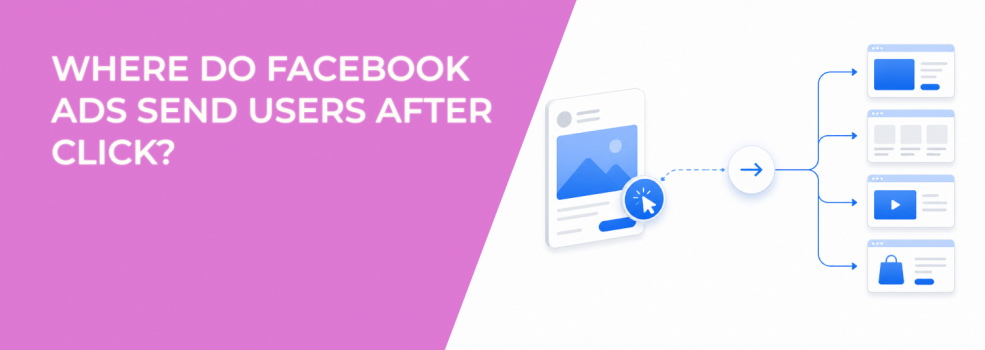
A click does not always send users to your website.
On Meta, the destination depends on the campaign objective. The platform routes users to different endpoints based on what you select during setup. That decision shapes what happens after the click — and whether that click turns into revenue.
If you choose a traffic objective, users leave the platform. If you choose engagement, they stay inside Facebook or Instagram. This routing logic directly influences CPC, CPA, and lead quality.
How Meta decides where your ad traffic goes
The destination is tied to the objective — not just the ad.
- Traffic campaigns send users to external websites. Meta optimizes for link clicks or landing page views, so users exit the platform and must load your site before taking action.
- Engagement campaigns keep users inside Meta. Users land on pages, posts, or events where interaction happens instantly without loading delays.
- App, page, or event campaigns direct users to assets you manage. This allows Meta to track interactions more reliably within its ecosystem.
Each destination creates a different optimization loop. That loop determines how quickly Meta identifies valuable users and how efficiently it spends your budget.
Why destination choice shows up in CPC and CPA
You can run two campaigns with identical CPC — and completely different outcomes.
A traffic campaign may show strong CTR and low cost per click. But when you check deeper metrics, the pattern often breaks. Landing page views drop below link clicks. Conversion rates stay low. CPA climbs.
The issue is not the click. It is what happens after.
When users leave Meta, the platform depends on Pixel or Conversion API signals. If those signals are weak or delayed, Meta starts optimizing for clicks instead of conversions. That leads to cheaper traffic — but worse results.
Keeping users inside Meta produces faster feedback. The algorithm sees interactions immediately and adjusts delivery. That improves efficiency — but often pushes toward low-intent actions.
What a destination mismatch looks like in Ads Manager
A mismatch between user intent and destination shows up clearly in performance data.
You will typically see:
- A gap between link clicks and landing page views. This indicates slow page loads, accidental clicks, or weak alignment between ad and destination.
- High CTR combined with low conversion rate. Users click out of curiosity but do not complete the intended action.
- Low cost per lead but poor downstream results. Leads generated inside Meta often lack urgency or buying intent.
- Short session duration on site. Users leave quickly because the destination does not match expectations.
This is where fixing the post-click experience matters. A strong seamless ad-to-landing page experience reduces friction and aligns expectations between the ad and the destination.
When sending users to a website makes more sense
Website destinations work best when the user needs context before converting.
A landing page allows you to explain the offer, address objections, and guide users through a structured path. This is especially important for B2B, high-ticket offers, or services with longer sales cycles.
In many cases, conversion volume drops initially — but quality improves. That often leads to better cost per qualified lead or lower CAC over time.
The main risk is friction. Mobile users may drop off before the page loads. That is why monitoring click-to-landing page drop-off
is critical when scaling traffic campaigns. When keeping users inside Meta performs better
On-platform destinations reduce friction.
Instant forms, page interactions, and event responses load immediately. Users can act without leaving the app. This often lowers CPL and increases conversion volume.
However, the tradeoff becomes visible later.
Lower friction reduces the effort required to convert. That usually lowers intent. Many advertisers see strong lead volume — but weak follow-up engagement or low close rates.
When comparing lead forms versus landing pages the decision should focus on qualified outcomes, not just volume.
Final takeaway
Where your Facebook ad sends users determines how effectively clicks turn into results.
Traffic campaigns provide control — but introduce friction. Engagement campaigns reduce friction — but weaken intent signals. The right choice depends on your funnel stage and how ready the user is to act.
If performance breaks after the click, start with the destination.
That is where CPC turns into CPA — and where profitable campaigns are either built or lost.