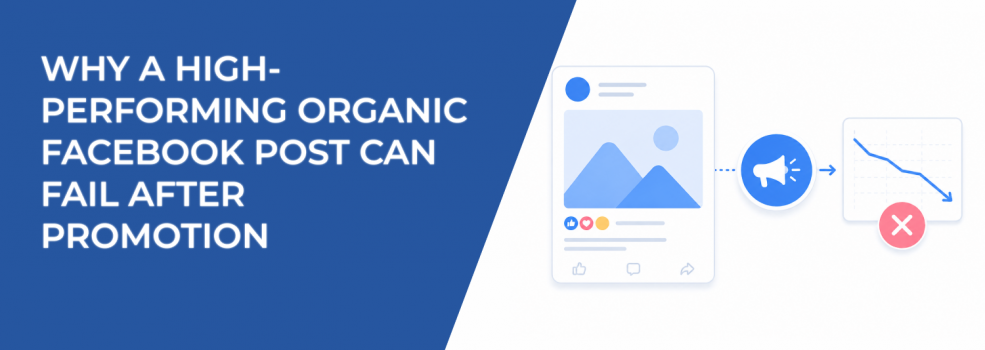
A Facebook post performs well organically. Comments increase quickly. Shares keep growing. Engagement looks unusually strong.
Then the post gets promoted.
Within a few days, the same post starts struggling:
- engagement quality weakens;
- outbound clicks decline;
- CPM rises unexpectedly;
- conversions stay flat despite larger reach.
Most advertisers assume the algorithm “changed.”
Usually, the real issue is simpler.
The post succeeded inside a warm organic environment but failed inside a cold paid environment.
Those are completely different conditions.
Problem: Organic posts depend on audience familiarity that disappears after promotion
Organic Facebook posts mostly reach people who already know the brand.
Followers, previous engagers, existing customers, and repeat viewers all process content differently from cold audiences. They recognize the tone, understand the context, and usually require less explanation before engaging.
Paid promotion removes that advantage immediately.
Once Meta expands delivery through the ad auction, the same post reaches users with no existing relationship to the business. The content now competes against entertainment posts, creator content, competitor ads, and unrelated feed distractions.
This changes user behavior fast.
A founder’s opinion post may receive excellent organic discussion because followers already understand the industry context. After promotion, cold users scroll past because the message takes too long to process.
The creative itself did not suddenly become bad. The audience conditions changed.
This is one reason why relevance matters more than raw reach becomes increasingly important once campaigns move from organic visibility into paid distribution.
Solution: Rebuild the organic post for cold-feed attention
The best-performing promoted posts usually simplify what made the organic version successful.
Cold audiences make decisions faster. They do not carry the same patience or contextual familiarity as existing followers.
That means promoted posts often need:
- a faster hook;
- clearer positioning;
- stronger opening visuals;
- simpler framing;
- immediate audience relevance.
For example, an organic educational post may begin with several lines of setup because followers already understand the subject matter.
The paid version usually performs better when the core idea appears immediately instead.
A cold audience needs to understand within seconds:
- who the content is for;
- what problem it addresses;
- why it matters now.
This is why experienced advertisers rarely boost successful organic posts unchanged. They often rebuild the concept into a paid-specific version optimized for colder traffic conditions.
The original post reveals audience interest.
The promoted version restructures that interest into faster attention capture.
That process aligns closely with using organic post insights to improve paid campaigns, especially when advertisers want to preserve engagement themes while improving paid delivery performance.
Solution: Promote the post to warmer audiences instead of cold traffic
Some organic posts are not designed for prospecting at all.
Community-style content often performs far better when promoted to audiences that already recognize the brand, such as:
- page engagers;
- video viewers;
- previous website visitors;
- Instagram engagers;
- warm retargeting pools.
A founder story, customer discussion, or behind-the-scenes post may work extremely well inside warm retargeting campaigns because the audience already carries contextual trust.
The same content can fail badly against cold prospecting traffic. This is where many advertisers misjudge creative quality. They assume strong organic engagement automatically means the creative scales broadly. Often, the creative only performs strongly within a specific audience context.
That is why why strong creatives fail with the wrong audience remains one of the most important concepts in Meta advertising. Delivery conditions matter just as much as the creative itself.
Many advertisers improve performance simply by separating promoted content into two buckets:
- warm audience amplification;
- cold audience acquisition.
That distinction usually stabilizes engagement quality quickly because Meta receives cleaner behavioral signals from each audience group.
Final takeaway
A high-performing organic Facebook post can fail after promotion because paid delivery changes the audience environment completely.
Organic engagement depends heavily on familiarity, community context, and previous exposure.
Paid distribution removes those conditions and places the content inside colder auction environments where users evaluate posts much faster and with far less patience.
The solution is not avoiding promotion altogether.
The solution is adapting the post before promotion:
- simplify the message;
- strengthen the hook;
- match the content to the correct audience temperature;
- rebuild strong organic concepts into paid-friendly creatives.
Organic engagement still provides valuable signal data. It simply does not guarantee paid scalability on its own.