Some Facebook ads are already weak before the campaign goes live.
Not because the budget is wrong.
Not because the creative is ugly.
Not because the platform cannot work.
They are weak because the advertiser is uncertain about the audience.
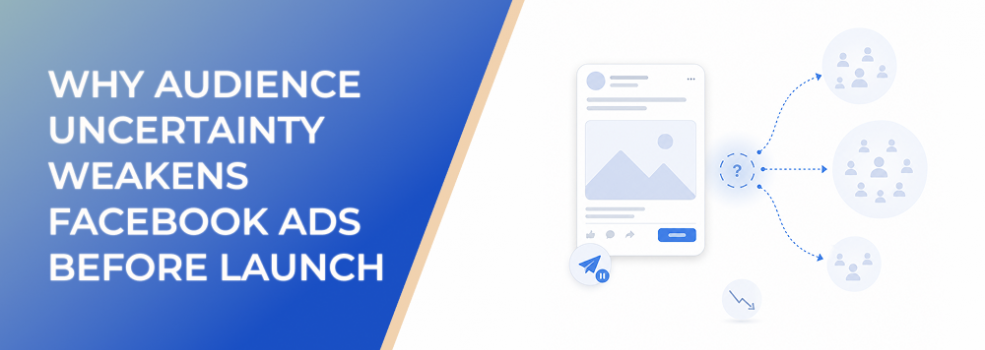
When a campaign launches without a clear answer to “Who exactly should this reach first?” every downstream decision becomes less reliable. The message becomes vague. The targeting becomes broad. The test becomes noisy. The results become harder to interpret.
Audience uncertainty is a pre-launch strategy problem.
The Problem
Audience uncertainty means the advertiser cannot confidently define the people most likely to care about the offer.
The team may have a rough idea:
Small business owners.
Fitness enthusiasts.
Marketing managers.
Parents.
Homeowners.
Software buyers.
But these labels are too broad to guide performance marketing decisions.
A strong audience definition should explain not only who the person is, but why they are likely to respond now. It should include context, pain, intent, buying stage, and relevance signal.
Without that clarity, the campaign launches on hope. Meta may still deliver impressions, but the advertiser has not given the system or the creative team a strong strategic starting point.
Why This Problem Hurts Performance
Audience uncertainty hurts performance because it weakens the campaign before any data is collected.
The first budget cycle is spent searching rather than validating. The ad reaches a mixed group of users, some relevant and many not. Early engagement may come from people who like the topic but do not have buying intent.
That can hurt CPC, CPA, CAC, ROAS, and lead quality.
It can also create false learning. A campaign might appear to fail because the offer is weak, when the real issue is that it was shown to the wrong people. Or it might appear to work because clicks are cheap, while sales quality remains poor.
Audience uncertainty also affects creative. If the team is unsure who the ad is for, the message has to stay broad enough to fit everyone. Broad messages rarely create strong intent.
Common Scenarios Where This Happens
A startup launches ads to “founders” without distinguishing funded founders, solo founders, technical founders, agency founders, or founders with a specific operational pain.
A B2B advertiser targets job titles but does not know whether the decision-maker, influencer, or end user should be reached first.
An ecommerce brand targets broad interests before identifying whether the best buyer is problem-aware, competitor-aware, ingredient-aware, price-sensitive, or loyal to a niche style.
A local service business runs ads to everyone in a radius instead of identifying likely trigger events, such as moving, renovating, planning an event, or needing emergency support.
An agency inherits a client account and keeps previous audiences because nobody can explain why they were chosen.
Why the Problem Happens
Audience uncertainty happens because many teams treat targeting as a platform setting rather than a strategic decision.
They ask, “What interests should we choose?” before asking, “What buyer situation are we trying to reach?”
Another reason is that businesses often have multiple possible customer profiles. Instead of prioritizing one for the campaign, they try to include all of them. That creates blended audiences and diluted messaging.
Audience uncertainty also comes from weak source research. Advertisers do not investigate where buyers spend time, which communities they join, which creators they follow, which competitors they compare, or which professional criteria define fit.
Finally, teams may over-trust automation. Meta’s delivery system can optimize from signals, but it still needs a useful starting point, strong creative, and meaningful conversion events.
The Solution
The solution is to resolve audience uncertainty before launch with a clear pre-launch audience decision.
Build an audience plan around four elements.
1. Buyer profile
Define the person or account you want.
Include role, need, awareness stage, buying trigger, budget fit, and qualification standard.
Example:
“Marketing directors at B2B SaaS companies with active paid social budgets who need more qualified demo requests, not lower-cost form fills.”
2. Relevance signal
Identify why this person is likely to care.
Relevant signals may include professional role, group participation, competitor engagement, niche profile following, content engagement, website behavior, CRM data, or previous purchase behavior.
The relevance signal is what separates a real test from a guess.
3. Message angle
Decide what this audience needs to hear first.
Cold audiences may need problem framing. Warm audiences may need proof. Competitor-aware audiences may need differentiation. Professional audiences may need business impact.
4. Success metric
Define what good performance means.
Do not rely only on clicks or leads. Choose metrics such as qualified lead rate, booked calls, sales opportunities, purchase conversion rate, CAC, ROAS, or pipeline quality.
How LeadEnforce Helps
LeadEnforce helps when the pre-launch question is, “Where can we find a more relevant audience to test?”
Instead of relying only on broad interest categories, advertisers can use LeadEnforce to build audiences from Facebook groups, Instagram profile followers and engagers, LinkedIn-derived professional data, and custom social-profile sources. Its feature pages describe these source types across Facebook group targeting, Instagram targeting, LinkedIn audience creation, and custom audiences from social profile links.
This makes LeadEnforce useful for turning audience uncertainty into audience hypotheses.
For example:
A B2B advertiser can test job-title and company-based professional audiences.
An ecommerce brand can test followers of niche Instagram profiles.
A local business can test community-based audiences.
An agency can compare source-based audiences across client segments.
LeadEnforce does not decide the strategy for you. It gives you more intentional audience inputs when the strategy calls for them.
Risks and Considerations
Source-based audiences still need validation.
A group, profile, or professional segment may look relevant but perform poorly. Audience quality depends on source quality, audience size, intent level, message fit, and offer strength.
Too-small audiences can fatigue quickly. Too many audience tests can spread budget too thin. A strong audience with weak creative may still underperform.
Do not use LeadEnforce as a substitute for customer research, clear positioning, conversion tracking, or sales feedback.
Also consider compliance and platform rules when building and using custom audiences.
Prerequisites and Dependencies
You need a clear campaign goal and a defined customer profile.
You need relevant source communities, profiles, professional criteria, or custom social-profile data if using LeadEnforce.
You also need a strong offer, a landing page aligned with the ad promise, reliable conversion tracking, and enough budget to evaluate results without reacting too early.
Practical Recommendations
Before launch, document every audience assumption.
Use this format:
Audience: Who are we testing?
Signal: Why do we believe they care?
Message: What angle matches their situation?
Metric: How will we judge quality?
Risk: What could make this audience misleading?
If the answers are vague, do not launch yet.
Use LeadEnforce when native targeting feels too broad or when the best audience is better represented by communities, profiles, professional criteria, or custom social-profile sources.
Then test with discipline. Audience clarity is not about being certain. It is about making the uncertainty measurable.
Final Takeaway
Audience uncertainty weakens Facebook ads before launch because it creates vague targeting, vague messaging, and vague learning.
Define the audience, relevance signal, message angle, and success metric before spending budget. The clearer the audience hypothesis, the more useful every campaign result becomes.
To turn audience uncertainty into cleaner source-based tests, join the free 7-day LeadEnforce trial period.
Related LeadEnforce Articles
- How to Stop Guessing Facebook Ads Audience Size — Explains why size alone does not prove audience quality.
- How to Find Better Facebook Ads Audiences With Broad vs Narrow Targeting Tests — Helps structure audience-width tests around clear hypotheses.
- Interest Targeting on Facebook: What Still Works (and What Doesn’t) — Provides context for advertisers relying on native interest targeting.
- Targeting Facebook Groups with Ads: What’s Possible and What’s Not — Useful for understanding group-based audience opportunities and limitations.